The Linear Calendar Wall

IMG_6743.jpg

“For 5 and 6 year olds, time becomes marked by what happened yesterday, today and what might happen tomorrow.”

Sally Haughey – Fairy Dust Teaching

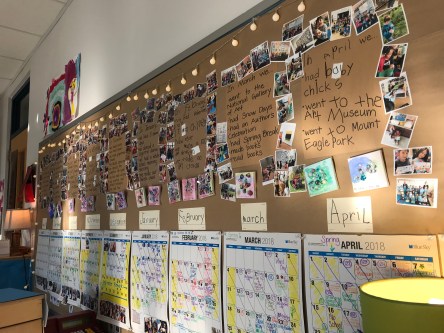
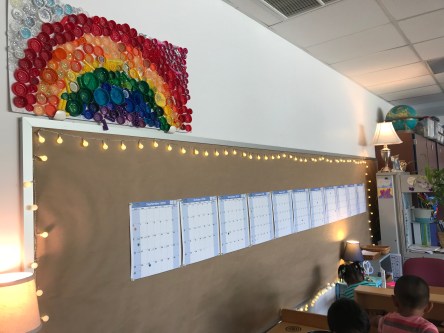
Our linear calendar is an important teaching tool and classroom routine in our kindergarten world.  This idea was born after many conversations with Kassia Omohundro Weekend, author of Math Exchanges, as we were both beginning new school years teaching kindergarten for the first time. We weren’t satisfied with the typical calendar routines in kindergarten (or the higher grades we had previously taught) and started to ask ourselves what would be a meaningful and authentic engagement for documenting the passage of time. We wanted to incorporate a time line of sorts, along with an audit trail documenting our learning together over the course of a year. The linear calendar has evolved a bit over the past seven years, but it remains an important piece of our classroom journey.

I get a calendar from an office supply store every summer and pull it apart. I display it from August to July on a large bulletin board in our room. Every month is included because I want it to show a full calendar year. The first thing that goes on the calendar is our birthdays. I spend time the first week of school having each child find his or her birthday month and day and put a star sticker on that day. This is how the calendar wall is introduced to the children. I see a lot of talk and curiosity as they ask, “When is my birthday?”, “How many months until my birthday?”, and “Look! My birthday is close to (a friend’s) birthday!”
IMG_9918.jpg

Each month, I take that page off the wall and bring it over to our meeting area. We interact with this calendar all month in an authentic way – just like I write in my calendar planner. Together, we write in important events such as Back to School Night, early releases, guest speakers, teacher workdays, holidays, etc. We indicate days we are in school and days we are at home by highlighting weekends and holidays with a yellow marker. I spend time at the beginning of each month showing how the calendar flows into the next month by starting on the next day. This is a tricky concept and one worth talking about every month. Some years I have cut the extra days off the end and beginning of the month so the kids can see how it all fits together. When August ends on a Wednesday, then Thursday is the first day of September.
IMG_6216

Every day we look at the calendar during morning meeting and see what is happening that day and what might be happening later in the week. At the end of the day, we cross out the day and write what day of school we just finished. We look to see what is happening tomorrow and for the rest of the week. I’ve found this SO much more meaningful than a song about what “yesterday, today and tomorrow” is, a sentence frame about what today is and what tomorrow with be or a recitation of reading the calendar – all things I’ve done in the past and yet, in June, many kids didn’t know how to interact with a calendar or tell you when tomorrow is.

The kids interact with this calendar on their own throughout the day. You can see them reading it with pointers, talking about how many days until winter break, counting days until the next birthday, reflecting on things we did in prior months, and having conversations during play, reading, etc. I am always amazed at the meaningful conversations that happen in front of the calendar wall.

IMG_6744

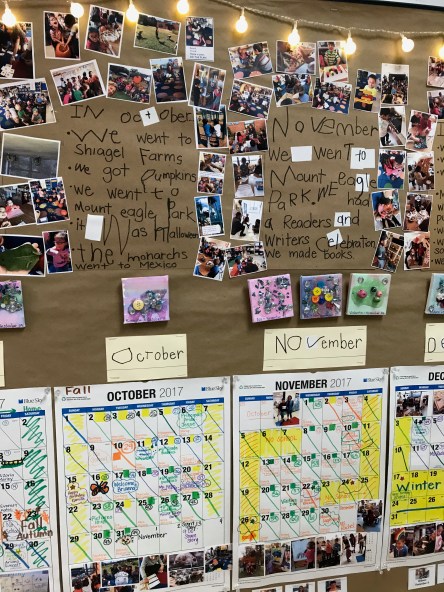
At the end of each month, we reflect on all that we accomplished or experienced that month. We create an interactive writing piece together to summarize the month, and choose pictures to display on our calendar wall. The children and I put this together and display it above the calendar month page. This creates a timeline that captures our year together. Children, families and visitors all enjoy looking at our wall story about the year.

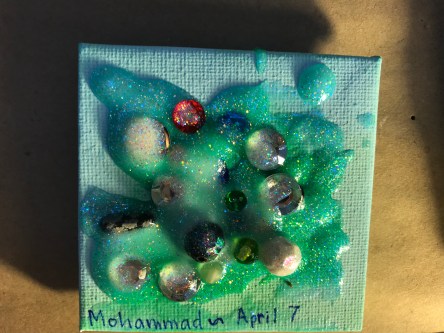
With each month page, I also display the piece of art that each child creates on their birthday, and birthday cards with the child’s name, picture and birth date.
IMG_7946.jpg

Engaging the children in meaningful conversation, noticings, experiences and authentic calendar interactions and talk is appropriate and beneficial in kindergarten. It’s also fun!

I’ve found the linear calendar to be an essential tool in the teaching and learning in our classroom. I hope this post is helpful to anyone interested in creating one with their kids! Enjoy!
IMG_2803.jpg

Our 2018-2019 calendar wall – ready to go!


“Islands of Certainty” – Learning Sight Words

IMG_7099.jpg

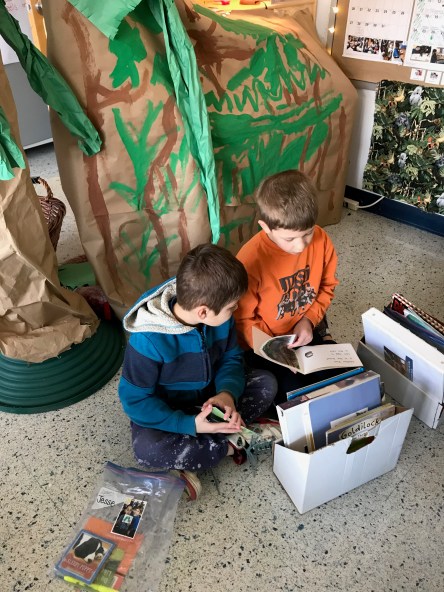
Sight words. Flash words. Fast words. Word wall words. Popcorn words. High frequency words. Dolch words. Fry words. Whatever you want to call them – they are the words that appear most often in printed materials. Having a solid core of automatically recognized  sight words makes a huge difference in fluency and comprehension. It allows readers and writers to navigate text more easily, and spend more energy focusing on constructing meaning, problem solving and writing more complex words.

Marie Clay referred to words that children know instantaneously as “islands of certainty, in a sea of print”. She writes that, “in the familiar story the child locates a word he knows and builds a response around it.  Then the child’s reading of text comes to be controlled by particular words even though he can only recognize one or two words” (Clay, 1991). This reminds us of the importance of making sure that everything we do is in the service of meaning. We can’t simply teach kids lists of words to memorize or put these words on flash cards. We have to focus on teaching these words in meaningful text and show our readers how these known words can be “islands of certainty.” We have to help our readers and writers see how to make these words theirs, and how they can use that knowledge in their reading and writing.

Once I’ve determined which words are already known and automatic for each child, I plan the words to introduce for each student and/or group. I typically introduce a new word at the end of a guided reading group, or during interactive writing, but occasionally I do this in a one-on-one reading conference. Regardless, I always make sure it is introduced within the context of meaningful text – either a book we are reading together or a piece of interactive writing.

Selecting a word to teach:

-look at your pre-assessment to determine which word to teach

-choose a high frequency word (four-letter words are easier to learn, don’t start with two-letter words – Marie Clay speaks of this in Literacy Lessons, II. She states that the four-letter words that are frequently used, like: “‘come’, ‘look’, like’, ‘here’, and ‘this’, provide a better introduction to how words work in English than two-letter words like ‘to’, ‘is’, ‘at’, ‘on’, ‘up’, ‘it’ and ‘me’. In some ways, two-letter words are hard, exceptional, and they do not contribute much to dealing with the sequencing or clustering of letters in the language.” (p.41) Also, two-letter words are often visually confusing (on/in, is/si, no/on))

-look for one that occurs in a book the group has read (connect to the known, keep meaning first)

Teaching a new sight word:

Breaking a word into letters:

-teacher quickly assembles a word with magnetic letters on a board on the right hand side of the board

-the teacher demonstrates, with deliberate movements, breaking out the letters – sliding the letters, one at a time, from first to last, to the left on the board – building the word again – then read the word while running finger under the word

-invite a child to try building the word, carefully observing and supporting the left to right movement – then reading the word together

Tracing a word:

-teacher writes word with dry erase marker, then reads the word

-invite child to trace over the letters with her finger, ensure left to right tracing

Connecting to meaningful text:

-look back in the book you’ve read to find the word, search and locate the word on several pages

Connect with writing high frequency words:

-explain that we can learn to write words by learning to look at them carefully when we read

-tell the student to look at the word (either written or the magnetic letters) – run your finger under the word and read it slowly

-ask the child to read it slowly and/or run his finger under it – “Look at it carefully.” – ask the child what they notice about the word

-ask the child to take a picture of it in their brain – ask the child to close his eyes and see the word in his head.  “Can you see the first part? The next part? The last part?”

-ask him to open his eyes and look again at the written word – “run your finger under it and say it slowly”

-invite the child to write the word without looking – if he is hesitant, tell him he can look where you have it written, if he needs to

-the child should say the word slowly as he writes

-compare the word in the book to the one with magnetic letters and to the one the child has written again, reading the words – talk again about what they notice

-remind the child that this is one of their words now, it’s in their brain and they will be able to read and write it from now on and forever!
 

What’s most important is that kids have time to then practice reading these new words in the books they read. They need to see how reading these words fast will allow them to pay attention to other challenges in the books they read and the books they write. They need to have time to read, talk to others, and make meaning from texts that are just right for them. This is when knowing the sight words has the most power – allowing the reader to focus on making meaning, problem solving and constructing a reading processing system.

img_3951.jpg

Our Environment

IMG_7080.jpg

“In order to act as an educator for the child, the environment has to be flexible: it must undergo frequent modification by the children and the teachers in order to remain up-to-date and responsive to their needs to be protagonists in constructing their knowledge.”

Lella Gandini (1998)


One of the “big kid” visitors who stops by our classroom every morning before school asked me, “why do you have so many cool things in your room?”. It was a question that has stuck with me. Why do I have so many “cool things” in our room?

IMG_7017.jpg

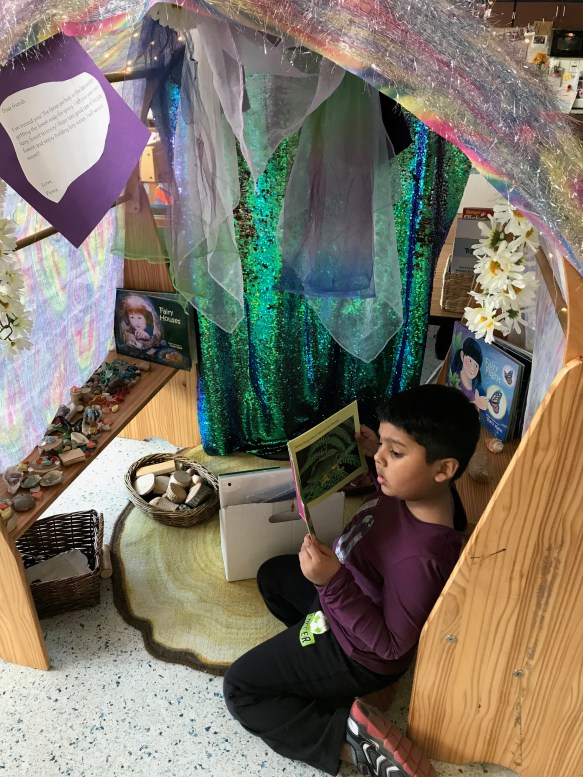
I’m a firm believer that the environment is the third teacher, responsive to both teachers and children creating learning together. We co-construct and negotiate the curriculum together. My classroom can’t look like a cookie cutter model, identical to the one across the hall or identical to the classroom from last year. It must grow and evolve based on who is living in the space right now. I believe that our classroom environment can help shape the identities of the children in that classroom and their relationships with each other. Our space gives power and agency to the children in our room.

IMG_6944.jpg

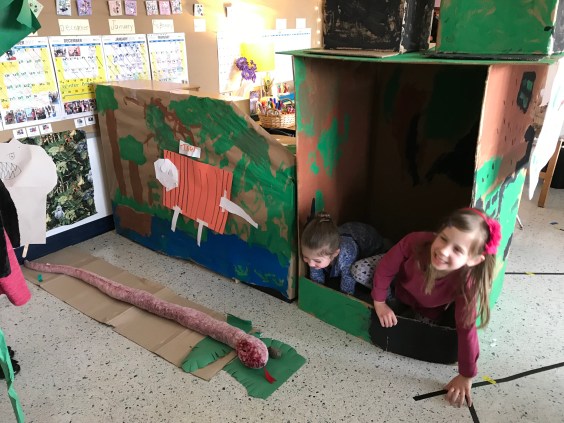
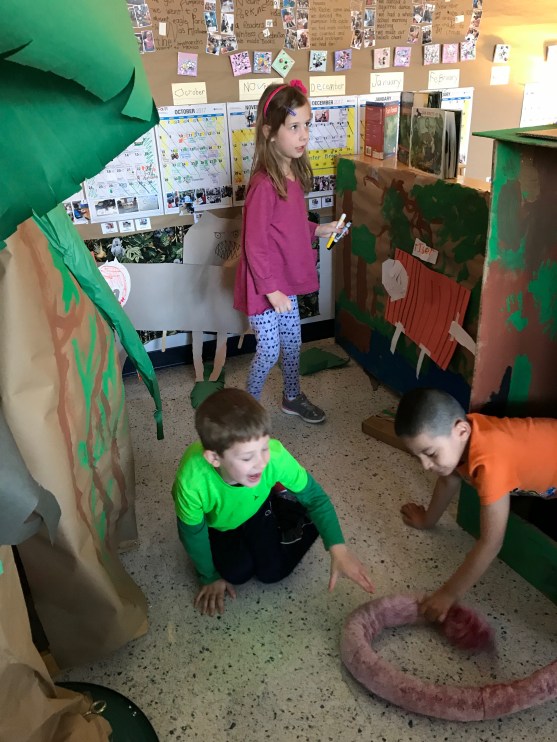
As I look carefully around the room, I see reflections of the children everywhere. The rainforest was created by them, planned, designed and brought to fruition by the kids who took on this challenge. The block area was redesigned by moving it into a bigger space to allow for more children to build – again, initiated by the children. The huge kidney shaped table is a large collaborative work space for art projects – not a reading table with the teacher at the center. The linear calendar reflects important dates for this class – important events, birthdays, field trips, learning experiences that keep track of our shared journey through this school year. One of our bookshelves became an engineering center to store the marble run, the legos, and other building tools because this year the kids are avid builders. Our storytelling kits reflect dances we’ve done (like our baby beetle dance) and books we have read, with tiny toys to retell the experiences we’ve had. There is a basket of Pokemon cards and Pokemon toys that kids have brought in. The kid’s book boxes are overflowing with books that have been chosen by the reader of each individual book box. The classroom library is arranged and labeled by these kids, in a way that works for them. The chandelier that hangs in the center of our room has pieces of art that each child created that is representative of who they are. The photos scattered throughout our room are of children and their families and shared experiences we want to remember. And because I am also a member of this community, my small teaching table has a few things that bring me joy and that I want to share with this community – a picture of me and Judy Blume, a unicorn tape dispenser, a peacock feather, a bowl of shiny rocks – but it is also a work space for children. The mandatory teacher desk I’m required to have in my room serves a great purpose as a stand up work space for provocations and displays that the children create. Currently, it houses materials to build Calder-inspired mobiles and sculptures.

IMG_7195.jpg

So why do I have so many “cool things” in our room? Because I have a lot of cool kids. The classroom a reflection of who they are – as individuals and as a community. They own it, and more importantly, they know they have a say in it. Their voices are heard and they are encouraged to contribute and create. They help negotiate what is in the classroom, what goes on our walls, what the space looks like and what is available to explore and create with. Their lives and interests are reflected in the space and it evolves as the children evolve. It’s a collaborative experience of many identities brought together in a year of learning.


Screenshot 2018-03-01 22.18.35

Day 10


Leprechauns and Jaguars

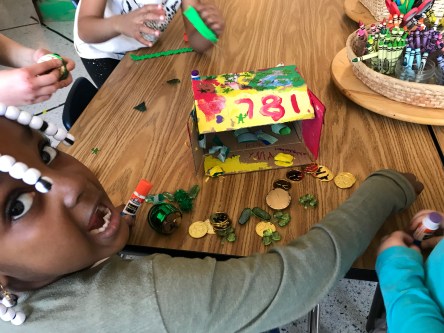
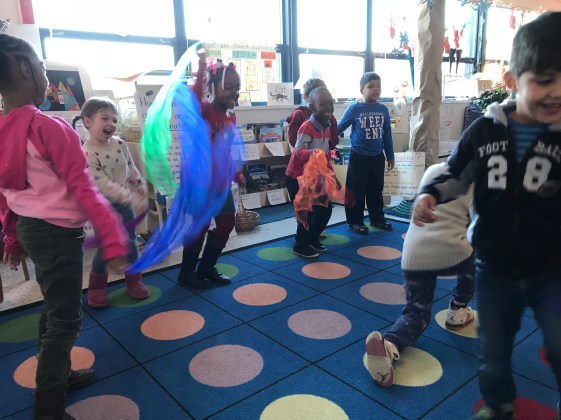
It’s Friday afternoon Explore time in my kindergarten classroom and we have a lot going on. The room is buzzing with the happy sounds of children learning, talking, playing, negotiating problems and enjoying each other. It’s how we begin and end every day.

IMG_7212.jpg

A group of kids are working intently on building a leprechaun trap. They are debating ways in which to catch the leprechaun without hurting him. Or “her”, as the conversation turns to deciding what gender leprechauns are, because, “leprechauns can be girls, too…it wouldn’t be fair if leprechauns were all boys, right? Fairies can be girls or boys and leprechauns are the same way.” They decide that having a whole lot of tape on the walls, floor and ceiling will make the leprechaun stick no matter where it runs around in the trap. They then contemplate what will happen if we do catch a leprechaun. Will we build it a house…or maybe it can just live in the fairy house? That one is still up for debate.

IMG_7210.jpg

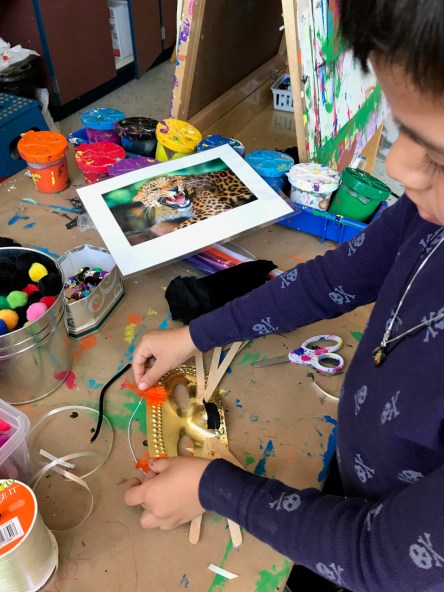
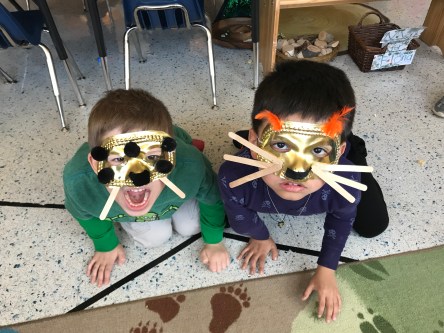
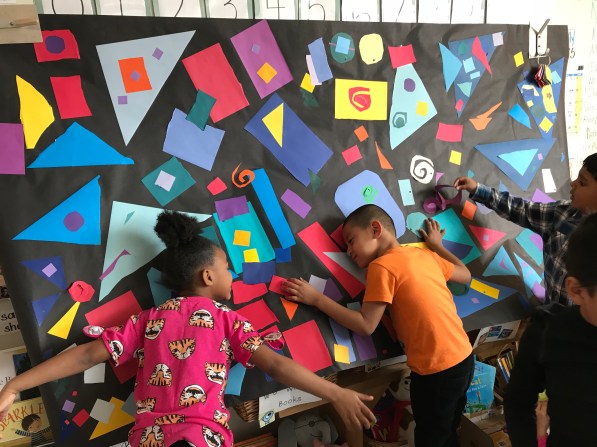
At the art table, two kids are carefully constructing masks to be jaguars in our rainforest dramatic play area. They are looking closely at a picture, talking about the teeth, counting the number of whiskers, picking out materials that will make the mask look and feel like a jaguar and making big plans for the jaguar play that will begin next week. (ummmm…that may be my SOL on Monday…yikes.)

IMG_7218.jpg

Meanwhile, a group of kids are building a structure with MagnaTiles and unifix cubes. The unifix cubes are Minecraft people who live in the structure made of squares, triangles and rectangles. The kids talk about what shapes they are using, how to make the structure stronger and deciding roles that each person will play as they go in and out of this structure. To be honest, I don’t really understand the Minecraft play, or the significance of 3 unifix cubes as a person, (and believe me, it HAS to be 3!) but the five kids deeply engaged in the play do. And that’s all that matters.

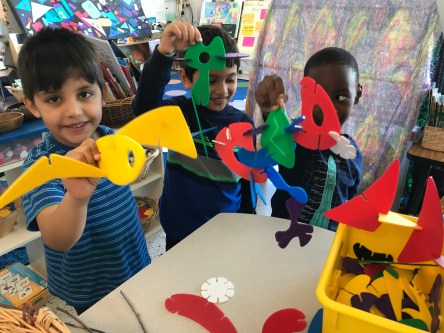
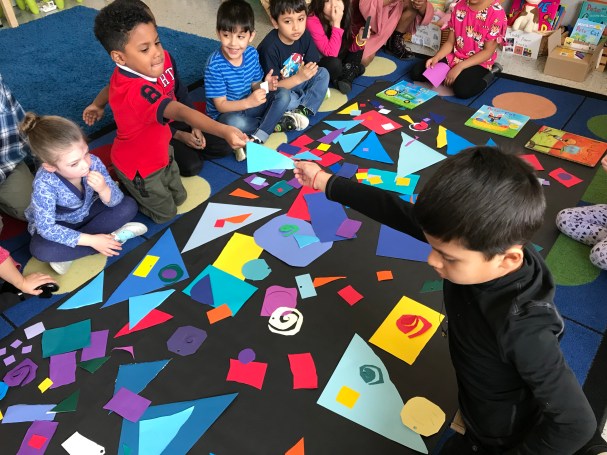
Finally, a few kids are making mobiles and sculptures inspired by Alexander Calder and our visit to the National Gallery. They are building their art and talking about what the shapes look like, what colors they are and how they could fit together. They are cooperating, collaborating and so very proud of their art.

IMG_7201.jpg

I stop and take it all in. Kidwatching. As I watch and listen, I am in awe, yet again, by the power of play. The thinking and creating that happens during our Explore time goes way beyond any standards or curriculum. It’s kid created, meaningful, authentic and deep.  I am grateful to be in a school where play is allowed, honored, encouraged and respected as a critical part of our early childhood classrooms. I wish all schools, and all children, had that gift.

Nothing without joy.

Screenshot 2018-03-01 22.18.35

Day 9


Currently – In Our Classroom

watching – tall block towers, pieces of art in various stages of completion, children making books, book boxes bursting at the seams, a vet clinic that has just about lost the excitement, legos that have been made into Bayblades and are spinning all over the room

IMG_6723.jpg

listening – to children talk about art, “I see….I think…I feel….”, and to children learning how to navigate conversations in authentic ways

IMG_6821.jpg

appreciating – the freedom to allow kids to play and a large space to give kids multiple spaces to play, work and live for 180 days

loving – the excitement around our field trip to the National Gallery of Art tomorrow

dancing – the life cycle of a mealworm, which is actually not a worm, but an insect – they become baby beetles

wishing – for more time to do documentation of all the learning that happens every day

planning – the launch of our next PBL – creating an geometry art museum

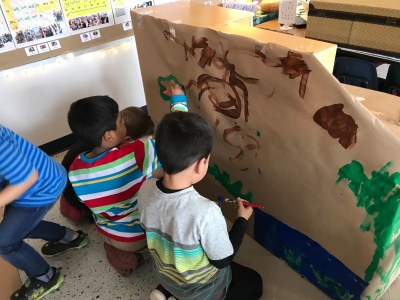
creating – a collaborative art piece on a canvas with blues and greens for the background – looking forward to adding more things to our mixed media piece

reading – Art Is…, Alfie: (The Turtle That Disappeared), Uni the Unicorn and the Dream Come True, The Big Umbrella, The Water Princess, Sandy’s Circus: A Story About Alexander Calder, Action Jackson, Be Kind, The Noisy Paint Box: The Colors and Sounds of Kandinsky’s Abstract Art, Love

IMG_4113.jpg

writing – nonfiction books, guided reading books for my kids about friends and things they love, labels for our beautiful stuff to create with

wondering – about Reggio practices, about culturally relevant teaching, about what worked well today and what didn’t, about where we are going next

Screenshot 2018-03-01 22.18.35

Day 6

“You can’t find anything in here!” – Organizing Our Library

IMG_6584.jpg

We had just returned from our monthly walking field trip to a local park, where we had found a fallen log and spent some time investigating and talking about what might live there. I was reminded of a book I had, A Log’s Life, and went over to our nonfiction book bins to look for it. The kids were waiting patiently on the rug, (as patiently as kindergarteners can wait), as I was looking furiously through the many nonfiction bins we have. I finally found the book – just after one of my kids said,

“We need to organize this library better! You can’t find anything in here! Why don’t we make it like the big library?”

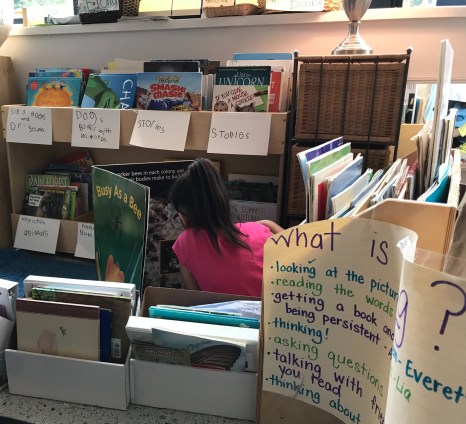
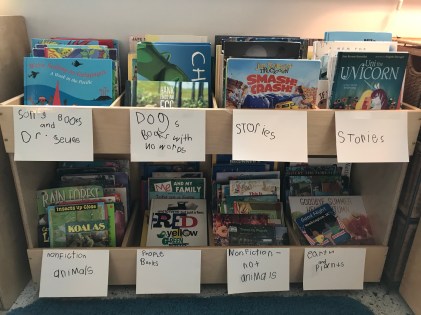
Yes! She was right. The books that we had sorted in September as “learn about the world” or “stories” – were ready to be sorted again, with all the book knowledge that my kindergarteners had gained this year. I invited anyone who wanted to help with this project to gather on the rug during Explore time and we would organize the library better.

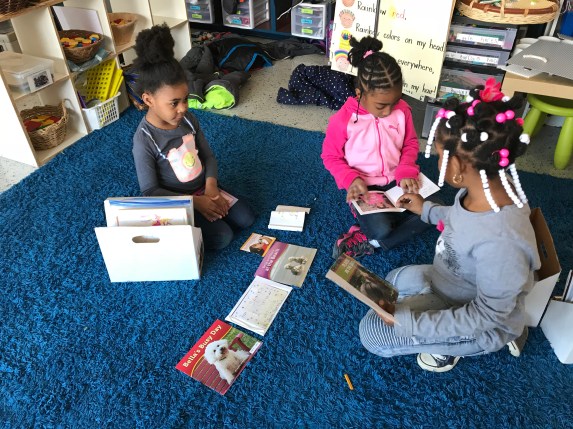
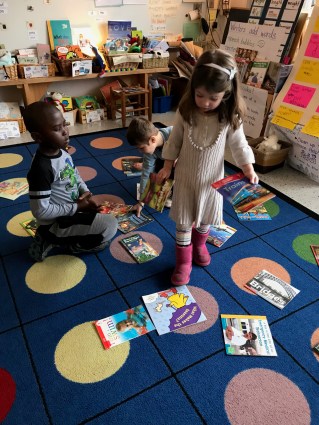
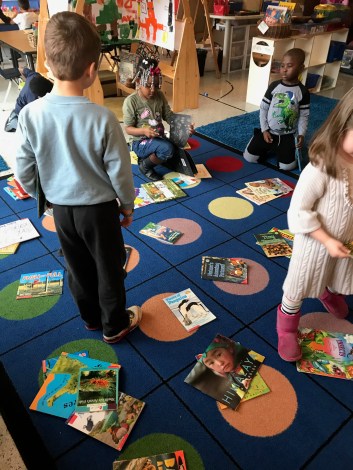
Several kids were interested and started working together, sorting the books into piles and having such wonderful conversations!

IMG_6585.jpg

“We should keep all the dog books together. And all the monkey books in one place. And the snake books….wait, there’s a lot of books about animals. Maybe we can keep all the animal books together. But there’s a lot of books about dogs. I think dogs need to be on their own or there would be too many mixed in the animals. Then we couldn’t find dog books.”

“We have books about people…like farmers and nurses and Native Americans…Martin Luther King, Jr. and President Obama. We can make one place for books about people.”

“Here’s a book about colors. We read this book when we were making art and learning about colors. People use colors to do art, so it should go in the people place.”

I listened carefully and was amazed at how the kids negotiated the task, the organization and the labeling to make sure the library worked for them. Their conversations were so authentic and I loved listening to how they talked about where books belonged. They spent over two hours on this task and then proudly shared their accomplishment with the rest of the class.

It’s been one week and I’ve noticed how books are being returned to the correct bin and that this part of our classroom library has been revived – more kids are getting books from here and sharing new finds with each other. Ownership, pride, persistence, problem solving…these five and six year olds never cease to amaze.

IMG_6587.jpg

Labeling the bins with interactive writing

IMG_6595.jpg

The newly organized and labeled bins! We will add pictures next.

Screenshot 2018-03-01 22.18.35

Day 2


Fidelity vs. Thoughtfulness

img_9986 We live in a time right now when professional resources are abundant. We have endless access to lesson plans, problem based learning projects, activities, ideas, blog posts, professional books, teachers sharing with teachers, curriculum guides, programs, etc… I can Google any topic and find a wealth of resources. Teachers are not at a loss for what to teach and ideas for how to teach it. But there’s something that I keep coming back to:

Are we being thoughtful with what and how we teach?

There are now scripts written out for literacy workshops, charts to copy or simply post, literacy “cookbooks” of sorts with specific lessons for exactly what your students might need and other resources to make our lives easier and to save time. These are good things, for the most part. Don’t get me wrong. They are based in research, carefully thought out by expert educators who know how kids learn best, tested in real classrooms with real kids. I own most of these resources and use them as I plan – (as a resource, not as a script). And these are WAY better than any basal textbook series I’ve ever seen. These resources have definitely lifted the quality of literacy instruction in many schools. They’ve provided a scaffold for implementing literacy workshops.

But are we thinking deeply about the kids we are teaching? 

img_0082Years ago while teaching in Florida I was at a required basal textbook training for a series my county had just adopted. The representative said, “Look! Everything is written out for you. Even the teachable moments. You don’t even have to think!” And that’s when I walked out of the meeting. I didn’t go into teaching to not think. And I value my profession way more than to accept the idea that it would be a good thing if I didn’t have to think. It’s offensive and degrading to be told you don’t have to think.

It’s easy to flip open a book and have your lesson plan written out for you and ready to go. And chances are, with many of these resources, you would be teaching a good lesson. We get ideas from each other – that’s what teachers do. We don’t have to constantly recreate the wheel.  But I hope that we are still thinking. And reflecting. And connecting with OUR kids – the ones sitting with us in our classrooms at this very moment. I hope we are not taking exactly what’s handed to us and teaching it blindly because we were told to “teach with fidelity”. We need to think and question. We need to teach our kids to think and question. We need to continue learning as teachers and understand the WHY behind what we are doing. We need to be responsive and reflective as teachers.

img_0081A teacher leader in my county once helped me reflect on the idea of fidelity vs. thoughtfulness. I keep coming back to that. Perhaps we need to be implementing new structures, programs, etc. with “thoughtfulness”, rather than “fidelity”. We need to look at the programs, curriculums and expectations our district and administration give us with a critical eye. We need to be very careful with resources we find online. We need to tweak the “recipes” in these literacy “cookbooks” to meet the needs of our students. We need to use the pre-printed anchor charts as a temporary scaffold for us as teachers – and replace them with kid pictures and drawings and our own students’ words as soon as we feel solid in that teaching.  We need to deconstruct these things together with our team, be thoughtful in our implementation, question and reflect on what works and what doesn’t.  As one of my former principals always says, “the answer is in the room”.  Talk, reflect and think together – don’t just blindly follow something from outside. We need to use the abundance of resources we have as departure points to launch our own best teaching. We need to keep talking, questioning and thinking with our team and on our own.  As I’ve said before, we teach children, not curriculum, programs or standards.

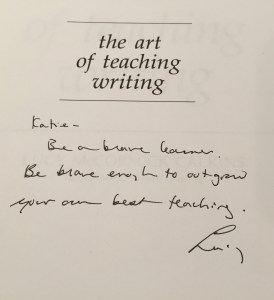
Be thoughtful. Question. Be willing to change your thinking.  And as Lucy Calkins once wrote in my copy of The Art of Teaching Writing, 

“Be a brave learner. Be brave enough to outgrow your own best teaching.”

img_0877

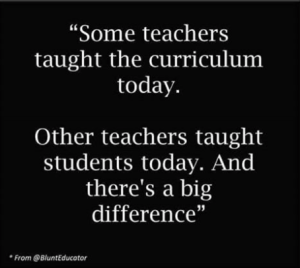
Teaching Students, Not the Curriculum

Screenshot 2016-01-27 10.13.41

Thanks to Heather for sharing this timely quote!

I often say, “I teach children – not the curriculum, program or standard”. I can’t remember where I first heard this statement, but I love it and I truly believe this. My children – the ones I’m teaching RIGHT NOW – are first and foremost in my mind as I plan, set up invitations and provocations and determine the next steps in my instruction. I use a wide variety of resources provided by the state, my county, my school, my colleagues and my own professional library – but I believe they are resources, not a prescribed script to follow. My plans are constantly changing and evolving, in response to the five and six year olds in my classroom. This doesn’t mean that I wing it. Not at all! I spend a lot of time planning the framework of our day, looking at individual students and where they are in their ZPD and making instructional decisions based on my research, beliefs and philosophy of how children learn. But I don’t consider myself a “Responsive Classroom” teacher or a “Units of Study” teacher. You will see much of the philosophy of Responsive Classroom because I believe in a constructivist approach and that the social curriculum is at the heart of what we do; you will see a balanced literacy approach and you will see Writer’s Workshop and Reader’s Workshop because I believe (and have believed and taught this way for 24 years) in a framework of time, choice and response. But within that framework, every year looks a little different – based on the kids in our room that year. It’s kind of like building a house. The framework stays the same on most houses, but what’s inside is different depending on who lives there. The framework of my teaching is the same – a workshop approach, balanced literacy approach, constructivist, inquiry-based learning – but the details of how it looks each year is different, based on who lives in our classroom that year.

I worry that in today’s climate of one-size-fits-all instruction, with increasing kits, units and books that pre-plan lessons down to the minute being hailed as the “answer” to educational problems, that teachers aren’t being challenged to think. Are we reading the script or lesson that another teacher used with her kids, blindly following what “the experts” say to do?

Or are we reading the lessons carefully, reflecting on how it will work in our classroom, with our students, discussing and collaborating with colleagues about the lessons, and then planning a lesson that we own, along with our current students? I hope we are. I hope we are trusting ourselves and supporting each other. And I hope our schools are providing the time and support for all teachers, and especially our new teachers, to think deeply about instruction.

We can’t stop thinking, reflecting, questioning and challenging our own best teaching – and the resources we use. And we can’t forget that we teach children – not a curriculum.

2016-01-20 10.28.07

A project coming to life in Writer’s Workshop.