Strategies: Is This Really How We Read?

I had a teacher in a workshop recently who told me she didn’t think she used any strategies when she read.   I explained that, for proficient readers, we don’t even realize we are using strategies to help us comprehend; they are so second nature to us. Some people say that when we are proficient at comprehending, our strategies go underground.  They act so fast and fluently that we are not consciously aware we are using anything at all – we just know we understood what we just read and we are fine with that.  So what about all this strategy teaching?

First let me digress.  Last week I finished reading State of Wonder by Ann Patchett, one of my favorite authors.  It’s a wonderfully written story of Marina sent to the Amazon to find out more about the death of her colleague in the pharmaceutical research lab.  While in the jungle she is also meant to check on the progress of Dr. Swenson who doesn’t send reports or updates on her research about the new drug she’s developing. I enjoyed the book and understood every single detail of it.  Did I stop periodically and ask myself a question, or think through a picture in my mind, or literally make any connections as I read?  No, not that I remember.  But, do I think those strategies, as well as others, played a part in my understanding?  Absolutely.  If I had to go back now and answer the question, “Was there a picture in my mind when the young boy Easter was being attacked by a snake?”  Of course there was. And if I brought it to mind for you now, I could describe that scene in great detail. As I read on from chapter to chapter was I wondering/questioning the information about Ander’s death? About the Lakashi tribe and their ability to get pregnant well into their seventies? About why no one taught the deaf boy to communicate better?  I certainly did wonder those things.  Could I make a connection to the Lakashi women constantly braiding Marina’s hair to the days when I sat braiding my two daughters’ long locks?  Sure I could…now.  But while I was reading, I did not make myself metacognitively aware of what I was doing because I didn’t need to.  I was focused on meaning and just kept reading.

So why are we all “making our strategies visible” for the children in our classrooms?  Why are we thinking aloud about what we do in our heads when we comprehend?  We are doing it because some struggling readers (and others who comprehend on the literal level but no deeper) need us to slow down our reading process system and make it make sense to them.
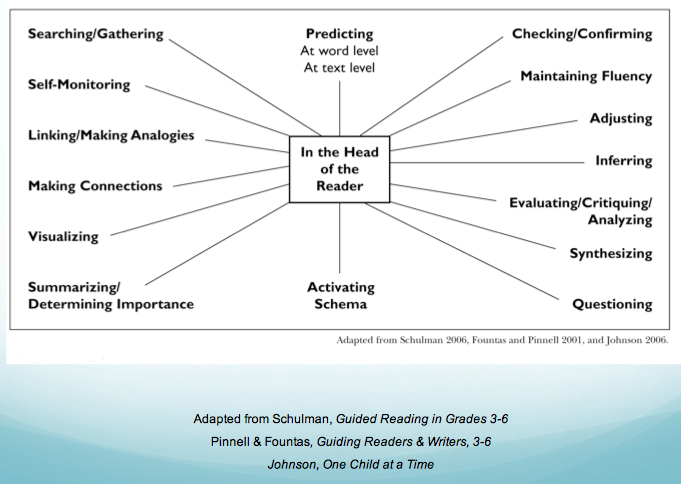
Children who struggle don’t realize what is going on in the heads of their classmates who are fluent comprehenders.  So when we slow it down and think aloud about our process it spells it out for those students.  Then we do some shared demonstrations and guided practice so that they begin to see that those strategies can help them make sense of texts.  Our goal is always to help students think like proficient readers, not just name a strategy, define a strategy, or complete a worksheet on a particular strategy.  The goal is for them to take on these thinking strategies so that they too can begin to use them fast, flexibly, and not even realize they are using them.

In chapter 9 of Catching Readers Before They Fall, Katie and I talk about the strategy teaching that we see in schools and how to make it more effective particularly for struggling readers.  But I wish there was more conversation about this topic.  What is the difference between teaching a strategy for strategy sake and teaching a strategy so that it will actually help a student become a better reader?  Shouldn’t we all be wondering about this? In her last post, Katie Keier asked us to be thinkers and reflect on our teaching? Are there more teachers out there who are reflecting on the strategy teaching that is being asked of them?  Please comment and join the conversation.

Where have all the thinkers gone?

Life consists in what a man is thinking of all day.  

                           – Ralph Waldo Emerson

So I’ve been thinking a lot about teaching lately. I tend to spend the first several weeks of summer reflecting on the past year, looking towards the upcoming year and asking myself what worked and what didn’t. I go for long runs and bike rides and think about my teaching. I surround myself with other thinkers in my life – people who are constantly asking themselves “why?”, questioning, wondering and reflecting on their own best practices.  Twitter and blogs provide another place to think and read about what other educators are thinking, and allow me to question, wonder and grow as a learner. I can’t imagine teaching any other way.

But I’m worried. I hear a lot of the conversations in the teaching world revolving around a “tell me what to do” mentality.  I’ve talked with teachers who define their literacy or math block as, “whatever the teaching manual says to do that day”.  But where are the students in this plan? We expect a teacher’s guide, a pacing guide, a list of test items and a copy of the standards and we think we’re good to go.  This is what much of education has been reduced to.  It’s the only way that many teachers know. While all of these things are important tools to have, I think educators have to be thinkers. We can’t let other people do our thinking for us. We are the ones who know our students and who must be responsive to what our students do each and every day. A pacing guide or teacher’s manual can’t possibly do this.

I was at an inservice once for a basal reading series and I was asking several questions about how this “one size fits all” program could possibly reach the needs of my students. I was doing some serious thinking and questioning about the program our county was adopting. The presenter told me, “look, it’s all right here in the teacher’s manual – even your teachable moments. You don’t even have to think!” I told him that when I stopped thinking, I would stop teaching.

In this era of standardized testing and accountability it’s even more important for us to be thinkers and to teach our students to be thinkers. While a bubble test does have a correct answer, much of life does not have a correct answer. It requires problem solving, reflecting, questioning, wondering  and lots of thinking. I want my students to be curious and thoughtful, to wonder and ask “why” as much as they can.  I want to model this by challenging (professionally, of course) questionable practices or curriculum mandates that I don’t feel are in the best interests of our students. I need to be current on best practices and solid research to support my questions and be ready to propose an alternative plan. I need to be constantly thinking and learning. Not only for me, but for all the students I teach every day.

So how do you describe yourself ? Are you a thinker or someone who reflects on his or her teaching? Do you question what is asked of you if you feel that it may not be what’s best for students?

I hope teachers are resting up this summer, reflecting on their teaching and getting ready to make next year a fabulous teaching and THINKING year! What have you been thinking about this summer? We’d love to hear your thoughts!

photo from Wikimedia Commons

Books & Boys – A Review of Pam Allyn’s Best Books for Boys

”Reading can feel as risky as walking a tightrope even if it doesn’t look nearly as daring.” – Pam Allyn

We feel very fortunate to be asked to read and review Pam Allyn’s new book Best Books for Boys: How to Engage Boys in Reading in Ways That Will Change Their Lives. It was a book that we found ourselves highlighting, nodding our heads and even saying “yes!” at several points while reading. Pam’s commitment to our boy readers, and all children, is evident through the work she has done with LitWorld, and her other books for teachers. This is a book that needs to be in the hands of all teachers – for them and for the boys in their classrooms. Best Books for Boys is for any teacher searching for ways to “hook” the boy readers in his or her classroom.

Allyn writes, “All of us, but it seems boys especially, are taught to dislike what we cannot do well. To avoid that trap, let us balance challenge and comfort.”  It is with challenge and comfort that she sets up her classroom environment, immerses boys in great books, provides opportunity for book choice, and encourages book clubs and partnerships where boys can talk, laugh, and explore books together.

Covering just about every topic and genre imaginable, Pam gives us a wonderful selection of books, including poetry, non-fiction, and fiction, to entice our boy readers.  She divides those titles and reviews into emergent, developing, and maturing to further make it easy for her readers to use this resource.  We can all expand our repertoire of great reads by keeping this book handy.

We love how Pam supports us in creating classroom environments that foster a love of reading in all students, including our most reluctant boy readers. Here is our “don’t forget list” as we plan for next school year.  We need:

–    a well-stocked, diverse classroom library that reflects not only the levels but also the interests of our students

–    to show boys why people read: “To laugh. To discover. To research, wonder, and imagine.” and help them develop reasons of their own

–     to invite male role models into the classroom to talk about their reading

–     to value different kinds of reading including magazines, web sites, blogs, comics, graphic novels and video games

–     to be responsive to active learners and to provide space for boys to be themselves

–     to provide lots of time for play and movement surrounding reading

–     to value and make time for daily independent reading, encouraging choice and supporting boys as they learn to choose books that match their interests

–     to honor the social aspect of reading by providing time for meaningful talk about books, poems, and stories.

Here are some of the wise words from Pam that caused us to ponder, connect with a particular student or remind us of the important work we do:  
“There should be little difference between reading for school and reading for fun: we want boys to approach all their books with curiosity and excitement.”
”Let’s align reading more with play than work. Let’s think of it more as a joy, a distinct pleasure of being human, than as a task. Let boys read, and let them read what they like.”


”Reading can feel as risky as walking a tightrope even if it doesn’t look nearly as daring.”


”Giving boys books at a variety of levels helps them to build a sturdy foundation so they feel safe in trying more challenging ones. It is also essential to value each book in and of itself, not just as a stepping stone to more challenging ones.”


”My mission is to help all children achieve not only functional literacy but transformational literacy. The kind of literacy that will allow them to learn something new every day, connect to all people everywhere, and to invent new ideas that could change the world.—And in this process, to learn, through reading, how to be the kind of person they want to become.”

We highly recommend Pam Allyn’s Best Books for Boys.  Read it, enjoy it, and keep it close on your bookshelf as a reminder of how important it is to reach our boys and as a reference as you strive to help every boy become a reader.

Never Give Up

In November, the second grade class I supported got a new student. Lupita was a sweet, kind, quiet child who was learning English as a second language, although she had been in English speaking schools since kindergarten. When Lupita arrived, we gave her a Developmental Reading Assessment (DRA2) to determine where she was in reading and what our next instructional steps would be. She tested at a level 3 – end of kindergarten level – and this was November of second grade. Yikes. She immediately became a concern for us and our literacy team put our heads together to see what our best approach might be to support the classroom teacher.  Our Reading Recovery teacher offered to eat lunch with her and do a modified Reading Recovery lesson with her for a few weeks, our ESOL teacher and classroom teacher each did guided reading lessons with her in the classroom, and I added her to one of my Leveled Literacy Intervention (LLI) groups.  All of this was in addition to the work she did daily in the classroom. She made remarkable progress and ended the year as a strong, strategic reader who loves to read and talk about books.  Her end of year DRA2 level was a 24 – very close to the second grade benchmark. I have no doubt that she will continue to thrive as a reader.

We all love to hear success stories such as these, and I know all of you have similar stories to share and celebrate. So what can we learn from Lupita? How can we be ready to greet the Lupitas that will be in our classrooms next fall?

1 – Continual monitoring of student progress (see entry on Progress Monitoring) is key.  When we are checking in on student progress with meaningful data (running records, anecdotal notes, etc.) we can adapt our instruction to best meet his or her needs. We make sure that no child falls between the cracks or is overlooked and that no time is lost in accelerating his or her learning.

2 – It takes a village. The task of teaching Lupita to read was a team effort, with frequent communication between all of the teachers working with her. Most classroom teachers are qualified to instruct children who struggle, however, they have 20 or even 30 other children to instruct as well.  They can do their part, but they need specialists to provide support as well. A double (or sometimes even triple) dip of quality instruction that complements each other is essential. If a child is being pulled for a small group or one-on-one intervention, they should also be receiving guided reading instruction or one-on-one conferencing in the classroom. Frequent communication between specialists and classroom teachers helps the intervention be much more effective.

3 – Never, ever, give up.  Our students who struggle need us. They need us to try everything we know and to not make excuses for why they aren’t learning. If something isn’t working – we need to put our heads together and come up with a new plan.  We can’t give up on any of our students.

What success stories do you have? Please share!

What’s to know about RTI?

Katie and I have been reading and chatting about the book “RTI From All Sides:  What Every Teacher Needs to Know” by Mary Howard.  It came out in 2009 – don’t know how we missed it, but perhaps we were knee deep in writing our own book!  Howard makes some great points.  She talks about the mistakes we made with NCLB, but how we can now use RTI as “our opportunity to change direction” and make “effective, excellent literacy instruction a collaborative venture in our schools.”  She suggests we proceed with caution as we make decisions for how, when, and with whom we will meet the needs of our struggling readers.


Howard gives us a list of everything that RTI promises to do if done right.

Response to Intervention (RTI) isn’t just part of the 2004 reauthorization of the Individuals with Disabilities Education Improvement Act (IDEA), it’s a chance for us to really do right by our struggling readers. The idea is for early intervention plans that will successfully keep many students from entering special education. Every school’s faculty has probably heard about the three tiers, but it’s the first tier that interests Katie and I the most.  Tier I supports the professional development of all teachers so that classrooms can be the first place where struggling readers’ needs are met.  It’s one of the reasons we wrote “Catching Readers” – to help layer everyone’s understanding about reading process and how best to support struggling readers.

Here are just a few nuggets contained in Howard’s thought-provoking book:

“Teachers who differentiate recognize that the best lesson plan is the student sitting right in front of them.”

“Making meaning should be the goal of every instructional action and every activity in which we engage students.”

“Failing to support our teachers is the same as failing to support our students. This makes students pay for our limitations on both counts.”

“… the more assessment moves away from real reading, the less information we glean from it.”

Howard says, “I defy anyone to show me a skill (one worth teaching, of course) that cannot be expertly integrated into authentic reading.”

“…movement between tiers is not linear….The important thing is that instruction in all tiers is interconnected to promote strategies and skills across the curriculum and reinforce this learning in multiple contexts.”

“There is always the risk that the data collection process will overpower rather than support instruction.”

And my favorite…. “There’s no such thing as program nirvana.”

Hopefully these quotes will get you thinking or perhaps inspire you to add this book to your summer reading list.  We welcome comments/reviews from others who have read this text.

Teachers on Twitter

I’ve been tweeting on Twitter for over a year now. I find it’s an amazing place to go for professional growth, development and inspiration. I’ve learned so much from the people I tweet with. I’m amazed at how much my list of followers has grown – and how many outstanding teachers I’ve come to know simply by reading their 140 character tweets. Recently, Kassia Omohundro Wedekind, author of Math Exchanges (coming this fall through Stenhouse),  and I sat down to discuss how we use Twitter in our professional lives. You can listen to our short podcast on the Stenhouse blog or here. Please follow us on Twitter – and we will follow you back! I tweet from @bluskyz and @CatchingReaders, Kassia tweets from @kassiaowedekind and Pat tweets from @PatJ222. You can find an extensive list of people to follow on the Stenhouse blog.

How do you use Twitter in your teaching life?

Are Students Using Strategies on Their Own?

On occasion I hear teachers in grades 3-6 say, “I taught lots of strategies to the students, but there are some kids who don’t seem to be using them.” If students are not using the strategies independently to help them comprehend texts, we need to ask ourselves these 6 questions:

1.  Are the students in appropriate texts?  The students need to be in texts that are not too hard for them.  When texts are too challenging, kids expend so much energy solving the words that they have nothing left for comprehending.

2.  Was my modeling explicit enough?  Think about your modeled lessons. Did you really show students how the strategy (of activating schema, making connections, questioning, visualizing, etc.) helped you to comprehend or solve problems as you read?  Is there another way you could have presented it?  Students need to get the message that this strategy could help them at another time while reading on their own.  If they viewed your demonstration as an activity to watch, but were not engaged, then they will never take on that strategic action.

3. What happened during the shared demonstrations? Who talked?  Oftentimes we think the lesson went well because there was lots of strong discussion going on.  But think about which kids did all the talking.  If only 5-8 of your most verbal students participated, then you can’t assume that every child reached the same level of understanding.  It would be wise to do some follow-up small group lessons with the quieter or less able students.

4.  Who is all this strategy teaching for?  Remember, some students are already using plenty of strategies in an integrated way.  If they comprehend well, then their network of strategies is working just fine.  They don’t need to tell you which strategies they used to understand what they read.  Their strategies are working so fast and automatic they might not even be aware of how they comprehended. But for those students who do not comprehend what they read, you may want to provide some scaffolding in order to help them connect to a strategy anchor lesson.  For example, “Remember when we kept those questions in our mind as we read that article on the SMART board together… Let’s try that here and see if that helps you.”  Peter Johnston says, “As teachers we have to decide what to be explicit about for which students, and when to be explicit about it.” (Choice Words, p. 8.)

5.  How much guided practice was given to students with the most difficulties? Another thing to keep in mind is that not all students need the same amount of guided practice.  Be sure you are doing enough small group work with the students who need the extra time.  The transfer (of taking on strategies and using them independently) may take longer for some readers who struggle.  Also think about your language and the way you have set up various activities.  Have you changed your language in order to help the students take over the strategy use?

6.  Are you staying focused until you see evidence of children taking it on? What assessments do you have in place for discovering which students need more practice?

Keep a watchful eye on students and observe their work or conversations to decide how they are doing. On-going assessments can take many forms — individual conferences, texts that can be written on, sticky notes, listening in on group conversations, coding texts with symbols  (? = I’m unsure of this;  * = this seems like important info;  +  = I already knew this; ! = wow, that was interesting.)  Harvey and Goudvis say that these observations and assessments are the way that “we derive authentic understanding of how they (students) are doing and what they have learned or not learned.” (Strategies that Work, 39.)

What are your thoughts on your students’ strategy use and comprehension?

Chapters 8 & 9 in Catching Readers Before They Fall elaborate on these ideas.

Intervention: A Team Effort

As teachers, we are committed to making sure that all children succeed. For our children who struggle, we make sure many things are in place to catch them before they fall. One structure that my school has in place is Progress Monitoring Meetings. Every six weeks or so, we take two hours out of the school day for each grade level to meet about the students we are concerned about in the areas of literacy, mathematics and behavior or social issues. Everyone who works with this child is present at the meeting – classroom teachers, specialists, resource teachers, guidance counselor and administration.

We bring data in the form of running records, anecdotal notes, DRA assessments, portfolios, work samples, county benchmark tests and any other formative assessments given to support our observations, concerns and thinking. We use this time as a “meeting of the minds” to work together as a team to target strengths, weaknesses and decide what we can do to help each child succeed.

This time is not “just another meeting”, as many of us can relate to. It’s a focused, productive meeting that allows us to zoom in on every child who is struggling and make a plan for helping him or her. We create specific goals and a plan of action for each child, and work together to see that it is carried out. We come back together and share at our next meeting – refining goals, celebrating successes and deciding next steps. Intervention is a team effort. We view the students in our school as “our kids”, not “my kids”, and we all work together to make sure they are successful.

Reflecting back on the year, I am amazed at how much progress our most struggling students have made. I think approaching intervention for our children who need us the most through a collaborative, goal-oriented plan, based on ongoing assessments and quality data, has truly helped us catch many children before they fall.

How is intervention working at your school? We’d love to hear about it – please share!

All Kids Can Learn to Read: Believe it or not?

Lots of teachers say they believe that all kids can learn to read, but are we acting on that belief as much as we can?  How many of us are putting forth our best effort to make literacy happen for each and every kid in our classroom?  Or do we make excuses for some kids:

*His parents don’t speak English, so he’s always going to have problems with reading.  There’s no one at home to help him.

*She came to us from another school where the instruction was not good enough for those first few years.  Now how am I supposed to catch her up for all that lost time?

*My struggling readers get pulled out for so many things that they are never in my room when I need to meet with their group.

*He qualified for LD, so there’s not too much I can do as his classroom teacher.

*Her older brother was a slow reader.  She’s just like him.

And on it goes.  Instead of thinking of reasons why this child will never be a proficient reader, let’s start participating in the problem solving.

Recently I read an article that Katie recommended to me, “What At-Risk Readers Need” by Richard Allington.  You can find it in Educational Leadership, March 2011.  I highly suggest that everyone read it.  He lists several things that are NOT working, such as, sending the hardest-to-teach kids out in the hall to read with paraprofessionals, computer programs, and overreliance on core reading programs.  He mentions a few things that schools should be doing so that every student can learn to read by the end of first grade, such as more Reading Recovery (recommended by the What Works Clearinghouse) for first graders, high quality kindergarten intervention, and lots of high-success reading experiences (time spent reading books that students can read.)  “At-risk readers need more expert reading instruction than we have been providing.”  When Allington spoke on this topic at the recent IRA convention he refuted the complaint that there’s not enough money available to do all that needs to be done by saying, “The money is there; we’re just not spending our money in the right ways.”

I’ve been thinking about this article and Allington’s sessions at IRA a lot this week.  Please find that article and share it with some teachers and administrators at your school and let us know your thoughts.

Inferring: The Heartbeat of Comprehension

Pat and I presented to a wonderful and (WOW!) very large group of teachers today at the International Reading Association’s conference in Orlando. We’d like to share the powerpoint with you here. If you would like to print the handouts, you can get them from the IRA’s website. Also, you can find an extended version of our presentation as a video Webcast on the Reading Recovery website. Enjoy!