Many of us have strong literacy workshops up and running. We are supporting our readers and writers through modeling, rich conversations, conferences and independent work. But what about our math time? Are we supporting our young mathematicians in a similar way? Kassia Omohundro Wedekind shows us the power of small-group instruction through a math workshop approach in her new book, Math Exchanges.
Math Exchanges stands on the shoulders of great literacy thinkers such as Regie Routman, Lucy Calkins and Debbie Miller, as Kassia shows us how conversation and reflection through the workshop approach in math is as powerful for teaching and learning with young mathematicians as it is for young readers and writers. Teachers will see how creating math workshops with “community, rigor, and joy” can be a powerful (and fun!) way to teach math in this book that is a joy to read. Filled with practical examples, glimpses into the minds of expert teachers interacting with students, and real life “kid talk” from mathematicians in grades K-3, this book will be a welcome addition to all teacher’s bookshelves.
We have the honor of kicking off this blog tour and sharing more of Kassia’s deep thinking about math with you. Enjoy our conversation with Kassia Omohundro Wedekind!
1. I love how you connect Lucy Calkins’ advice “teach the writer, not the writing” to math. “Teach the mathematician, not the math” is such a powerful way to think about our small group instruction, or “math exchanges” as you call them. In this day and age of pacing guides, curriculum maps and standards, how do you advise teachers to stay true to these words and focus on our young mathematicians, not what our pacing guide dictates?
This is such an important question…and such a hard one! I think the bottom line is that if you are teaching for true and deep understanding, you must teach responsively. If you’re teaching from a place that is way beyond a child’s understanding or you’re teaching only for surface-level understanding, a child may learn to mimic understanding or pass a test, but she won’t really understand mathematics. And unfortunately, we already have a society with a lot of people who don’t really understand or even like math. So, I think we, as teachers, can make a powerful choice to teach responsively, even in the difficult time in which we teach. We can show the amazing true understanding that comes from teaching a child to construct understanding rather than memorize isolated facts and procedures. We can change how people view mathematics in their lives and in the world.
Even the best curriculum resources, maps, standards, and pacing guides (and there are some useful ones out there) cannot replace the knowledge the teacher has of the child. So, my best advice is to become an expert on your students. Learn more about how children construct numeracy in their minds and take responsive steps based on that information. When people challenge you, use your unique understanding of each child and your understanding of how math is learned to lead the conversation. Bring your data (qualitative and quantitative) of what the child knows and what the next steps are. I think people respond to teachers who are experts on their children and have carefully crafted instruction for their specific learners.
2. Throughout your book you highlight the importance of meaningful talk amongst our young mathematicians. Pat and I agree that talk is the foundation for powerful learning. How do you go about establishing this at the beginning of the year?
Giving yourself permission to go slowly at the beginning of the year to establish a culture of talk in your classroom is critical. You will have (or at least I do!) those moments of “I should be moving faster!” or “I didn’t have time to get to…” Just keep telling yourself that the time you’re taking to establish a community in which children actively listen to one another, respond to each others’ ideas and push each others’ thinking is well worth the investment of time.
In the beginning of the year I spend a lot of my planning time thinking about how I will facilitate talk in the focus lesson, math exchanges, and the reflection parts of my math workshop. We chart and practice some language that helps us explain our thinking (“I think…because…), connect our thinking to that of our classmates (“I agree/disagree with Jeremy because…”, “My strategy is similar to/different from Marta’s because…”) and summarize one another’s thinking (“When my partner solved that problem first she…”). We practice looking at the person speaking. We learn to turn and talk and then explain the ideas of our partners. These are the kind of dialogue skills that are useful across the content areas (not to mention in life!).
These kinds of conversations look a little different at each grade level, but I truly believe all kids are capable of this. In my kindergarten class in which about 80% of students are English language learners, we have been having these kinds of conversations from the first week of school. I won’t say that it’s always easy or that we always have profound conversations, but we are learning how to talk math with each other. During our reflection time children share what they have worked on during their independent (well, in September we’re working towards independent!) math stations. As part of a focus on sorting and patterning, last week Jenny brought a sorting tray of pom poms she had sorted according to color and size to the circle for reflection. She explained “I put the same color together.” We opened the floor for discussion. “You also sorted by big, medium, small, and really small. It’s size and color,” said Kara. “Big blue,” responded Patricia, a girl whom I had never previously heard say a single color word or size word in English. Talk differentiates itself naturally. Everyone learns to bring something to the conversation.
3. One of my favorite quotes from your book is “Imagine if, at the end of the school year, all kindergarteners left understanding math as a medium through which to wonder about and investigate their world. Imagine if each child left kindergarten with a sense of ownership and agency in the world of mathematics. Imagine if all kindergarteners viewed mathematics as a place for play, creativity, and imagination. Imagine the possibilities for these young mathematicians. Endless.”
As someone who truly hated math all through school and for much of my teaching career, this book has changed how I view math and how I teach math. It’s now one of my favorite times of the day! I never knew it could be this fun. What advice do you have for teachers who don’t enjoy teaching math? How can they change their thinking and become better math teachers?
I’m right there with you! I was not someone who loved math. (Side story: A high school friend of mine who I recently reconnected with asked me “Kassia, you wrote a math book? Do you remember eighth grade algebra when about half way through the school year you decided you’d just retake the class the next year so you spent the rest of the year napping in the back of the class?” Yes, I remember…)
I did not see myself as a mathematician until I started to really study how young children construct mathematical understanding. I read about these amazing studies that have been done with babies as young as a few weeks old (some of which are explained in my book) that prove that we are hardwired from birth to think mathematically. In one study babies were shown images on two screens of one and two dots. One or two drum beats were played. When one drum beat was played, the babies spent more time looking at the one dot image. When two dots were played, babies spent more time looking at the two dot image. We are born with capacity for numeracy and problem solving that we need to learn how to better teach to. When a baby is born we assume that this child will develop linguistic fluency. We assume the baby will learn to speak her language fluently, to read it and write it. We assume linguistic competence because we know we are hardwired for language. We are just as hardwired for mathematical fluency, and yet, when a baby is born we don’t necessarily assume that he will be as mathematically strong as we assume he will be linguistically. We need to change that.
Go into a preschool or kindergarten class and watch children play. You can’t help but be amazed by what they do. They sort, they arrange items in order of size, they count, they combine groups, they estimate. No one has taught them to do this. Children come to us with intuitive strategies for math and problem solving. They use math to make sense of and organize the world. And that’s great news. It means that it is not our job to impose a foreign system of understanding and facts on these children. It is our job to be curious about what they know, understand the strategies they comes to school with, and build on these strategies as children learn about more formal mathematics.
I think what makes me love kindergarten so much is that, as the kindergarten teacher you cannot be cynical about the world. You just can’t. When you sit beside a child to read, to play, to count, amazing things happen. And not just once in a while, amazing things happen every single day. So if there is any place to feel great hope and endless possibility for the future of mathematics, it is in the kindergarten classroom.
Wow. This is definitely a book that will change how you view math, and how you teach your young mathematicians. It’s a much needed addition to professional resources for elementary teachers. Please follow this blog tour at the following sites to enjoy more interviews with Kassia about Math Exchanges, and have the chance to win a free book.
Our Camp Read-A-Lot, hosted by Laura Komos (October 4th)
Reflect and Refine, hosted by Stenhouse author and first grade teacher, Cathy Mere (October 5th)
Elementary, My Dear, Or Far From It, hosted by Jenny Orr (October 6th)
Please leave us a comment or a question about Kassia’s interview or her book – or your thoughts on this post. We will be raffling off a free copy of Math Exchanges (or another Stenhouse book if you already have Math Exchanges) at the end of the tour. Enjoy!
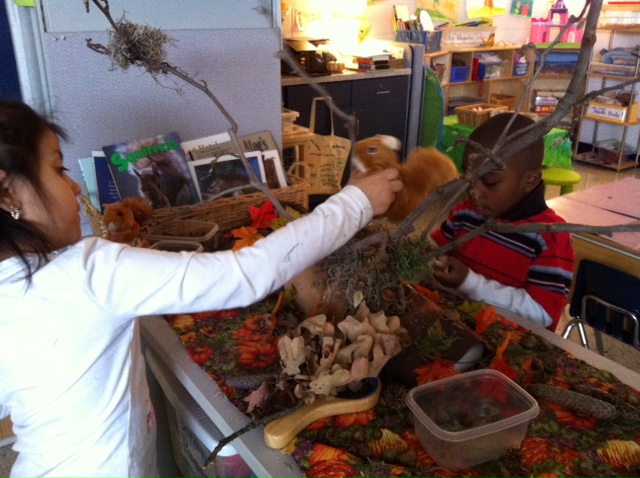 The children made a drey (squirrel nest in a tree, in case you don’t know that term – I didn’t until this study), and a den (squirrel nest that is in a hole in a tree). Observing the children play I hear key vocabulary words used correctly, witness scientifically accurate construction of the dreys and dens (correcting each other if anything is not as depicted in our books), see them using different books we’ve read as references in building the nests and replicating what they see the squirrels doing in the pictures as well as what we’ve observed them doing outside. I watch them as the mother squirrel prepares her nest for her babies and then nurses them – using the larger stuffed squirrel as the mom and the smaller plastic squirrels as the babies. I watch them make the squirrels chase each other, scampering up and down the tree, gathering acorns and hiding them in their nests – declaring that winter is coming soon so we have to store lots of acorns. They have mastered the county objectives – plus much, much more. They have experienced squirrel life through imaginative play. They have turned into strong observers of squirrels outside so they can replicate it in their play. They have truly become squirrel experts – through play. Would this have happened with only a read aloud, or a squirrel worksheet? No.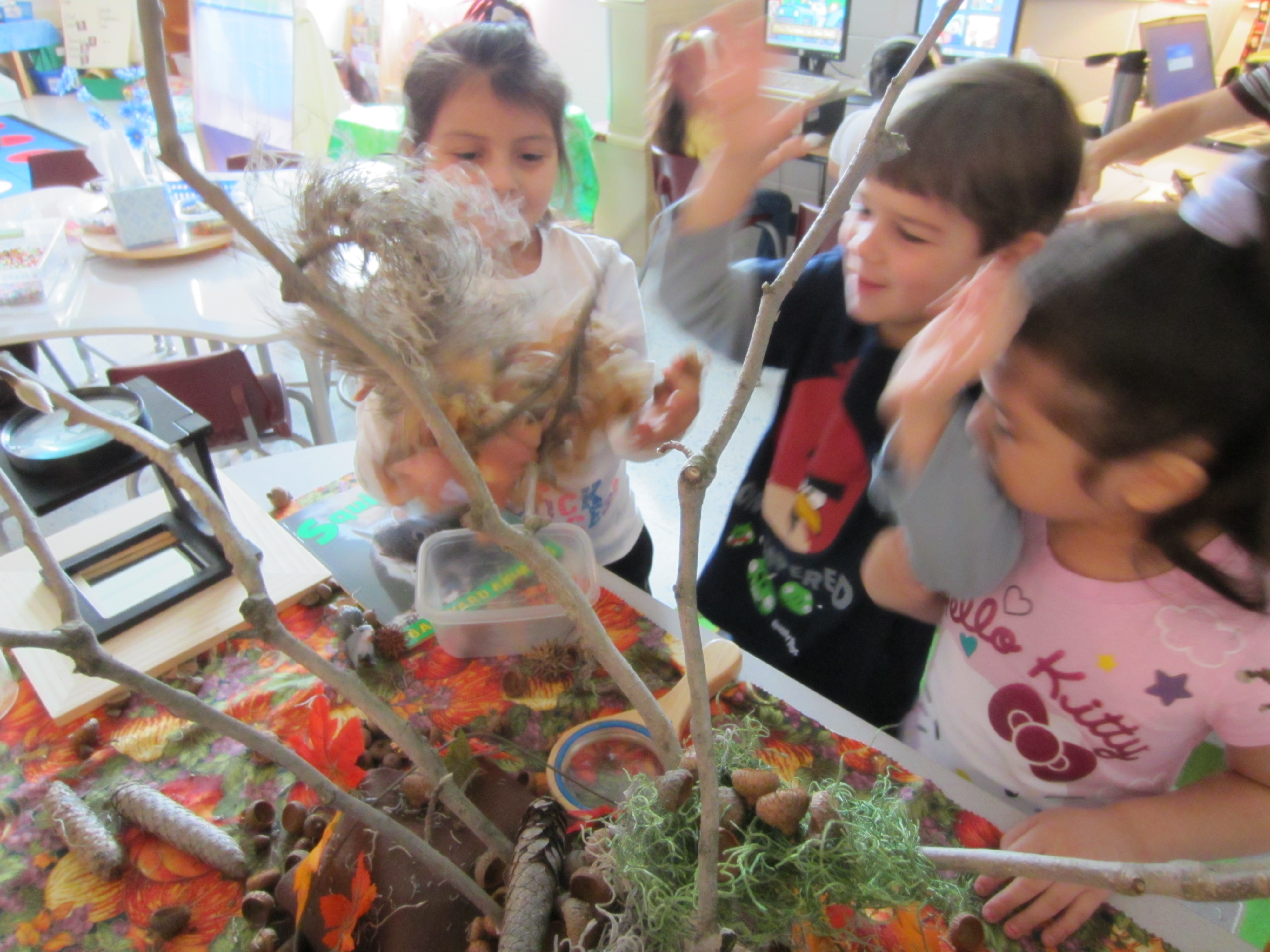










 Catching Readers, Sparking Joy