The National Council of Teachers of English (NCTE) is currently doing a blog series celebrating the National Day on Writing®.
I was excited to have our work in Writers Playshop be featured on their blog. You can read the post here.
Be sure to check out the many other posts by teachers passionately committed to teaching young writers. I promise these posts will inspire and engage you. Enjoy!
I’ll be at NCTE this year, presenting on Friday at 3:30 in Room 256 with Kassia Omohundro Wedekind and Christy Thompson. I hope we will see you there!
A word that is used quite frequently in education and often connected to a particular program or curriculum. It’s one of those “nails on a chalkboard” words for me, as it’s tossed around so often without a lot of discussion or conversation regarding its meaning or what it looks like in classrooms with actual children. Let’s take a look at what fidelity means. According to Webster, fidelity is the quality or state of being faithful and accuracy in details. Because I am curious about words and what they mean, I read further.
Fidelity came to English by way of French in the 15th century, and can ultimately be traced back to the Latin fidēlis, meaning “faithful, loyal, trustworthy.” While fidelity was originally exclusively about loyalty, it has for centuries also been used to refer to accuracy, as in “questions about the fidelity of the translation.” (Webster’s Dictionary website)
I’m left with questions regarding teaching with fidelity. Who are we being faithful to? A curriculum or children? What details are we challenged to be accurate about? A curriculum or children?
While teachers do not take an oath to become a teacher, I’ve personally always believed in, “first, do no harm”. For me, this means questioning and reaching for understanding about the “why” behind my pedagogy and always putting the children in my care and their needs first. Combining years of research, learning, observation and knowledge and continually seeking new research and learning is what I’ve found supports and sustains me as a teacher and allows the children in our classroom to truly thrive. Paying close attention to the details within the children in our classroom and what their needs are is at the heart of my work. No two days are ever the same. Teachers must continually think and reflect on the curriculum and how children are learning. There is not a script for teaching young children.
Perhaps we need to rethink what we are teaching with fidelity. What are we faithful to? What if we were faithful to children? What if we put them first in our planning and interactions in the classroom? What if we used many tools and resources, all supported by research and best practices, to teach?
What if we taught with fidelity to children?
After I hit publish on this post, WordPress connected this post with one I wrote in 2017. As I reread those words, I wanted to reshare a portion here because it connects to this current post so well.
A teacher leader in my county once helped me reflect on the idea of fidelity vs. thoughtfulness. I keep coming back to that. Perhaps we need to be implementing new structures, programs, etc. with “thoughtfulness”, rather than “fidelity”. We need to look at the programs, curriculums and expectations our district and administration give us with a critical eye. We need to deconstruct these things together with our team, be thoughtful in our implementation, question and reflect on what works and what doesn’t. As one of my former principals always says, “the answer is in the room”. Talk, reflect and think together – don’t just blindly follow something from outside. We need to use the abundance of resources we have as departure points to launch our own best teaching. We need to keep talking, questioning and thinking with our team and on our own. As I’ve said before, we teach children, not curriculum, programs or standards.
“Once upon a time there was a magical forest. And a lion lived there. But he didn’t have a friend. So one day he found a girl who wanted to live in the magical forest with him. She had a crystal that lighted up when she was with kind people. The lion loved the girl and they were friends. They lighted up the crystals to find other friends and be kind. They loved the animals, the magic forest and everyone. The end.”
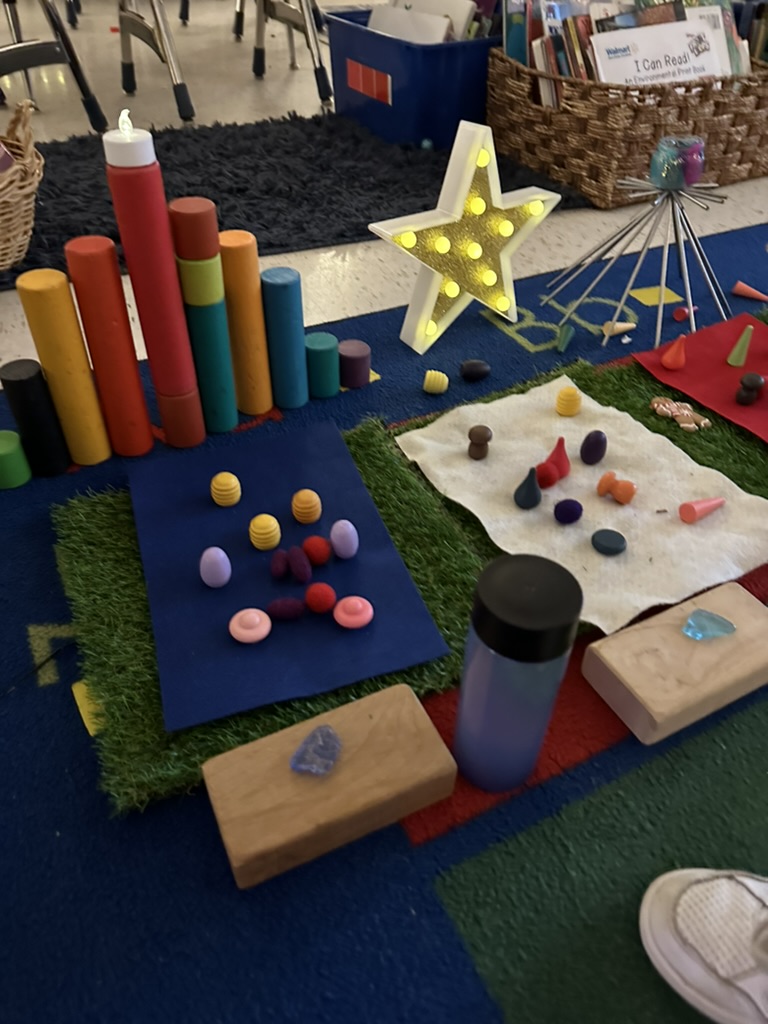
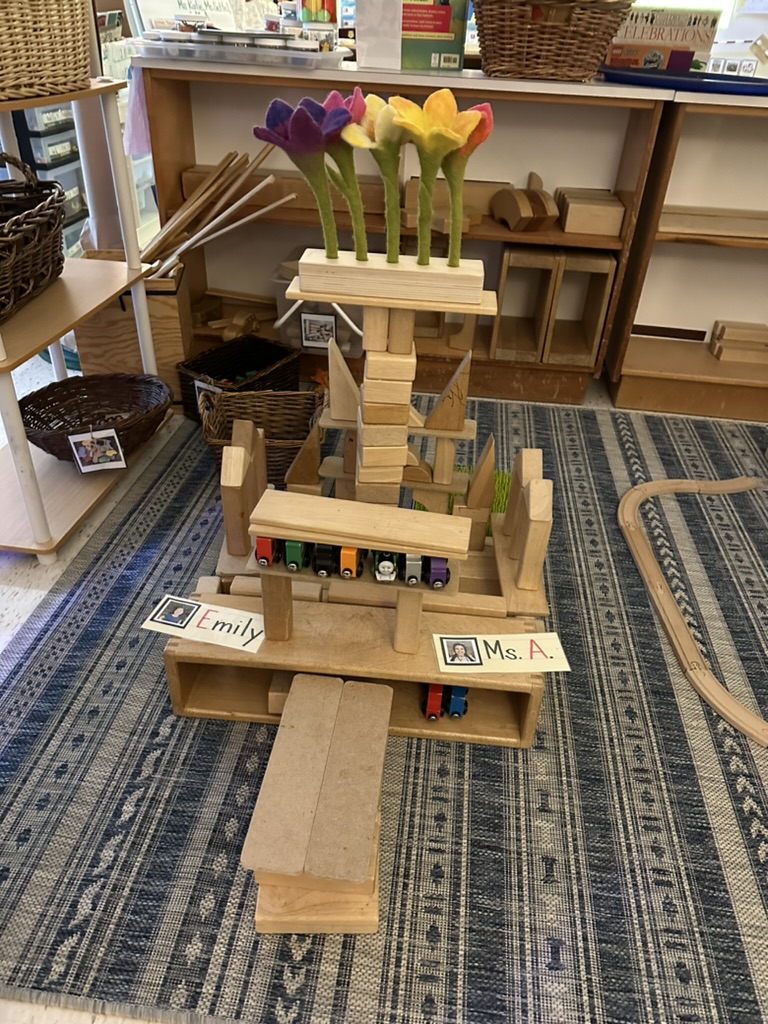
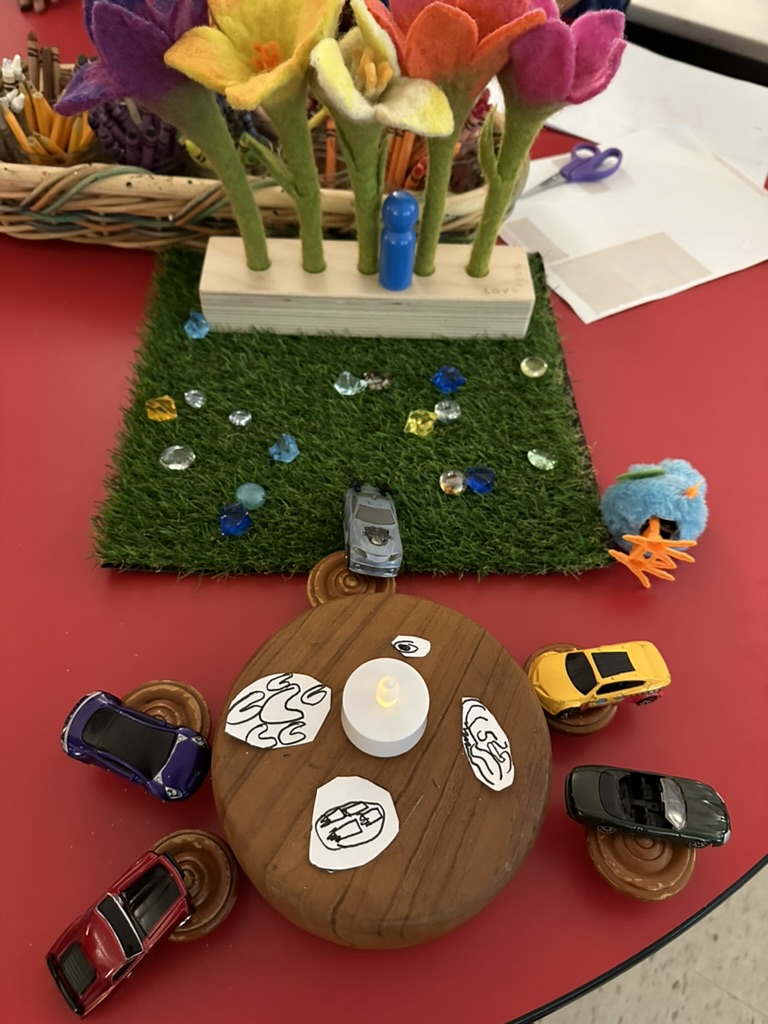
Storytelling in kindergarten. It’s my “magical forest”. From our first day together, children are encouraged and invited to find the stories in our classroom. Susan Harris MacKay inspired me to believe and to share with children that “stories live everywhere”! And their job (our job!) is to find them and share them. Each day that first week of school, I bring a material to our gathering rug. It might be blocks, paper, loose parts, clay, sand, magnetic tiles, etc. – any material that is in our room out for them to play and engage with. I make up a simple oral story using the materials and then invite the children to find their own stories in our room.
“Stories live everywhere! What story will you find today? Off you go!”
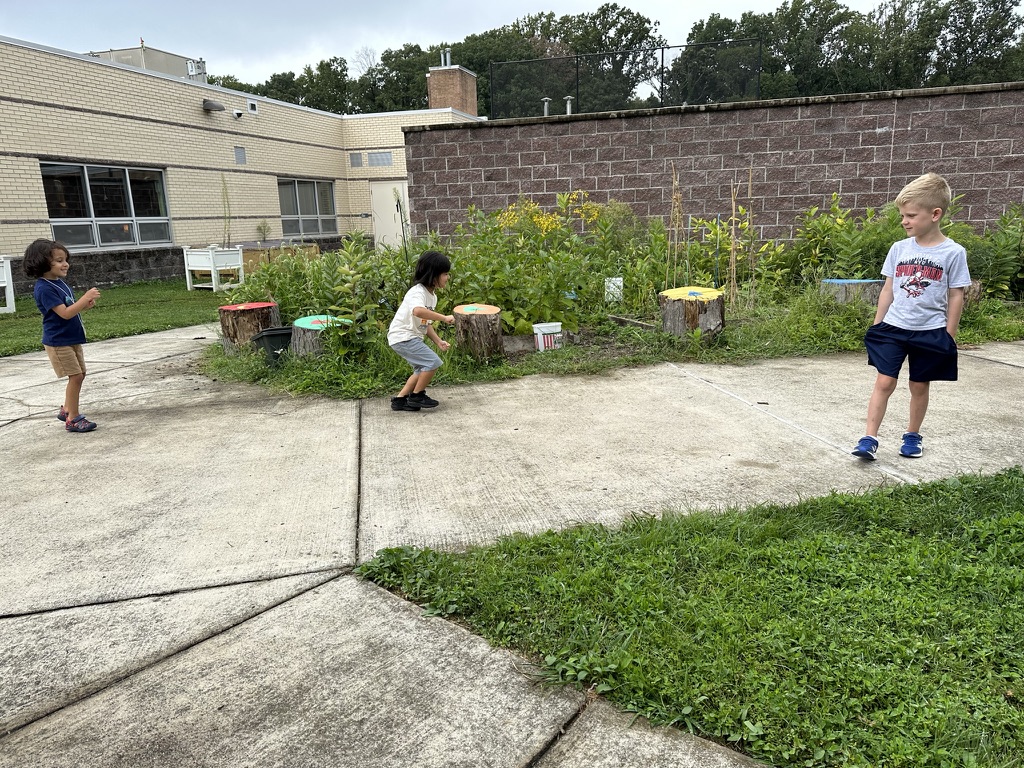
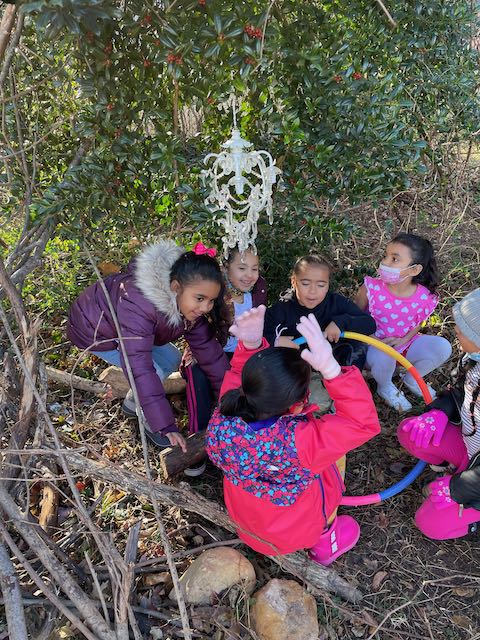
They don’t need to be asked twice. Children eagerly run off to find their stories. They find stories as they play at the light table, the dramatic play area (equipped with minimal props – real kitchen items, scarves, baby dolls), the block area, the music area, the art table or the Story Shelf (our shelf with loose parts that I add to on a regular basis – starting very small and simple and expanding as the year goes on). They soon discover that stories do, indeed, live everywhere. I roam around the room, eagerly listening to their wonderful stories. And then I invite them to put their story in a book, so it can live forever. There are blank 3 page books in our art area and many of the children choose to make a book with their story right away. But some wait a while to take this next step. And that’s okay. After listening to their classmates tell their stories, while looking at a photo I took and projected, or sitting beside the storyteller, or listening to an author share the book they made – all children will eventually want to make books so their stories can live forever.
But for now, the joy is in the process of finding stories and sharing them with one another. Oral language is a key component of a kindergarten classroom. We learn about characters and setting and children delight in knowing those words and purposefully plan these elements in their stories. They realize that stories live in the cafeteria, in our specials classes and on the playground. I continue with loads of storytelling as we create our story together as a community. They lean into an identity as a storyteller. They become confident in their oral language and their ability to capture the attention of peers and adults with their words. They learn story language and what makes sense. They learn how to answer questions from friends and add details to make their stories clearer. These first days set the stage for the rest of our year together. Our Writers Playshop follows a predictable structure of a whole group focus lesson, story making time and ending with a sharing time. But our story telling focus quickly expands.
We move into story acting – where children dictate a story to me and then they become the director as they choose actors and actresses to act out their story in front of an audience of their friends. We take our storytelling into math, where loose parts and tiny toys help children create math stories to explore mathematical thinking. We grow into our identity as authors and illustrators as book making takes off and our classroom library becomes full of the books we make. And we grow into our identity as readers, as we listen to many, many rich read aloud books and ask ourselves, “what did we hear or read today that might help us as story makers, authors and illustrators?”.
This work is not new, nor is it exclusively mine. I stand on the shoulders of so many wonderful educators such as Katie Wood Ray, Lisa Cleaveland, Donald Graves, Lucy Calkins, Matt Glover, Trisha Lee, Vivian Gussin Paley, Michelle Kay Compton, Robin Chappele Thompson, Georgina Ardalan, Angelique Thompson, Kenisha Bynoe, Susan Harris MacKay, Matt Karlsen, Angela Stockman and the many, many educators I’ve connected with through the years of studying writing, literacy and the Reggio Emilia approach to learning and teaching. Our Writers Playshop (named “Playshop” several years ago by a child who asked me why it was called “workshop” when it was really play) is a product of my 33 years of teaching, learning, unlearning, observing, reading, writing, researching and reflecting. It changes often, and I continue to learn and listen to what the children are telling me. There is not a script or a program to follow. It’s about following the children. I’ve found that the standards and expectations of a public school kindergarten classroom can be far surpassed with this way of teaching. Children go way beyond what is typically expected in a kindergarten curriculum. Writers Playshop is a powerful way of teaching that honors, challenges, supports and celebrates children and their learning – for life, not just for school.
If you’d like to get started, here are a few resources you might check out. Stay curious, keep reading and talking with colleagues and most of all, trust the children. Play is how children learn. Jump in tomorrow – join your children in finding stories, telling them and writing them down. Trust the children. Story creates our communities and brings joy to our lives. It’s truly magical.
“Children have a right to high-quality, vigorous instruction intended to support their academic skills within the discipline of literacy. But those skills must be inextricably linked to stories – to the paths every child determines need clarity in their own life. Increasing literacy skill should be seen as a means by which the stories flowing through each of us are supported as the effort they are to make better sense of the world in which we experience the complexity of our everyday lives. Literacy skills are no end in and of themselves, and treating them as such takes us further from the capacity every child has to use them to find and share our stories.”
Susan Harris MacKay in Story Workshop: New Possibilities for Young Writers
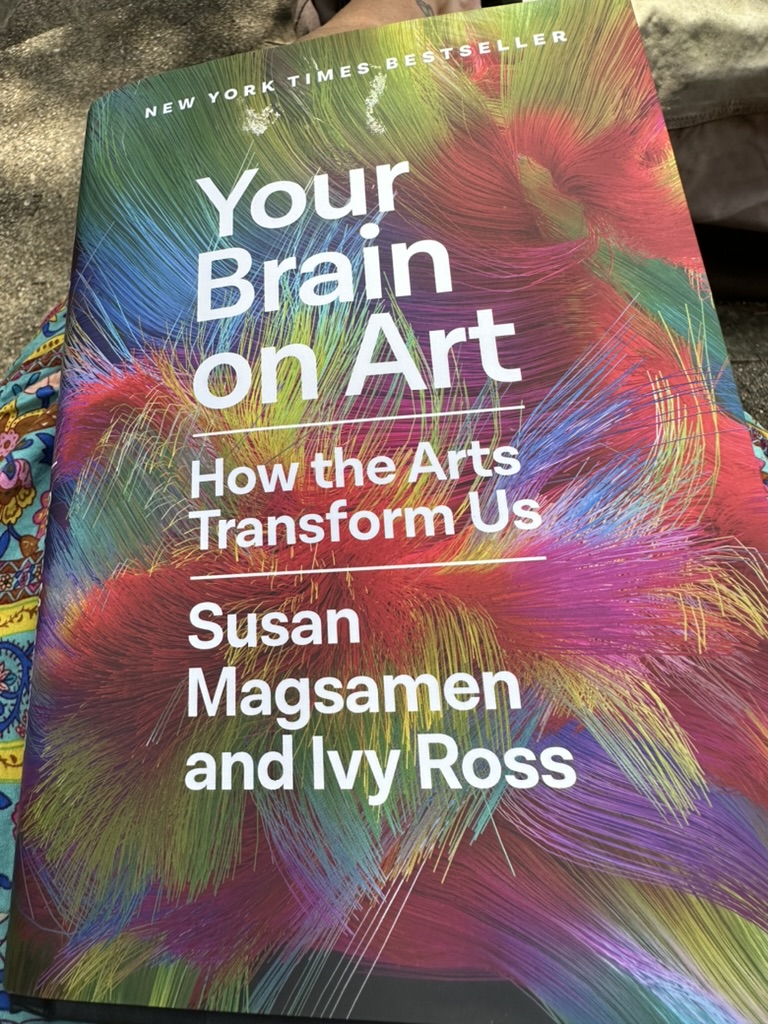
I was left with the understanding of how art is (or should be!) essential in our lives – for physical health, for emotional wellness, for connection, for relationship, for making sense of the world we live in, for relating to others, for self-expression, for being fully human – for pretty much everything. The importance of the arts is scientifically proven and well-researched in the field of neuroaesthetics (the scientific study of the neural bases for the contemplation and creation of a work of art). Art experiences should be available to everyone.
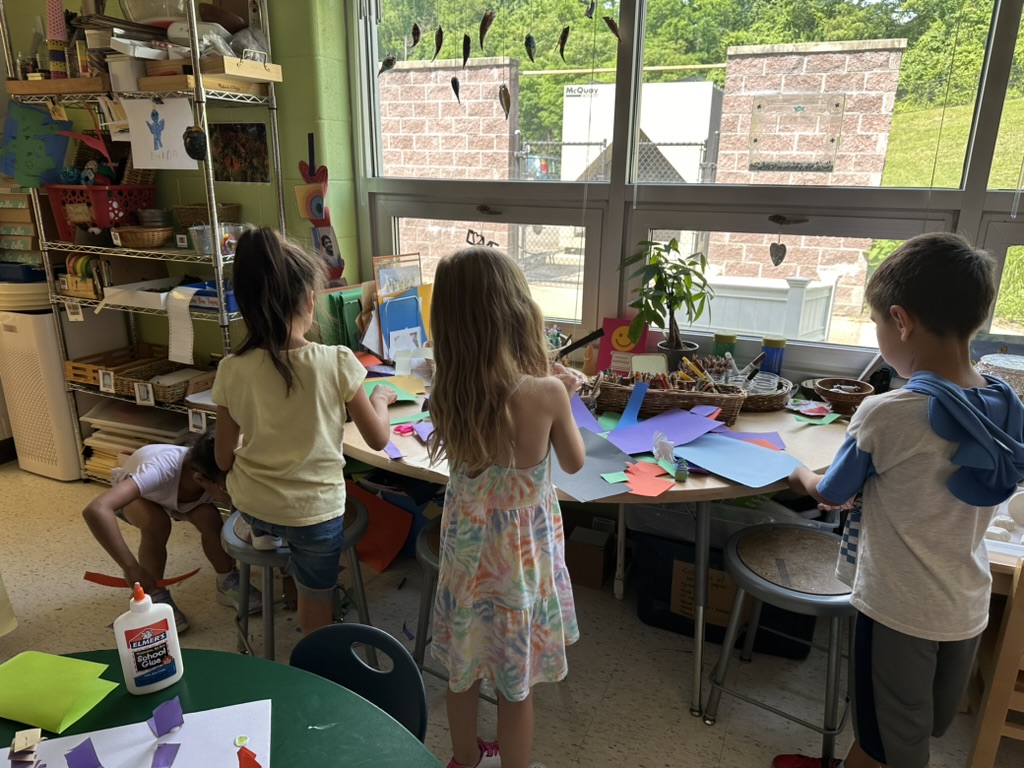
And school is one place we can make those art experiences available! I believe art is a right for children. And to be clear, I’m not talking about crafts – where children are instructed to follow the teacher’s lead and example to create something that looks like everyone else’s craft. I’m talking about art experiences that are open-ended, process oriented (focused on experimenting and exploring materials as one creates), playful, unique and limitless. Art is a way children can play, communicate, process experiences and feelings, use their imagination and negotiate meaning in endless ways. Our art experiences include paper, clay, loose parts, nature, markers, paint, pens, keyboards, drums, rhythm sticks, storytelling, drama, nature walks, light boxes, projectors, pencils, chalk, scissors, wire, cardboard, beads, staplers, tape and more.
In our kindergarten classroom, the art area is a favorite space to go – and this art area often expands throughout the room – and outdoors. I provide a multitude of materials, adding more things as children request them or when I see that a new material is needed. Materials are displayed and arranged in ways that children can access them independently. Children are invited to make and create in the art center during morning arrival, our Readers and Writers Playshop time and Choice Time throughout the day.
I introduce artists and their works throughout the year. Andy Goldsworthy, Alma Thomas, Howardena Pindell, Wassily Kandinsky, Picasso, Monet, Henri Matisse, Jackson Pollock, Joan Miro, Paul Klee, Fanny Sanin, Bisa Butler, Jean-Michel Basquiat, Jeffrey Gibson, Sonia Delaunay, Alan Shields, Georgia O’Keefe and Alexander Calder were some of the artists we discovered this past year. I also spend a great deal of time talking and learning about illustrators in the books we read. I teach the children to read art with the “I see, I think, I wonder, I feel” thinking routine from Project Zero. Each time we look at art or think about art, I make the connection that they are artists, too – and they might be inspired by the artists we get to know, or each other. I want the children to see themselves as artists and to have a sense of self-efficacy surrounding art and being creative. Creativity is an essential piece of our lives and our classrooms should nurture and allow for creative experiences.
“Creativity seems to emerge from multiple experiences, coupled with a well-supported development of personal resources, including a sense of freedom to venture beyond the known.” Loris Malaguzzi
How can you provide experiences and creative opportunities and invitations for the children you teach? How can art become another language in your classroom? And what might that mean for you, as an educator? Having a “sense of freedom to venture beyond the known” makes me think of limitless possibilities for children, and for us as educators. I think art can provide that space for us.
Learning is not the transmission of a defined body of knowledge, what Loris Malaguzzi refers to as a ‘small’ pedagogy. It is constructive, the subject constructing her or his own knowledge but always in democratic relationships with others and being open to different ways of seeing, since individual knowledge is always partial and provisional. From this perspective, learning is a process of constructing, testing and reconstructing theories, constantly creating new knowledge. Teachers as well as children are constantly learning. Learning itself is a subject for constant research, and as such must be made visible.
Carla Rinaldi and Peter Moss
It is our job as educators to learn as much as we can. To read, think, talk, question, wonder, challenge…and then do it all again. To be brave enough to challenge our own best thinking – to observe, listen, reflect, talk, learn and unlearn. We have to be researchers, kidwatchers and thinkers – alongside the children we teach, and in partnership with colleagues and knowledgeable others who can help us learn and push our thinking. We have to ask the hard questions, ponder the unanswerable questions, and keep growing as educators. We have to be willing to rethink our pedagogy, to observe and collect data, and to continue learning. We must continually ask “why?” Our children deserve this. We deserve this.
Our pedagogy is not small.
However, there are many movements to make our pedagogy small. Scripted programs, lockstep curriculum, plug and play slide decks, TikTok teaching, non-educators influencing and making decisions, etc… – these all can negate the knowledge of the teacher. They can negate the brilliance of the children. They can dumb down the learning. They can ignore the funds of knowledge our children and their families bring. They can take the trust and ownership away from the teachers and children. They can steal the joy and reduce teaching to following a script, a program or a curriculum made by people who have never known your children, your community, or you.
So how can we keep our pedagogy big and in service of the children, families, community and us?
Ever since I started teaching, I have devoured professional books, articles and journals. I’ve found people, as Katie Wood Ray said, “to stand on their shoulders” and learn from their brilliance. I’ve followed researchers, educators and wise thinkers who have done this work for a long time and who continue to contribute to our field. Whose shoulders do you stand on? Who are you reading, joining in conversations, following research, and learning from? How are you pushing back on teaching that is not best practice and can actually do harm to children? How are you collecting the research and continuing to learn in the context of the children you teach? How are you constructing knowledge and being open to different ways of seeing?
It’s time for teachers, as professionals, to stand committed to big pedagogy. I hope you’ll take some time this summer to find some shoulders to stand on, to think about what this might mean for you as a teacher, and most importantly, what it might mean for the children you teach.
I’ll start by sharing a short list of a few of my current favorites. Please join me in sharing yours – the shoulders we can stand on in this journey together. Happy learning!
Storytelling is a tremendous way to engage in meaningful literacy learning and play in your classroom – no matter the age of your learners. I encourage you to welcome the stories your students bring into the classroom, to encourage the wonderings and noticings of the stories that live in the land we learn and play on, and to make the space for children to explore these stories in multi-modal ways. Children deserve to have stories fill their lives and to have their stories be listened to and celebrated.
I wrote a guest post on the CCIRA blog! Please visit their page to read the post in its entirety. Enjoy!
Digital is not an enemy – it’s a new possibility.”
Carla Rinaldi, President of Reggio
I try to spend most of my life living in a space of thinking about what’s possible. And sometimes that’s hard. Really hard. Lately, it’s been an ongoing challenge. I never thought I would be considering ways to teach four and five year olds remotely. And yet, here we are. When Carla Rinaldi suggested that digital is a “new possibility”, it opened my eyes to viewing distance learning in a new light. As I reflect back on four months of distance learning with kindergarteners, I realize that we had several successful routines and learning adventures, as I’m sure you all had, as well. It’s important for me to share them and to invite you to share yours, as this is the way we can grow and learn together – making our journey into distance learning the best it can be. And remembering that this is temporary.
Our job is too difficult and too beautiful to do alone.”
Amelia Gambetti, Reggio Emilia, April 2015 (quote from Diane Kashin’s blog)
If you’ve followed my blog for a while, you’ve heard me write about my firm belief that we teach children first and foremost – not standards, curriculum or programs. I think we really need to remember that as we move to virtual teaching in the foreseeable future. At a wonderful webinar by Mike Flynn, he said, “good online teaching is good teaching – don’t let the ed-tech get in the way.” We need to focus on our students first, then what good in-person teaching would look like and then choose a tech tool that matches. We can’t focus first on the fancy technology that might be flashy and look cool, but may not be what our students need.
I used Google Meet because it was one of the approved platforms in my district. You can do these things on Zoom or Microsoft Teams and I’m sure other platforms that I’m not familiar with. Blackboard Collaborate Ultra will present more challenges, because of the inability to see more than 5 people at a time on the screen, but it’s still possible to adapt for your online platform if that’s what you have to use. I’d like to continue this blog series with a look into a few things that worked for us in math and literacy learning in whole group. You can find my previous post here.
Math
I continued the number talks and math routines that we were used to doing in the classroom and adapted them for a virtual setting. Here are a few of the ones that worked well, with links to explain them further.
Finger patterns were a favorite, and we used them in a variety of ways. This required being able to see everyone on the screen, something that I felt was essential for many reasons – finger patterns being one of them. I had a magnetic 10 frame and number cards from the fabulous Tiny Polka Dot math game that I would show the kids. The kids would then use their fingers to show me the number in multiple ways. This might sound like, “How many? Show me on your fingers. I see 3 and 4. Can you show me 7 a different way? I see 2 and 5.”
Which One Doesn’t Belong? – We used Christopher Danielson’s book in the classroom along with this website and created many of these images on our own in Google Slides. This was an easy math routine to adapt to virtual by sharing the screen and recording children’s thinking in the Jamboard or Google Document.
How Many? – This is another excellent math book by Christopher Danielson, but the book is just a starting point. Once you start thinking “how many?” when looking at objects, you start taking pictures of all sorts of things! When you water your garden, when you’re organizing painting supplies, when your running shoes overflow the closet (OK, maybe that’s just me) – all are opportunities for a math talk that begins with the question, “how many?” I love these talks because there are so many possibilities and it gives kids a chance to count, explain their thinking and think beyond rote counting. Choosing highly engaging photos hooks kids right away and makes for an exciting math talk.
Three Act Tasks – I had a lot of success using these in virtual learning. This website will explain what a 3-Act Task is. These are highly engaging and really challenge kids to think and explain their thinking.
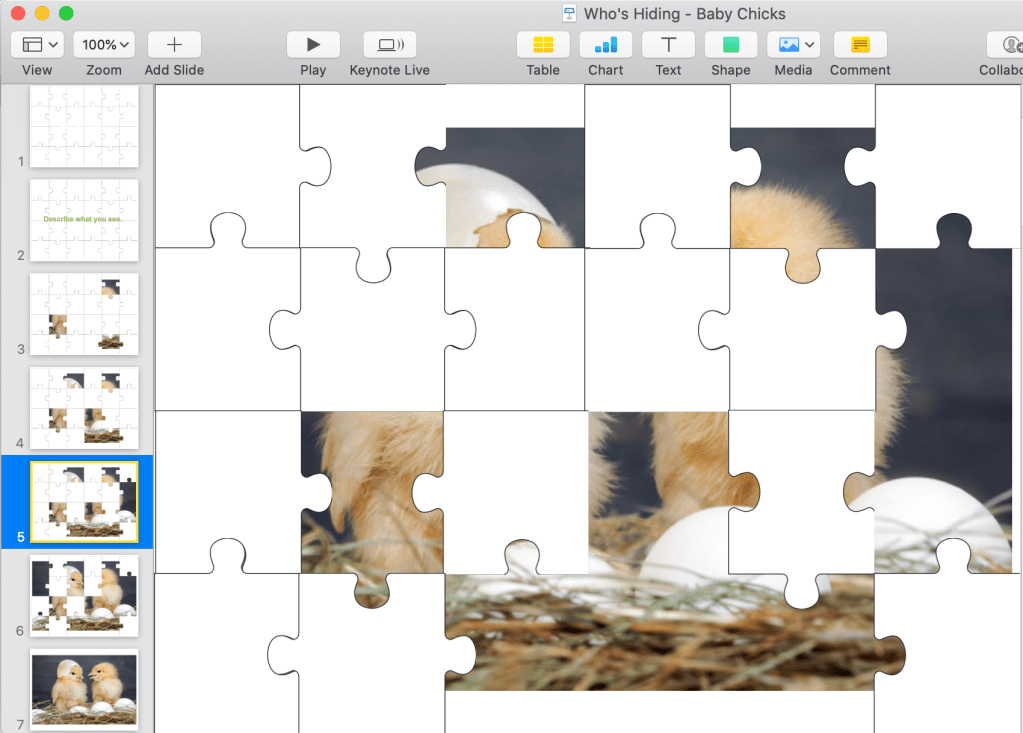
Is it Fair? and Who Is Hiding?– Antonia Cameron, Patricia Gallahue and Danielle Iacoviello’s wonderful new book Early Childhood Math Routines explains these routines in depth. This blog post shows you how an Is it Fair? routine might go. Using photos that kids are familiar with and their names makes this engaging and a rich mathematical conversation, where kids have to decide and justify if an image is fair or not. Who Is Hiding? is another quick image routine that supports oral language and helps them make meaning through conversation as new information is presented. These open-ended math routines encourage rich conversation and debate and work well in a virtual platform.
Who Is Hiding? is a quick image routine that encourages close looking, wondering and meaningful conversation. Choose a photo that connects with your kids and content and create a Google Slides document where you can slowly reveal the picture – removing pieces with each slide.
Literacy
Literacy continued to be woven throughout our virtual classes, just as it was in the classroom. Here are a few things we did routinely in virtual learning.
Read aloud – I made sure to read aloud at least one book for every session we had. I shared in my earlier post how I shared the screen and used a digital text for read alouds. This let everyone see the words and pictures clearly. I also created a private YouTube channel where I read aloud books for kids to listen to on their own. Children need to hear us reading aloud and engage in conversations about books on a virtual platform as much as in a classroom.
Shared Reading – I used a variety of texts for shared reading. I brought several big books and charts home, but I found that children couldn’t see them as well on the screen. I would like to play around more with document cameras and a way to continue using our beloved big books. Poems, chants and big books in Google Slides, Jamboard and SMART Notebook worked well. I took a photo of our class anchor chart listing what readers do, and I placed that photo next to the shared reading text – just like we would have it hanging near our shared reading text in the classroom. I used my cursor as the pointer. I also learned that you can make your cursor larger in your computer’s Accessibility setting (Display – Cursor Size) – and that’s a game changer! Our poetry and song notebooks are such a huge part of our classroom reading life, and I want to continue this practice during distance learning by mailing home copies of the shared reading texts for children to put in their notebooks. Finding a way to distribute these is something that teachers need to think about. It’s important for kids to have hard copies of reading materials – not just digital. We need to figure out a way to routinely get these things into the hands of kids.
Shared Writing – I did shared writing on a large piece of paper as well as on a Jamboard or Google Document. If kids can have a white board or paper to write along with you, that’s even better and far more engaging. We continued to co-construct texts such as letters, class books and community stories – just like we did in the classroom. I found that if I was typing the children’s words, I had to slow down considerably. Inviting them to write along with me and share what they wrote in front of the camera helped me with that. Just as in the classroom, our shared writing pieces became shared reading pieces to revisit again and again.
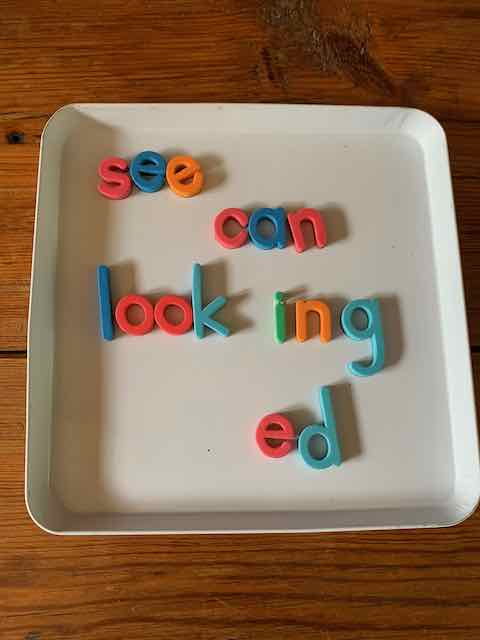
Word Work – A magnetic burner cover or a cookie sheet makes a great portable way to do word work virtually. I brought home my magnetic letters and used these often, just as I would in the classroom. With their white boards or paper they could do the word work along with me. I would love for my kids to each have a set of magnet letters – that’s something I’m thinking about for the fall. I recently learned about these letter tiles, and look forward to trying them out.
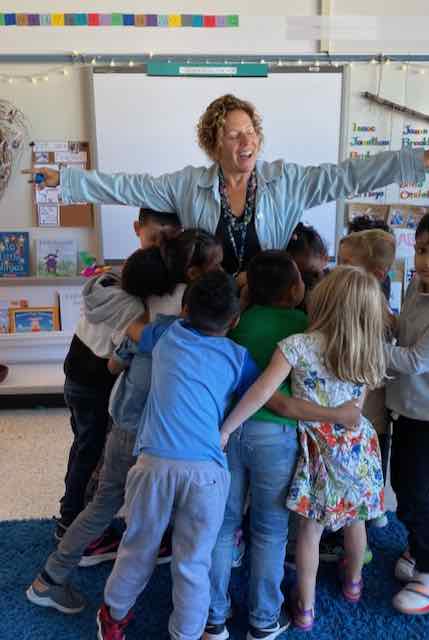
I want to be back in our classroom more than anything in the world right now. I want to experience the togetherness and pure joy that a classroom full of children brings. I want to hug children, paint with children, hear the joyous roar of children at play and share a book with tiny, squiggling humans on our rug. It physically hurts to know that won’t happen anytime soon. However, we can make distance learning the best it can be right now, at the same time we long to be back in our classrooms full of hugs, love, joy and children’s laughter. Maybe we can even create virtual classrooms that have all of that in a way that’s never happened before – it’s certainly a possibility. Loris Malaguzzi said, “nothing without joy”. How can we create virtual learning spaces that are full of joy?
What has worked well for you? Please share. We are all on this journey together.
Dancing and singing the monarch migration. I miss this.
I haven’t met any early childhood teacher who loves teaching virtually. Perhaps there are some out there, but overwhelmingly teachers want to be in classrooms – playing, hugging, learning and wondering with their students. We were plunged into distance crisis teaching last March, and we will be continuing this type of teaching for some time, I’m afraid. Embracing virtual or distance learning and looking for ways to make it work, and work well, is important, while acknowledging that this is temporary.
Carla Rinaldi, the President of Reggio said, “a digital experience is among the 100 languages – 100 possibilities – 100 ways of approaching reality – of the children. Digital is not an enemy – it’s a new possibility.”
How can we make distance learning the best it can possibly be – a new possibility for our children?
I’ve spent a lot of time reflecting on what worked and what didn’t work in virtual or distance learning for my kindergartners. I’m continuing to learn, think, explore and collaborate as I do Kitchen Kindergarten Summer Version – my district’s “continuity of learning” sessions. I will share a few things that I found are working quite well for whole group learning. I will tell you, I’m pretty “low-tech”. I start with what I know works well in the classroom and think about how I can adapt it to virtual teaching. I’m learning a lot more “high-tech” options this summer, but most of these ideas are in the “low-tech” category. I’m planning future posts on whole group, small group, 1:1 and play dates, as well as thoughts for how it might look starting with a new class of kindergartners.
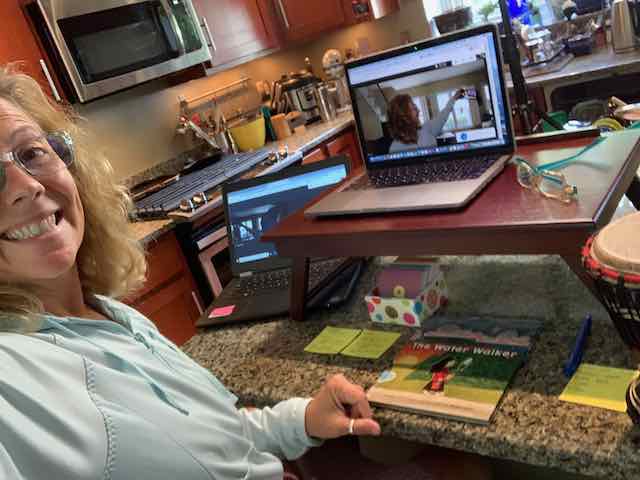
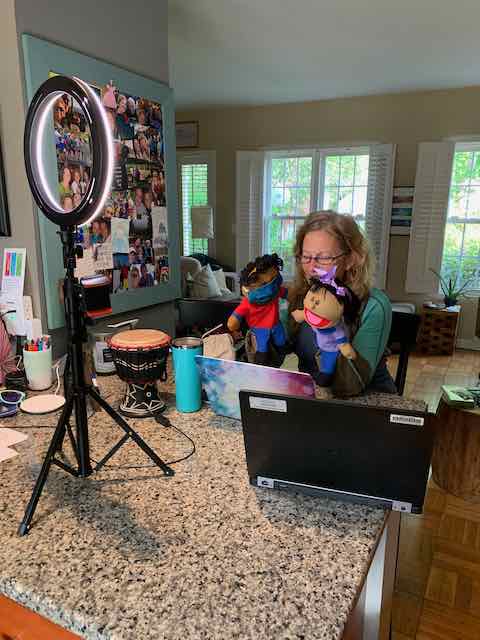
Kitchen Kindergarten – two laptops were KEY – I could see what the kids were seeing when I was sharing my screen.
A few ideas for whole group distance/virtual learning:
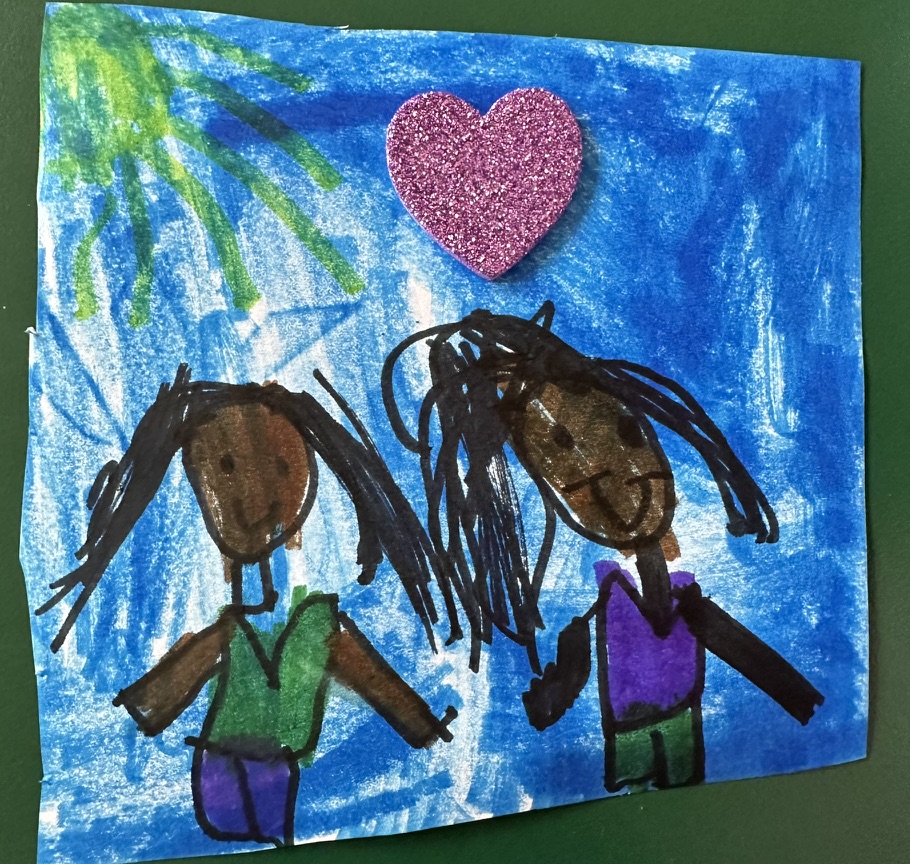
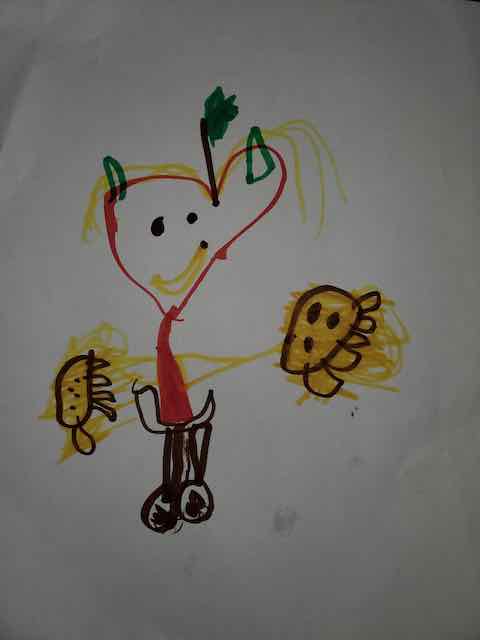
Langston’s drawing after a whole group song where kids created a character in each verse.
Have a predictable starting and ending routine. We start each Google Meet with a hello drum song, greeting each child by name. We end each Meet with a favorite class song, “Skinnamarinkydink” and then send each other hearts with our hands as we say good-bye to each child on the Meet. Singing virtually is messy, but fun – and so worth the joy of coming together with a song.
Plan activities that actively engage the children, rather than have them passively sitting in front of the screen. My kids all have white boards and this is a great way to have them be actively learning. They can write words, numbers, draw, etc.. I found this worked better than the chat box for kindergarten. We practiced letter formation, sight words, number formation, math stories, drawing, names, and played games with our white boards. Have the kids get up to dance, move, find things to share, etc. – just like in the classroom. We wouldn’t have kids sitting passively for 30 minutes in a classroom – it’s important to have lots of opportunities for active learning and movement while on a screen, too.
Give children time to talk and engage with each other. We have time each Meet to share stories and show our pets, apartments, toys, backyards and family members. I share my dog, my garden and tell stories of my life at home. Kids share books they made, art they created, and the stories of their lives that we love to hear. Our time virtually is much less than a school day, but we still need to make time to share all those stories that would normally be shared during our school day. It’s how we stay connected and feel like a community. I start each Meet with share time and invite kids to stay on after our scheduled class time ends if they have more stories to share. We often go well beyond the scheduled 30 minutes, but it’s important to hear what they have to say.
Hidden Pictures are a huge hit and a wonderful way to work on vocabulary, oral language and directional words and they are highly engaging. Highlights for Kids (remember the magazines in the doctor’s office when you were a kid?!) has them for free on their website. My kids LOVE them.
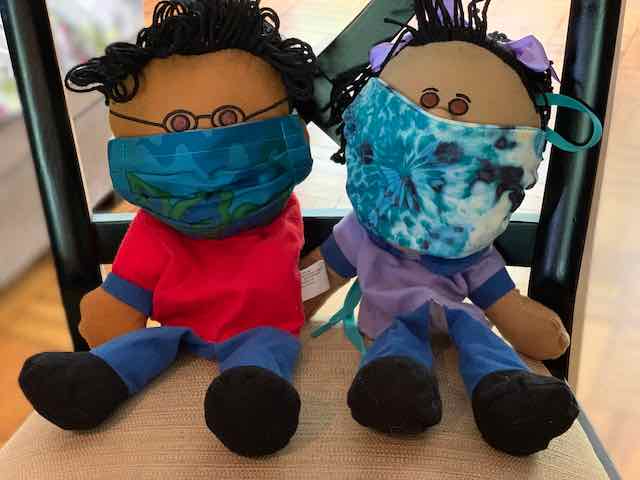
Puppets! I worked with a teaching artist from Wolf Trap Performing Arts Center this past year and learned so much about puppetry, so it was natural to continue this into our virtual classroom. The children engaged so well with puppets and it is definitely a strategy I will continue to use. Stuffed animals of our favorite book characters, well-known class puppets and some new friends helped me teach new concepts like why we need to wear a mask, and also helped us with navigating big feelings we had, social-emotional learning, retelling stories and engaging with number talks and math stories.
Read lots and lots of books and talk about them – just like we do in the classroom! I brought home a ton of books, but I found it was frustrating for the kids to watch me reading a book. They had trouble seeing the pictures, and if their Meets setting wasn’t right, if anyone else talked, their image would replace me. I made the switch over to reading books on a shared screen with a variety of tools. Open Library K-12 Student Library is where I look for titles of books I want to read first – they have so many books available for free. I also use Kindle for their many free digital books, and I’ve purchased some of my all-time favorites. I’m exploring Loom and using a document camera, too.
Continue focusing on inquiry and play. Mystery Doug and SciShow Kids are two of my favorite YouTube video sites for exploring questions that kids ask. They are short (3-5 minute) videos that focus on a question and encourage kids to talk and wonder. I found them to be great introductions to a topic. I will show the video and then stop and have a conversation with kids. Then we will do some type of active learning and invitation for kids to try something at home. We explored how airplanes fly and then made our own paper airplanes. We measured how far they could fly with our shoes/steps and then read a book about how to make paper airplanes to give them more ideas. Finally, the kids revised their airplane to see if they could make it fly even further. One day we learned about trees and wondered “what is the biggest tree?” – Mystery Doug pointed out that “biggest” could mean lots of different things and showed us several really cool BIG trees. Then I cut an avocado and showed the kids how they could grow their own avocado tree with an avocado pit, a jar and toothpicks. I leave links and invitations on our Google Classroom after each session for kids to revisit what we did and extend the learning if they choose. It’s also nice for children who didn’t attend the Meet to see what they missed and engage in the learning on their own.
Teach the kids how to mute and unmute because of background noise, but don’t control their voices. My friend Christy Thompson wrote a wonderful blog post about this here. Being able to use a tool like Zoom or Meets, where you can see all the kids is SO important. It’s easier for them to slide their voices into a conversation or raise their hands and it’s more like being in the classroom. It’s also so important to be able to see each other, show each other things and feel that sense of community that we all need. They want to see their friends. We have to let the kids see each other, talk and continue creating community in virtual learning.
These are just a few things that I’ve found work well. I’ll continue to share my thinking here. I truly believe that the teachers who have experienced virtual teaching and learning with children are the experts. We need to share our ideas and experiences with each other so that we can be in the best position possible to continue distance learning or resume when necessary this fall. What ideas do you have for whole group virtual learning? Please share!
Check out my new post on the CCIRA Professional Development Blog: The Importance of Choice in Writers Workshop (or Writers Playshop, as we began calling it this year). While you’re there, enjoy the rest of their blog.

 Catching Readers, Sparking Joy