Reflecting on Reggio – A Series of Wonderings

Wondering #1 – How can I set the classroom up to honor participation and relationship?
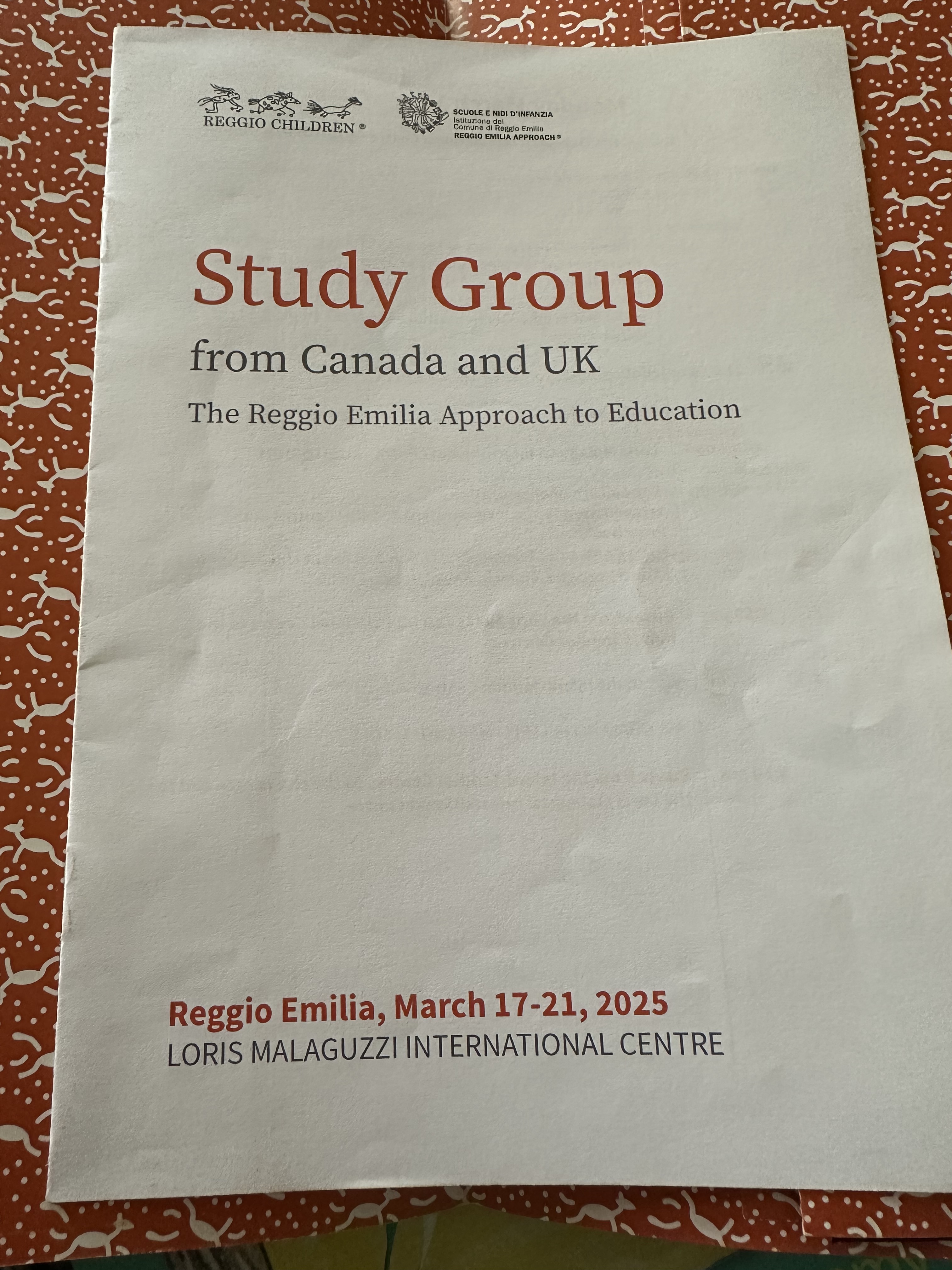
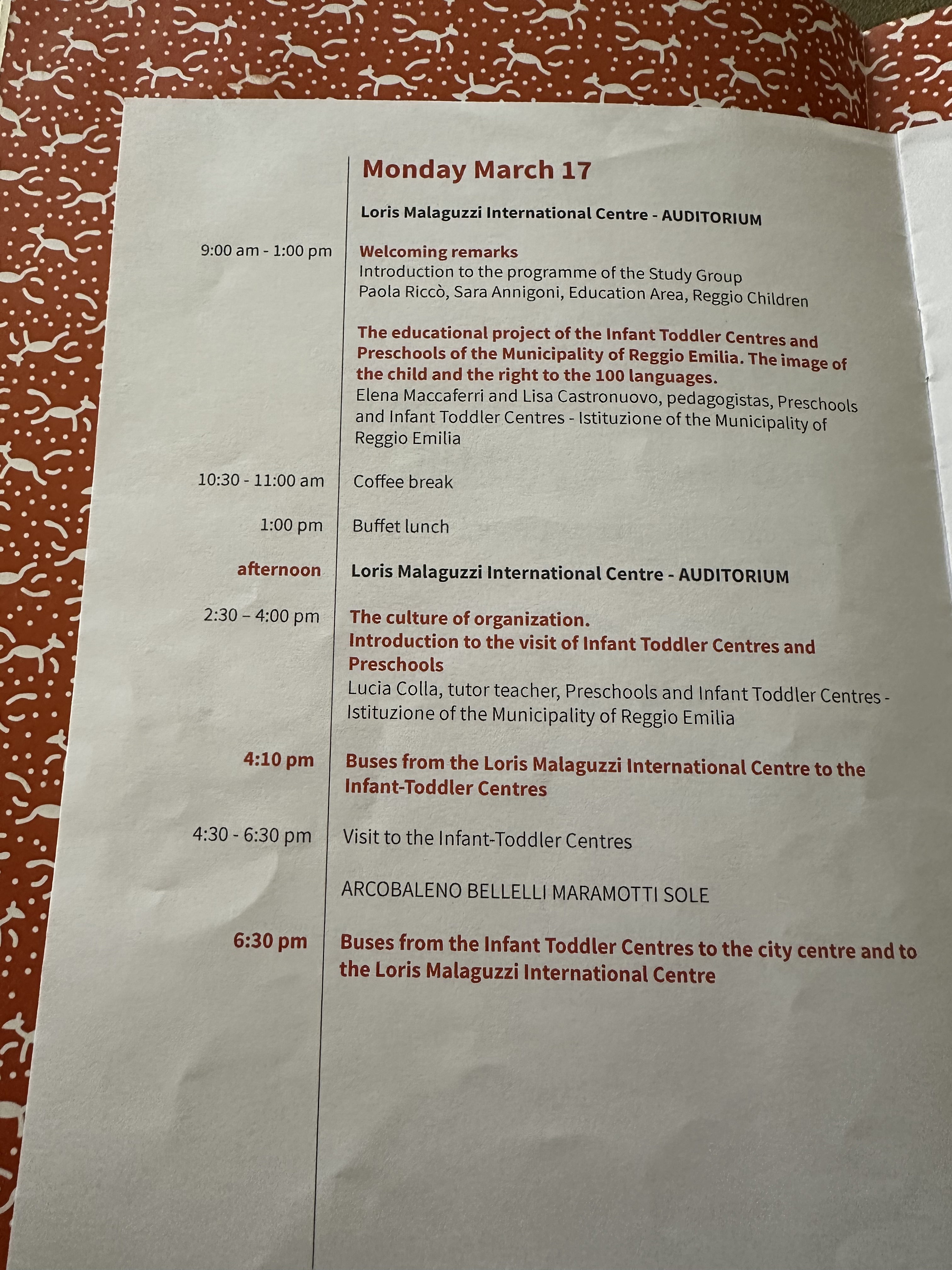
I was fortunate to be a part of a Reggio Emilia Study Group with the Vancouver Reggio Association in March 2025. I filled a notebook with words, my brain with wonderings, and my heart with joy and a sense of what’s truly possible in education. It’s an experience like no other – a tapestry of professional growth and personal growth in one full week of joyful learning, connecting and collaborating. This is the first in a series of posts as I compile my reflections on my week at the Loris Malaguzzi International Centre, the schools and the community of Reggio Emilia, Italy.
“The environment should act as an aquarium which reflects the ideas, ethics, attitudes and culture of the people who live in it.” Loris Malaguzzi

As I look back at my notes from day 1 in Reggio Emilia, I’m left with more questions than answers. This happens often when immersed in the pedagogy of Reggio Emilia. A new school year is beginning and teachers have the privilege of setting up the classroom environment. This is at the top of my mind right now, so I share these wonderings with you, in hopes that it gives you a new way to think about setting up your classroom environment as I ponder setting up mine, with a goal of participation and relationship.

Participation is the way to live in day-to-day relationship. Participation gives substance to rights. It is a way to achieve being a community.” Elena Maccaferri and Lisa Castronuovo, pedagogistas

What if we considered participation as a metaphor for relationship and learning? We participate to have fun and for joy. So how can we encourage participation in our classroom? Participation that children choose willingly and joyfully. I’m thinking of a new way to define “participation” – a definition that goes beyond doing what the teacher says. Rather, participation as a way of relationship and community.

What if we considered that the body is fundamental to learning? It’s where our sense of being in the world lies – with listening, feeling, being and becoming. How might this change our thinking as we plan the classroom space? For me, this means paying attention to the aesthetics. What senses are activated as I enter the classroom? What do children hear, smell, feel, see? What invitations are available for children as they explore the classroom? Can I invite children in to their space without having to say, “no, don’t touch, that’s for later, etc..”? Is it truly their classroom? Can they find cozy spaces with things familiar to them – such as family photos, favorite books from prior grades, stuffed animals of favorite characters, invitations to play with colorful and interesting objects? I want to fill my classroom with natural lighting or lamps, not the harsh overhead lighting. I will have larger areas for children to move and areas that are more compact, where children can make a tent or fit themselves into a smaller space. There will be a large group gathering area that is surrounded by shelves with our classroom library, so children feel like they are being hugged by favorite authors and the books we will love and learn with. I will have spaces to explore sensory materials, such as sand and water. I will have tables for children to work at, as well as spaces to stand and work or be on the floor. I don’t assign seats, as I believe that children can choose where they work best. This is something I will teach right away. Giving children control of as much as possible will help our classroom community come together and will give children a sense of agency and self-efficacy. I am continually asking myself what I can let go of controlling and hand over to the children. There are a surprising amount of things that teachers think we need to do that children are quite capable of doing! What might you give over to the children this year?

Do our classrooms honor children, who they are and who they are becoming? Do they honor the ideas, ethics, attitudes and cultures of the children and the teachers, as a community? I want to be sure my classroom is a blank page, so to speak, when children enter it. The walls are empty – with the exception of our linear calendar wall, family photos, our daily routines and a few select pieces of art that appeal to me and to children (Kandinsky, VanGogh, Picasso) or collaborative art from previous classes. The rest of the room will eventually be filled with children’s art and the tracks of their learning. I will have the fundamental space set up in a way that reflects what I know about young children and how they learn, but it will have many possibilities to be formed into a space that honors our community. The context is always evolving in response to what I observe and what the children tell me. Last year’s class loved blocks and our block area kept growing. The upcoming class might be the same, or they may need a larger art area. Time will tell. As I get to know them, we will negotiate the space to work for all of us. I want to be sure to keep my classroom clutter-free and well taken care of. I want to be sure that all materials I put out have a specific purpose and are taken care of. I model this and trust that children will take care of things. Children notice the “un-taken care of” in a space and it sends a message. When we take great care of our environments, the children will follow. Our environment is constantly transforming and evolving, as we follow the children and our community as it is being created.

Care takes care and brings care.” Bellelli School teacher

What are your wonderings as a new school year approaches? How can you help make your environment an “aquarium”, reflecting the community of learners in the space this year?

Check back soon for the next post reflecting on Reggio.
Fidelity…to what?

Fidelity.

A word that is used quite frequently in education and often connected to a particular program or curriculum. It’s one of those “nails on a chalkboard” words for me, as it’s tossed around so often without a lot of discussion or conversation regarding its meaning or what it looks like in classrooms with actual children. Let’s take a look at what fidelity means. According to Webster, fidelity is the quality or state of being faithful and accuracy in details. Because I am curious about words and what they mean, I read further. 

Fidelity came to English by way of French in the 15th century, and can ultimately be traced back to the Latin fidēlis, meaning “faithful, loyal, trustworthy.” While fidelity was originally exclusively about loyalty, it has for centuries also been used to refer to accuracy, as in “questions about the fidelity of the translation.”  (Webster’s Dictionary website)

I’m left with questions regarding teaching with fidelity. Who are we being faithful to? A curriculum or children? What details are we challenged to be accurate about? A curriculum or children?

While teachers do not take an oath to become a teacher, I’ve personally always believed in, “first, do no harm”. For me, this means questioning and reaching for understanding about the “why” behind my pedagogy and always putting the children in my care and their needs first. Combining years of research, learning, observation and knowledge and continually seeking new research and learning is what I’ve found supports and sustains me as a teacher and allows the children in our classroom to truly thrive. Paying close attention to the details within the children in our classroom and what their needs are is at the heart of my work. No two days are ever the same. Teachers must continually think and reflect on the curriculum and how children are learning. There is not a script for teaching young children. 

Perhaps we need to rethink what we are teaching with fidelity. What are we faithful to? What if we were faithful to children? What if we put them first in our planning and interactions in the classroom?  What if we used many tools and resources, all supported by research and best practices, to teach? 

What if we taught with fidelity to children?

After I hit publish on this post, WordPress connected this post with one I wrote in 2017. As I reread those words, I wanted to reshare a portion here because it connects to this current post so well.

A teacher leader in my county once helped me reflect on the idea of fidelity vs. thoughtfulness. I keep coming back to that. Perhaps we need to be implementing new structures, programs, etc. with “thoughtfulness”, rather than “fidelity”. We need to look at the programs, curriculums and expectations our district and administration give us with a critical eye. We need to deconstruct these things together with our team, be thoughtful in our implementation, question and reflect on what works and what doesn’t.  As one of my former principals always says, “the answer is in the room”.  Talk, reflect and think together – don’t just blindly follow something from outside. We need to use the abundance of resources we have as departure points to launch our own best teaching. We need to keep talking, questioning and thinking with our team and on our own.  As I’ve said before, we teach children, not curriculum, programs or standards.

Dear thinkers, learners, wonderers…teachers,

This letter is for the teachers who are thinkers. Learners. Wonderers. Observers. Reflective practitioners. Teachers, in the most real and authentic definition of that term. 

How are you doing? 

I write this because I see the struggle. I see the frustration. I see the joy being sucked out of our profession. I see the joy being sucked out of our learners.  I feel it as well. And I am concerned. Deeply concerned. I am concerned for what this means for teachers, for children, for families, for communities, for society, for the future. 

Teaching and learning go hand in hand. As teachers, we must be life-long learners. We must always question, wonder and dig deeper to truly understand how we can meet the needs of our children and understand the “why” behind what we do. If our profession is relegated to following a scripted program and spending precious planning time reading a curriculum program and not learning, questioning, talking, looking at children’s brilliant thinking and designing research-based instruction that serves the learners in our classroom at this moment, then we have failed as a system.

We have a great opportunity right now to use current research on literacy learning (and much has been, and continues to be, published by literacy researchers), to stay abreast of literacy learning and combine this with how we know children learn, based on years of research in learning and education. There are understandings that will be replaced in light of current research, but some things are still supported by research and should not be replaced. We can use all that we’ve learned in our careers as educators to bring the very best instruction to our children each day. Veteran teachers can help new teachers understand how to learn and reflect as a teacher. But there needs to be time and opportunities for conversation and true learning. Not more trainings where you are told “you don’t even have to think” or that there “is no space for questions”. We need questions and thinking now, more than ever.

Learning is at the heart of what we do. Research gives us new things to practice and new approaches and considerations to incorporate into our teaching. Science helps us understand the “why” behind what we do and helps us learn better and stronger ways to reach the children we teach. But research and science MUST be paired with deep thinking and talk about our methodology and our pedagogy and must always be connected with the learners in our classrooms and the teachers. There is no one-size-fits-all curriculum, as much as some might hope for this. Teaching is a science, AND an art. And when the agency and trust of teachers is taken away and replaced with a program to be followed verbatim, written by publishers who do not know the teachers or children, then we have big problems. When teachers are told to follow a written script with no conversation, reflection, understanding or learning as an educator trusted to teach the children, it will not be sustainable and will result in a serious lack of learning, joy for learning and longevity in the teaching profession. We need to bring back the learning to our profession. 

Teachers, I see you. I hear you. And I’m with you. Please find a way to take care of yourself and fuel your learning minds and hearts. You, and the children you teach, deserve that.

With love and hope,

Katie

Please feel free to comment, vent, share your feelings, share your hopes, share how you are sustaining yourself in this profession…anything that can help you in this magical, and so very hard, job we do. I truly do want to know how you are. We need to take care of each other. You are not alone.

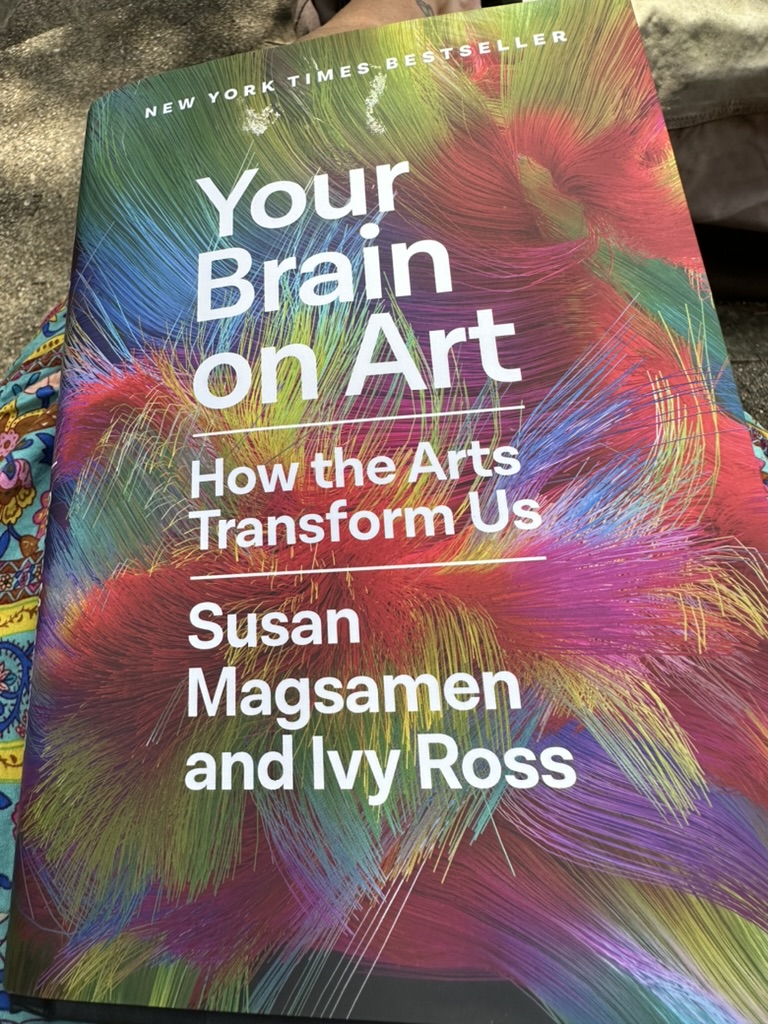
Your Brain on Art

I just finished reading Your Brain on Art: How the Arts Transform Us by Susan Magsamen and Ivy Ross. There was so much to consider while reading this book! The folks at The Studio for Playful Inquiry are doing a book study this month, and I’m excited to dive deeper into this book with others.

I was left with the understanding of how art is (or should be!) essential in our lives – for physical health, for emotional wellness, for connection, for relationship, for making sense of the world we live in, for relating to others, for self-expression, for being fully human – for pretty much everything. The importance of the arts is scientifically proven and well-researched in the field of neuroaesthetics (the scientific study of the neural bases for the contemplation and creation of a work of art). Art experiences should be available to everyone.

And school is one place we can make those art experiences available! I believe art is a right for children. And to be clear, I’m not talking about crafts – where children are instructed to follow the teacher’s lead and example to create something that looks like everyone else’s craft. I’m talking about art experiences that are open-ended, process oriented (focused on experimenting and exploring materials as one creates), playful, unique and limitless. Art is a way children can play, communicate, process experiences and feelings, use their imagination and negotiate meaning in endless ways. Our art experiences include paper, clay, loose parts, nature, markers, paint, pens, keyboards, drums, rhythm sticks, storytelling, drama, nature walks, light boxes, projectors, pencils, chalk, scissors, wire, cardboard, beads, staplers, tape and more.

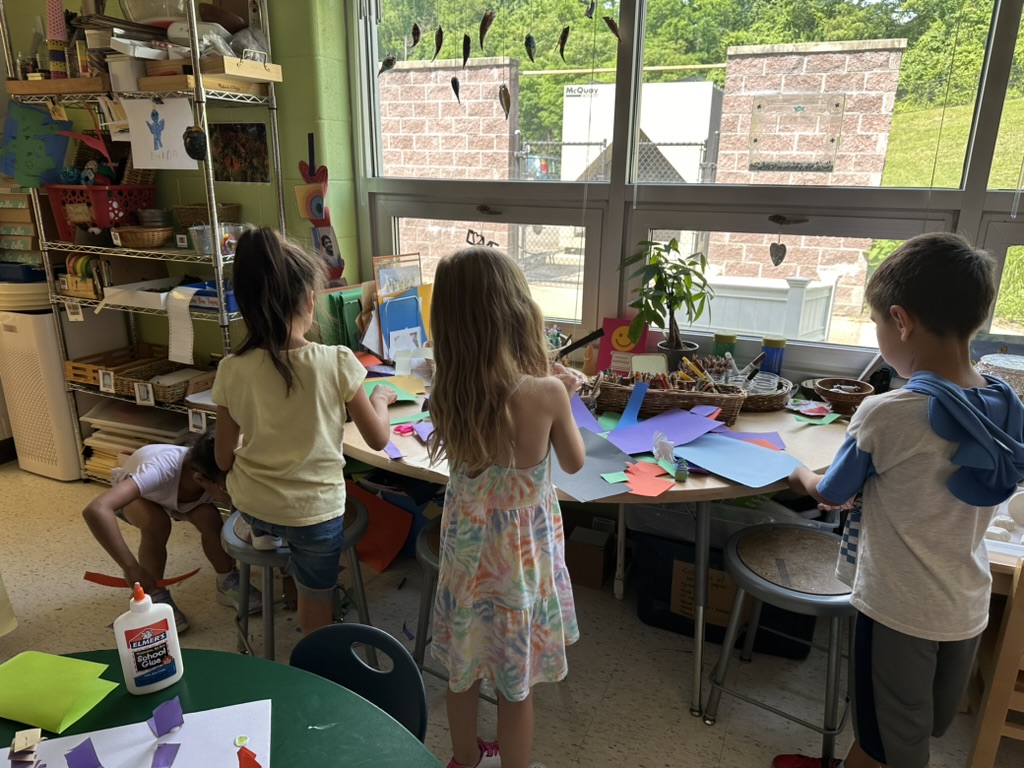
In our kindergarten classroom, the art area is a favorite space to go – and this art area often expands throughout the room – and outdoors. I provide a multitude of materials, adding more things as children request them or when I see that a new material is needed. Materials are displayed and arranged in ways that children can access them independently. Children are invited to make and create in the art center during morning arrival, our Readers and Writers Playshop time and Choice Time throughout the day.

I introduce artists and their works throughout the year. Andy Goldsworthy, Alma Thomas, Howardena Pindell, Wassily Kandinsky, Picasso, Monet, Henri Matisse, Jackson Pollock, Joan Miro, Paul Klee, Fanny Sanin, Bisa Butler, Jean-Michel Basquiat, Jeffrey Gibson, Sonia Delaunay, Alan Shields, Georgia O’Keefe and Alexander Calder were some of the artists we discovered this past year. I also spend a great deal of time talking and learning about illustrators in the books we read. I teach the children to read art with the “I see, I think, I wonder, I feel” thinking routine from Project Zero. Each time we look at art or think about art, I make the connection that they are artists, too – and they might be inspired by the artists we get to know, or each other. I want the children to see themselves as artists and to have a sense of self-efficacy surrounding art and being creative. Creativity is an essential piece of our lives and our classrooms should nurture and allow for creative experiences.

“Creativity seems to emerge from multiple experiences, coupled with a well-supported development of personal resources, including a sense of freedom to venture beyond the known.” Loris Malaguzzi

How can you provide experiences and creative opportunities and invitations for the children you teach? How can art become another language in your classroom? And what might that mean for you, as an educator? Having a “sense of freedom to venture beyond the known” makes me think of limitless possibilities for children, and for us as educators. I think art can provide that space for us.

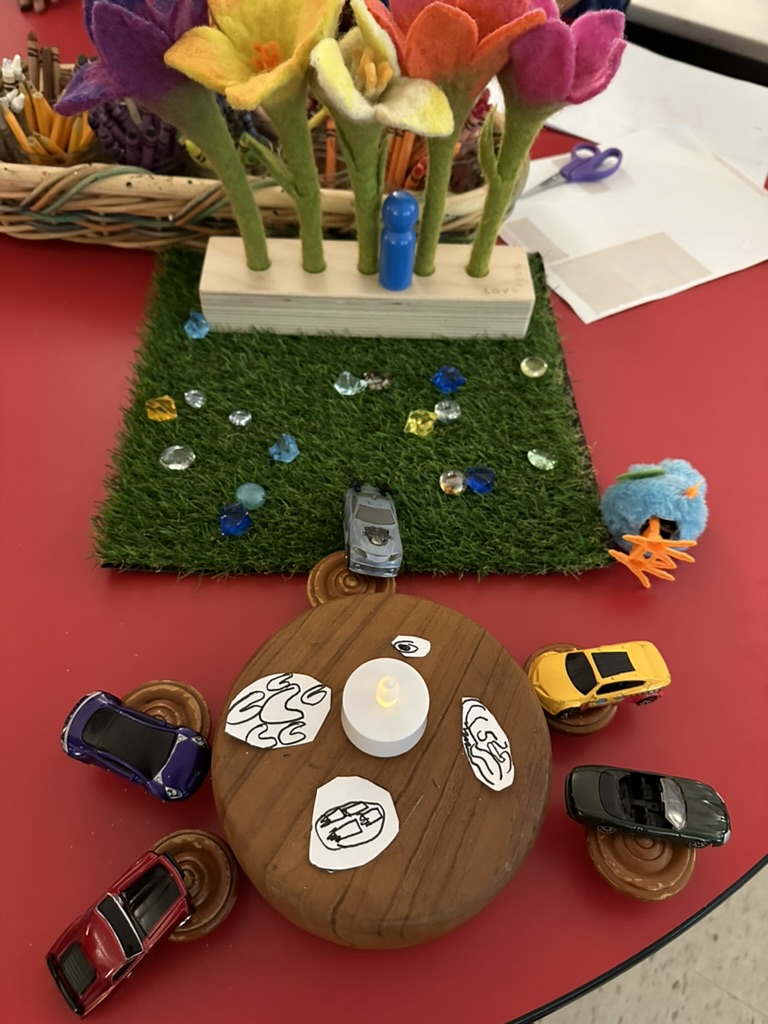
Using loose parts, paper and pen to tell a story
Making stories in the garden

What’s RIGHT with education?

Lately there has been a lot of talk about education in the news. Unfortunately, it seems to be a lot of talk about what’s wrong with education and how we can fix it. We’d like to take a minute to share our list of what’s right with education. What does it look like when things are going well? What are the signs that a school or a classroom doesn’t need to be “fixed?”

Here are a few of our thoughts.

1.  Teachers are smiling.

We’re not just talking about the “nice to meet you smiles,” but the genuine “I love my job” smiles. Those authentic smiles to kids, parents and colleagues in the hallways, classrooms and teacher’s lounges are signs that teachers love what they do. Teachers smile a lot more when they are respected, trusted, encouraged and celebrated.  A school most likely doesn’t need to be fixed when the teachers are happy.

2.  Kids are smiling.

We want our kids to love learning, love school, enjoy what they are doing, and feel valued as contributing members of the classroom community. It’s our job as teachers to make sure we’ve created the environment for this to happen.  Kids smile when they have choice in what they read and write, when they are listened to and respected, and when they are encouraged to do their best. A school most likely doesn’t need to be fixed when the kids are happy.

3.  Kids are reading and writing daily and growing as literate beings.

A school that is working well has kids engaged in daily, meaningful literacy work. Kids have ownership of their reading and writing and are given sufficient time each day to practice.  Kids aren’t doing mindless worksheets or isolated activities just to have something to turn in to the teacher.  Rather, they are being treated as real readers and writers in the world.  Their teachers are supporting them and helping them grow into proficient readers and writers.  That growth is measured in multiple ways, not just with test scores. A school most likely doesn’t need to be fixed when kids are engaged in meaningful literacy work.

4.  It is noisy.

We’re not talking about just random noise, but purposeful, meaningful literacy talk. Kids should be talking about their reading and writing daily. Literacy is social and kids (and adults) need time to talk in order to construct meaning and see the purpose that literacy has in their lives. A school most likely doesn’t need to be fixed when kids are talking about their thinking, their learning and their literate lives.

5 .  More teaching than testing is going on.

Teachers need to be interacting with and responding to the students in their classrooms.  Time is spent constructing the curriculum, choosing the read alouds, planning instruction, meeting with children to talk about their reading and writing, and assessing students based on their specific needs as learners.  A school most likely doesn’t need to be fixed when teachers are teaching and not just testing.

What else is happening in schools and classrooms that don’t need to be fixed?  We look forward to your thoughts!