Reading, Creating and Playing with Art

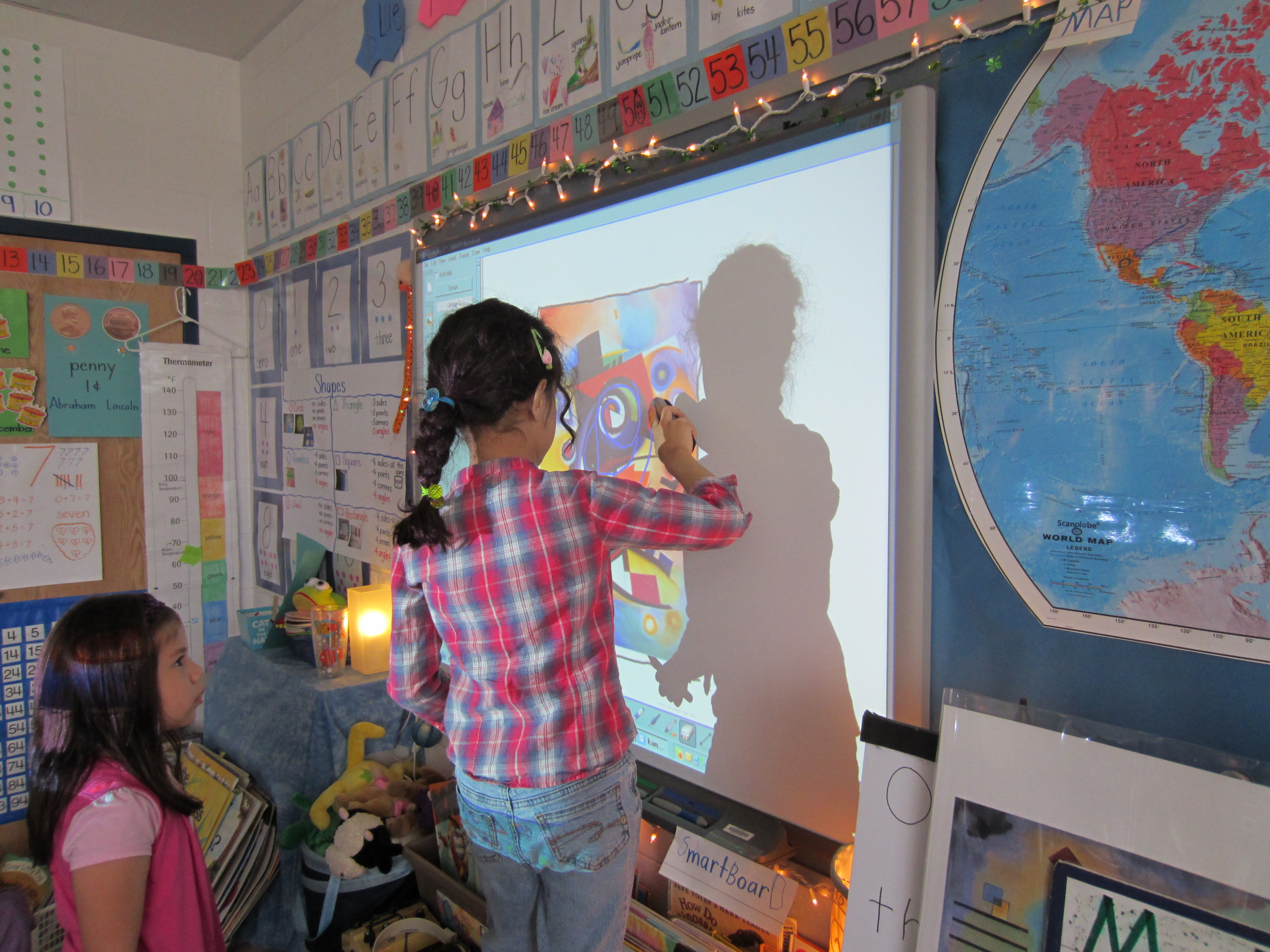
Playing with art on the SMARTboard

We have spent the last two weeks immersed in Wassily Kandinsky’s art. My kindergarteners have been talking about his art, tracing over it on transparency paper, playing with it on our SMARTboard, and creating their own “Kindergarten Kandinsky”. It’s been exciting to listen in on the conversations as the kids compared different pieces and wondered why Kandinsky made the choices he did as an artist. We have had fun playing “I spy” as the students looked closely for “the big blue circle next to the small triangle behind the three parallel lines”. They have enjoyed talking about the pictures Kandinsky made with shapes and we had quite an interesting discussion about how Kandinsky couldn’t have intentionally made an “Angry Bird” in one of his paintings since it was made 100 years ago. It started a great discussion about perspective, imagination and creating stories in our minds. I loved how they connected it to making pictures in our minds as we read!

They love looking at the big art prints on paper and the Kandinsky SMARTboard station has been a top choice during Explore time. I have a feeling the Kandinsky prints will continue to be a part of our classroom explorations and conversations for quite some time.
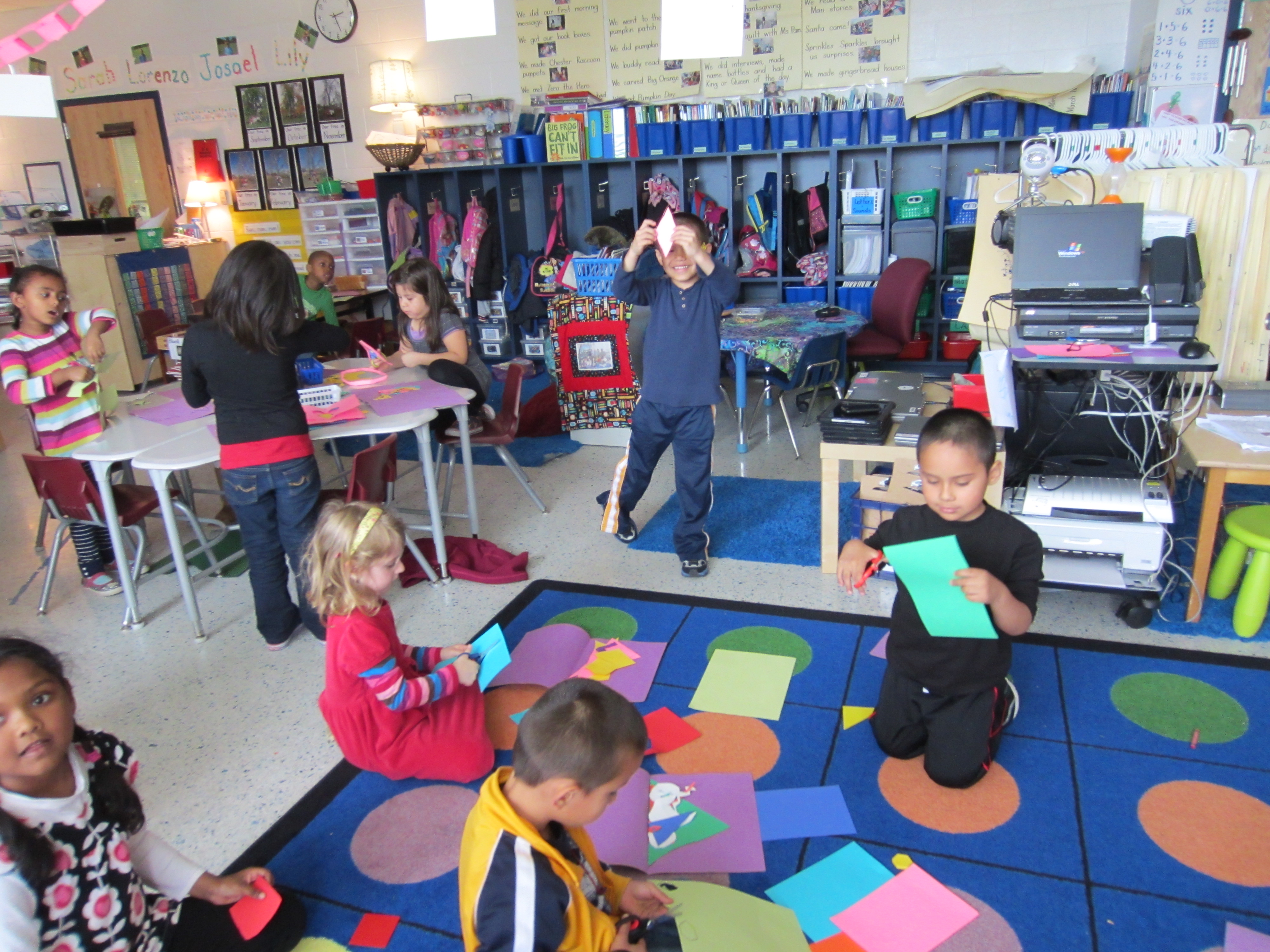
Cutting shapes for our mural

We ended our Kandinsky study by creating a class mural – our “Kindergarten Kandinsky”. The kids cut out a variety of shapes and lines and we carefully placed them on a large piece of butcher paper. We talked about where the shapes would go, how they would overlap, what the proximity to other shapes and lines would be and negotiated our artwork together. After everything was placed as the students wanted it, we glued it down. The kids were so excited to have a giant “Kandinsky” to discuss and talk about, just as we have talked about his original artwork.
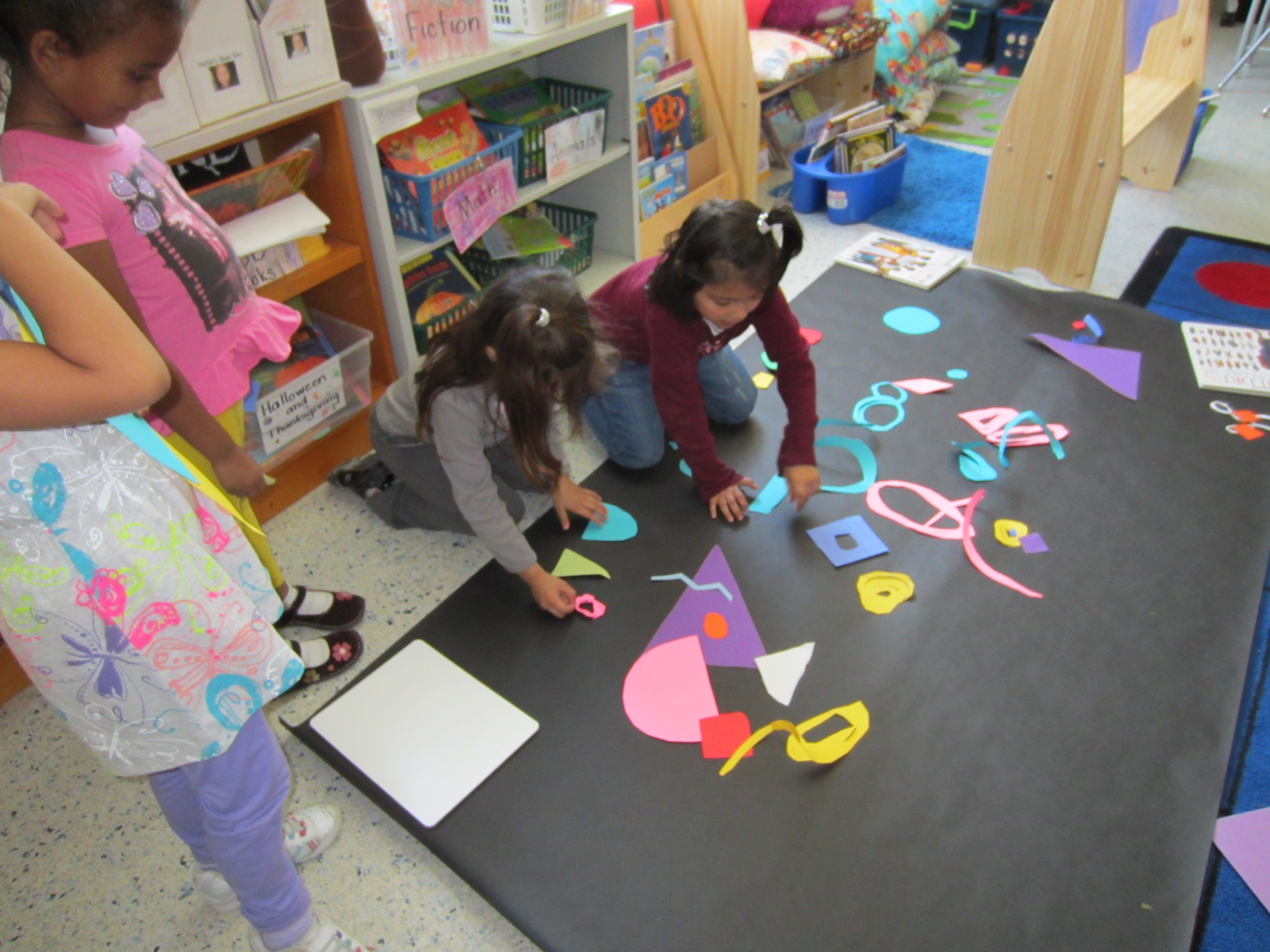
Negotiating placement of our shapes on our mural

Our finished "Kindergarten Kandinsky"

After spring break, we are starting a photography study of the alphabet through found pictures in the environment. I think the Kandinsky study has opened our eyes to reading pictures and seeing beyond the obvious. We are ready to look for letters in nature and in our environment. Stay tuned for a post in a few weeks on this new project!

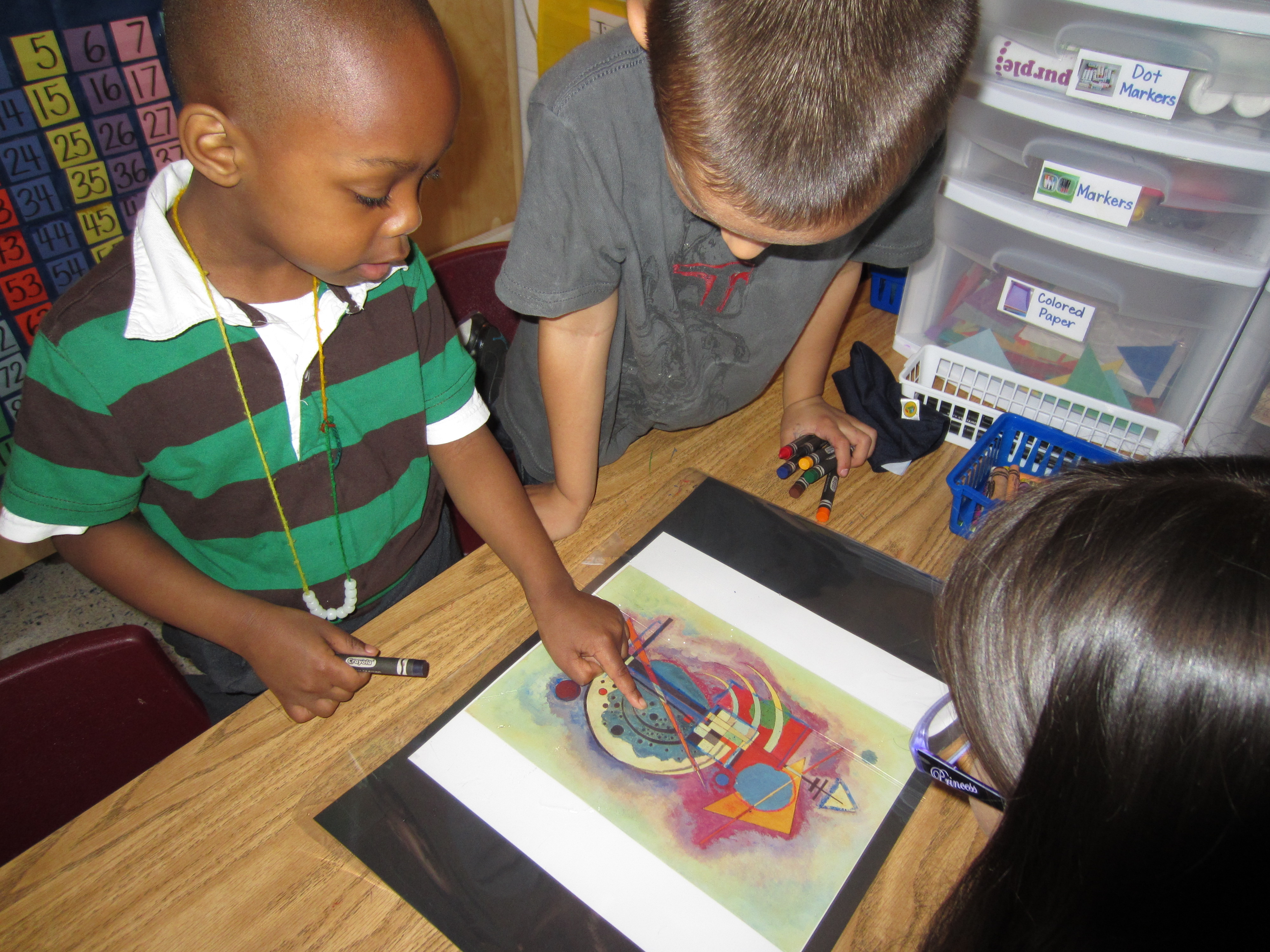
Art as a mentor text

Talking about art while tracing shapes and lines

My kindergarteners have been looking closely at the artwork of Wassily Kandinsky as we learn about geometry in math. We are using his art to explore shapes, lines, color and important vocabulary for positional words that are part of our state standards. I’m using Kandinsky’s art just like I use mentor texts throughout my literacy workshop. It’s been very exciting to see how the children are learning math while “standing on the shoulders” (as Katie Wood Ray says) of this artist. His fascinating abstract art paintings engage my students and allow us to surround our math instruction with rich talk about a variety of geometric terms, as well as art terms. For example, mathematicians use the term “rhombus”, but artists use the term “diamond” to speak about the same shape. We  are creating an ongoing shared writing text with what we are noticing.  This writing that came from their talk looked like this: I see a red square next to a blue curved line. I see a big yellow curved line overlapping a black circle. I see 5 small circles under a pink rhombus. 

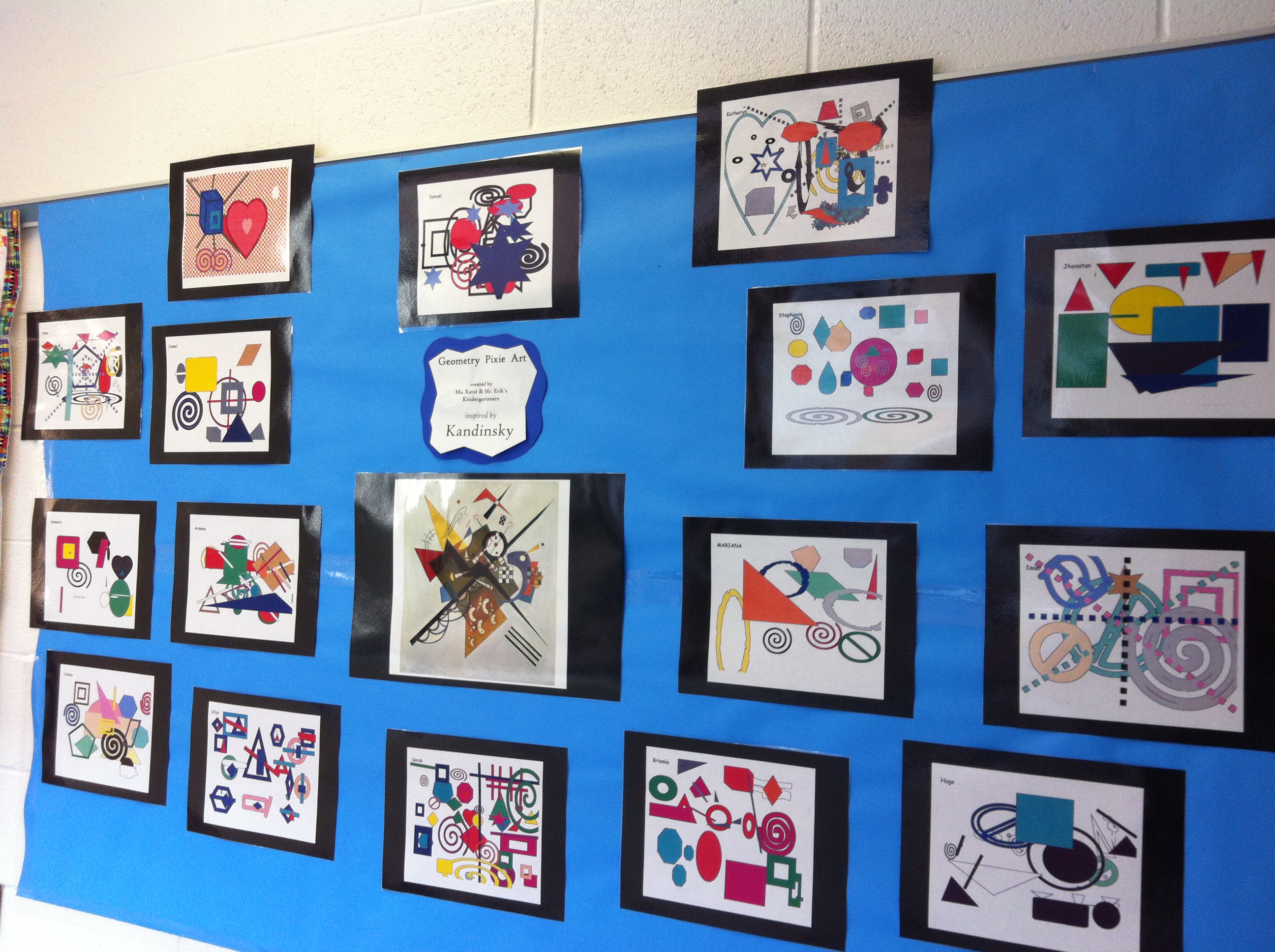
Last week we used the program Pixie in the computer lab to create our own Kandinsky inspired works of art. The students used a variety of shapes, colors and lines to create their own work of art. They talked about how they were choosing the placement of their shapes and carefully planned out their work.

This week we are creating our very own “Kindergarten Kandinsky” wall mural as we use his work as our mentor text to create a piece of art showing our knowledge of shapes, colors and lines. Stay tuned for an upcoming post about this!

I value the importance of visual texts, such as our Kandinsky pieces, as another form of literacy. Teaching children to read art, to create art from using artists as mentors, and to talk about art is a key piece of my literacy instruction.

How do you use visual art in your teaching? 

Our Pixie Kandinsky Inspired Art

Please keep ART

In the past few weeks I’ve seen a poster appear several times on Facebook that says “Earth without art is just eh.”  I love that!  I’ve also heard and read a lot about teachers saying that the pressures of the testing craze have caused them to cut back on art time (whether forced or by choice.)

But there is one school I know of that won’t buy into that (hopefully there are many more.)I spent my last six years of teaching at Baileys Elementary School in Fairfax County Virginia and that’s where I presently do my volunteering.  Teachers there believe that art is fundamental to a child’s education and they refuse to give it up.

Baileys has a partnership with the Kennedy Center called Changing Education Through the Arts where teachers take courses on arts integration and have the option of working with an arts coach. You can’t walk through the hallways without noticing how art plays a role in all subject areas.

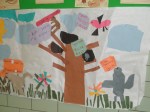
Kinder teachers use Horn and Giacobbe’s book, Talking, Drawing, Writing to help their students learn how to expand their drawings to add more details to their stories. And the many interactive writing murals include art made by the kids.

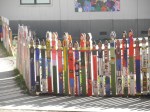
Many teachers study illustrations in picture books and discuss how the art adds to the mood/tone of the text.  I’m fairly sure that every child could name a famous artist or two because they study so many each year and make visits to local art galleries.  And check this picture out — even the picket fence around the butterfly garden is art!

Upper grade teachers have students write poems about works of art.

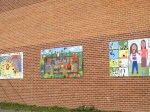
And take a look at the outside of the building.  There are over thirty large murals that decorate the outside of the building, done in partnership with local artists over the past several years.


I hope you are fighting to keep ART in your curriculum. (Click on a pix to see the gallery larger.)


Learning about Text Structures

In the fifth grade class I visit once a week, the students are busy learning with the teacher about different text structures.  The teacher began with compare/contrast articles.  Together they found signal words that would hint at this type of structure (see chart.) On other days they did some articles on the SmartBoard that were cause and effect structures.  On the day I joined the class, we worked together as a whole class on the famous San Francisco earthquake of 1906. The article was projected large for all to see. Once the students determined that it was a cause/effect article (and not a compare/contrast one), each student was given a paper with three causes listed.  As we reread the article students were to fill in the effects for each cause.  (Earthquakes caused buildings to collapse, people to be injured or killed, and a fire started.  The fire, that continued on for several days, caused more damage.)  It was interesting for the students to note that the fire which was listed as an effect of the earthquake, later became a cause.  They also noted that one cause could have one effect or many effects.

This week the class will be moving on to the  ‘sequence’ and ‘timeline’ text structures. The professional book from Scholastic called Guided Reading in Grades 3-6 by Mary Schulman offers many one page articles (that you are allowed to copy) for use in small group practice sessions.  I noticed a few that would work well as timeline structures on topics that would interest these fifth graders —  “Inventing a Game: How Basketball was Born” and “The History of Gum.”

Although the teacher and I do the introduction lessons with the whole class, further small group sessions are offered to students who need more practice. All the students, though, have been invited ‘on a search’ (of their Non-fiction books,  their on-line research, or in any of the magazines in the classroom) to identify and share articles they are discovering which represent the various text structures.

Although this work is certainly good for test preparation, we need to be sure that our emphasis in on comprehension.  Why is it important for kids to recognize a particular text structure?  The reason is that knowing how an article is organized can support your understanding of that article.  It’s easier to absorb the information once you’ve implied the text structure. Meaning making and understanding, after all, is the end goal.

One of my main beliefs about teaching reading is that the lessons we teach students should connect to real world reading.  That’s why I happily noted that Parade Magazine (part of Sunday’s Washington Post newspaper 3/11/12) had articles that fit all three structures. “The United States of Pizza” was a great timeline article.  “Happy 100th, Girl Scouts” compared the early troops with those today – the different badges girls could earn, the kinds and amounts of cookies sold, and so on.  And lastly, “Thyroid Cancer: Why is it on the Rise?” explained the causes of the increase in this type of cancer.  Sharing this with the students reinforced the value of their learning about text structures.

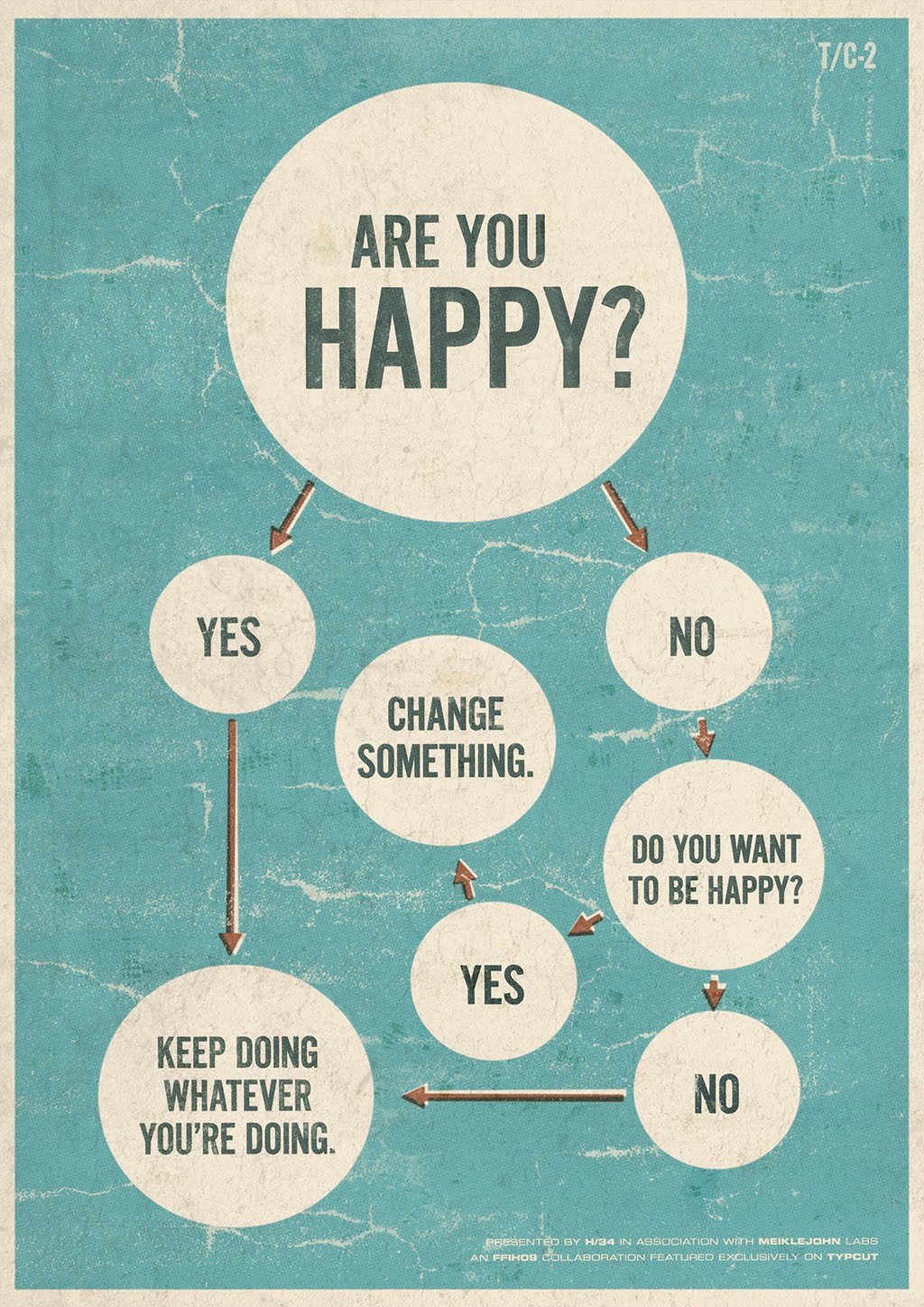
What makes you happy?

I enjoyed hearing Pat share about The Happiness Project over dinner last week, and just started reading it last night on my iPad. It got me thinking about what makes me happy in teaching. I’ve had some difficult years where it was very hard to focus on what made me happy. Years where the days that ended in tears far outweighed the days that ended with a smile. Years where I really questioned whether I could stay in this career or not. This year, in my first year teaching kindergarten, I am happier than I’ve ever been in my teaching career. On my run this evening I reflected on why – what is it that has me being so happy as a teacher right now?

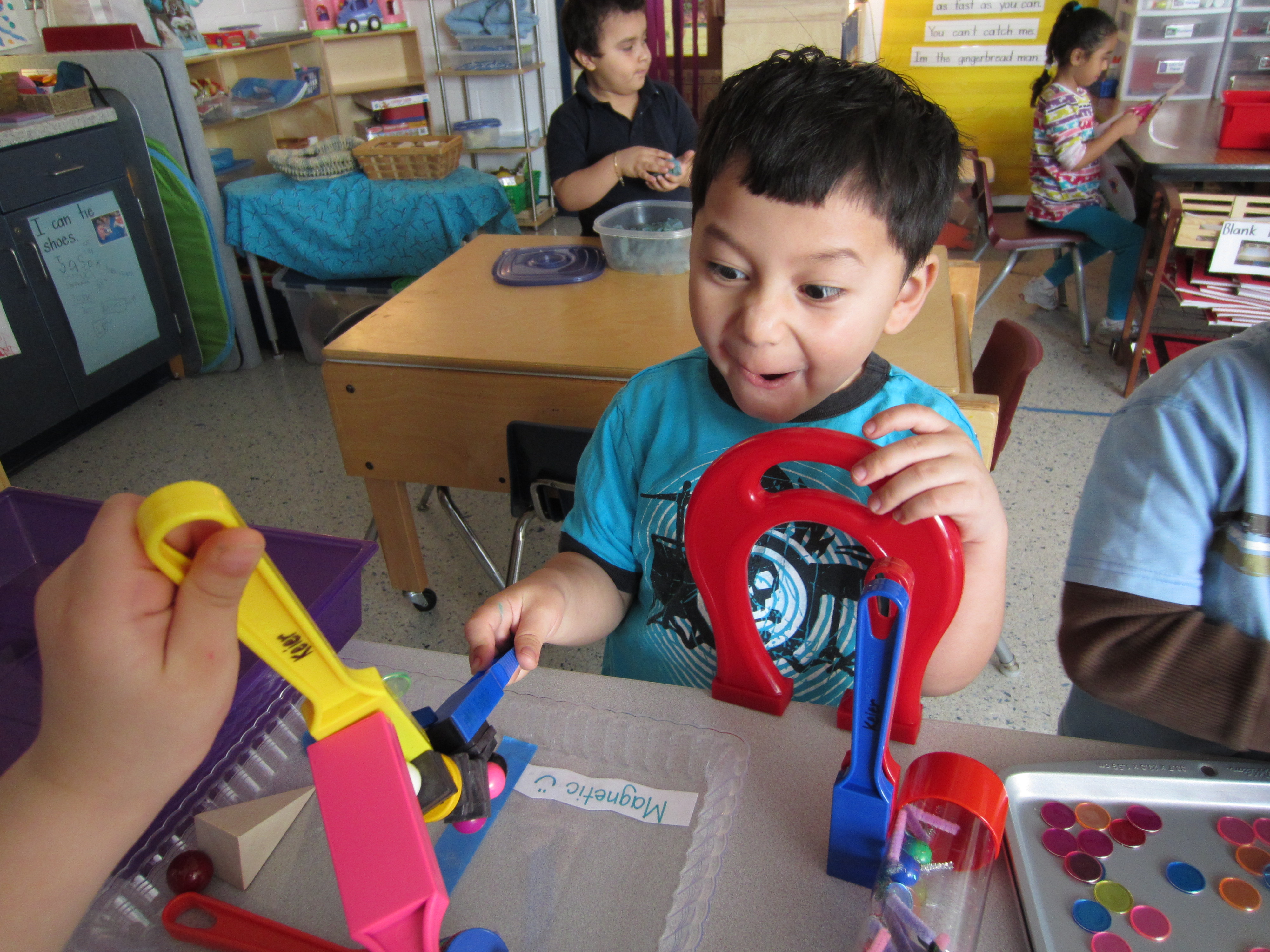
1. The kids. I absolutely love my students. They are funny, sweet, caring, energetic, loud, wiggly, creative, bouncy, squirmy, fabulous, thoughtful, inquisitive, wonderful little people. They love being at school and make our classroom such a happy place for us all to be. They force me to be in the present – in the “right now” – because that’s where their world exists. They celebrate the littlest things and help me see the beauty and magic in the 1/2 inch that our plant grows overnight, the magnets in our science center, the first words they put in their books and that first book they read all by themselves. Every day has little celebrations woven throughout. Even when things get tough (and yes they do get tough, as in any classroom) we work through the problems and end up back in our happy place. They seem to get, in their 5 and 6 year old wisdom, that life is short – fix our problems quickly so we can hug and go back to play. I learn so much from my students every day.

2. My team. I work with 2 dedicated, passionate, fun teachers and 3 amazing instructional assistants, as well as a wonderful ESOL team. I feel supported, encouraged and connected unlike any year before in my teaching career. It makes all the difference when you have team members you can share with, reflect with and create with. I never realized the power of collaboration until this year. I learn from these wise educators every day.

3. My school. I feel respected as an educator and trusted to make decisions in my classroom. This is huge. I am VERY aware of how little this happens in other schools around the country. Being trusted as a knowledgeable professional in your classroom and school is empowering and motivating and something ALL teachers should have. And it can make all the difference in how happy you are at work.

4. The play. Our day is full of play. Pure play, playful learning, playful discoveries, outdoor play, dramatic play, literacy/math/science play. Purposeful play that supports children in learning and growing in a developmentally appropriate way. How can you not be happy when your day is full of play? I work hard every day. I go home utterly exhausted. But I like to think of it as playing all day, because it rarely occurs as “work”.

5. The books. Reading books to kindergarteners is pure joy. I love sharing my passion for books with my young learners. They get so excited when I introduce a new book, they love reading books by themselves and with a friend, and they love hearing books read aloud. I get to plan great books to read for our curriculum and share them with my kids. It’s really one of the best parts of my job. Helping to cultivate a love of reading and writing through complete immersion in the wonderful children’s books that are out there is a tough job. But someone has to do it. 😉 I’m so happy it gets to be me.

What makes you happy? 

How do you stay happy in the face of the many challenges facing education and educators currently?

How Happy Are YOU?

Well, it’s not the best book I ever read, but I gave it a try when my book group recommended it.   And, among other reflections, I started thinking some things that relate to teaching and teachers, though it is NOT a professional book for teachers.

Gretchen Rubin writes about her 12 month project to feel happier in her life.  Although she felt she was happy enough with her job, husband, children and so on, she wanted to reach her full ‘happiness potential.’ It’s a bit of a twist on the typical self-help book.  The amount of research she has done was noticeable and interesting.

Each month was dedicated to a different topic — from getting rid of the clutter in her life to being more generous and kind to others to cutting down on her nagging and negative comments.  Many of the ideas were things I could relate to (and certainly use some improvement on), but others were not my cup of tea (I have no desire to write a novel in a month or start a collection.)  But the author states that each person’s happiness project would be different.

Her parenting chapters hit home for me as a teacher.  She worked on framing her statements in a more positive way which motivated her children to cooperate more and make better behavioral choices. Many of the scenarios were easily transferable to the classroom community.

But the real reason I’m mentioning this book is because it made me think of 3 types of teachers that I know:

1.) I have many teacher friends who are nearing retirement.  They are hesitant about leaving teaching because they fear not knowing what to do with their time. “I have no hobbies.” “I’m afraid I’d be bored.” “What would I do all day?”  This book could help.

2.) The other type of teacher is the one in the midst of her teaching career who gives so much time and effort to the job, there’s not much left for herself.  I know this feeling — of worrying so much about my students that it’s hard to let go and ‘have a life.’  These teachers have a hard time leaving the job at the schoolroom door.  I wish this book had been around when I was in that position and perhaps I would have been able to balance my job, home, and other parts of my life better.

3.)  The third type of teacher is the one that many of us have come in contact with at some point in our careers.  She/He is the complainer — “the students can’t do this… they can’t do that… they never…their parents don’t….” This book would definitely offer them some ideas of working on their negativity.

I’m interested in anyone’s opinion of this book or others you’d suggest.  I’m always looking for a good book recommendation.

Words We Know

A few weeks ago I wrote about using readers’ statements as a way to focus your teaching, as well as give kids some language to help them as they are learning a strategy or behavior. For the past week and a half, I’ve been using the readers’ statement, “Readers look for words they know.” I start all of our shared reading lessons with this statement, and refer to it throughout my guided reading groups and conferences with kids. We use highlighting tape  on our charts and in big books to highlight words we know from our word wall. I want my kids to start noticing all the words they know in the books, charts and online texts we read. I want these words to be “anchors” in the text as they solidify 1:1 matching and begin to self-monitor. We’ve added this statement to other statements we have focused on like, “Readers look at the picture to help them read the words.” and “Readers think about the book.”

I am really amazed at how all my readers,  even my most emergent readers, are taking on this readers’  statement. My kids are finding words they know, thinking about the text, and having a reading explosion in our classroom! Today during our literacy stations I saw a group of kids use Wikki Stix to underline known words on a chart and then go back and read the entire chart – helping each other make sure their finger was pointing to the word they were saying. I saw another group of kids reading a book about frogs and talking about the words they knew in the book. I overheard one child say, “I know some of the words, and the pictures can help me read the rest.”

It’s like the floodgates have been opened. Our readers’ statement explicitly told the kids that readers look for words they know. My students all see themselves as readers, so they are doing what readers do – looking for words they know. The excitement is contagious – there are words we know in every book and chart we read! Drawing their attention to the seemingly simple fact that readers look for words they know has raised the level of engagement during our reading time and has all my students reading and hungry for more words to know.  It’s an exciting time in kindergarten!