
Reading and interacting with art on the SMARTboard - finding and tracing shapes and lines on Kandinsky's work
Reading and interacting with art on the SMARTboard - finding and tracing shapes and lines on Kandinsky's work
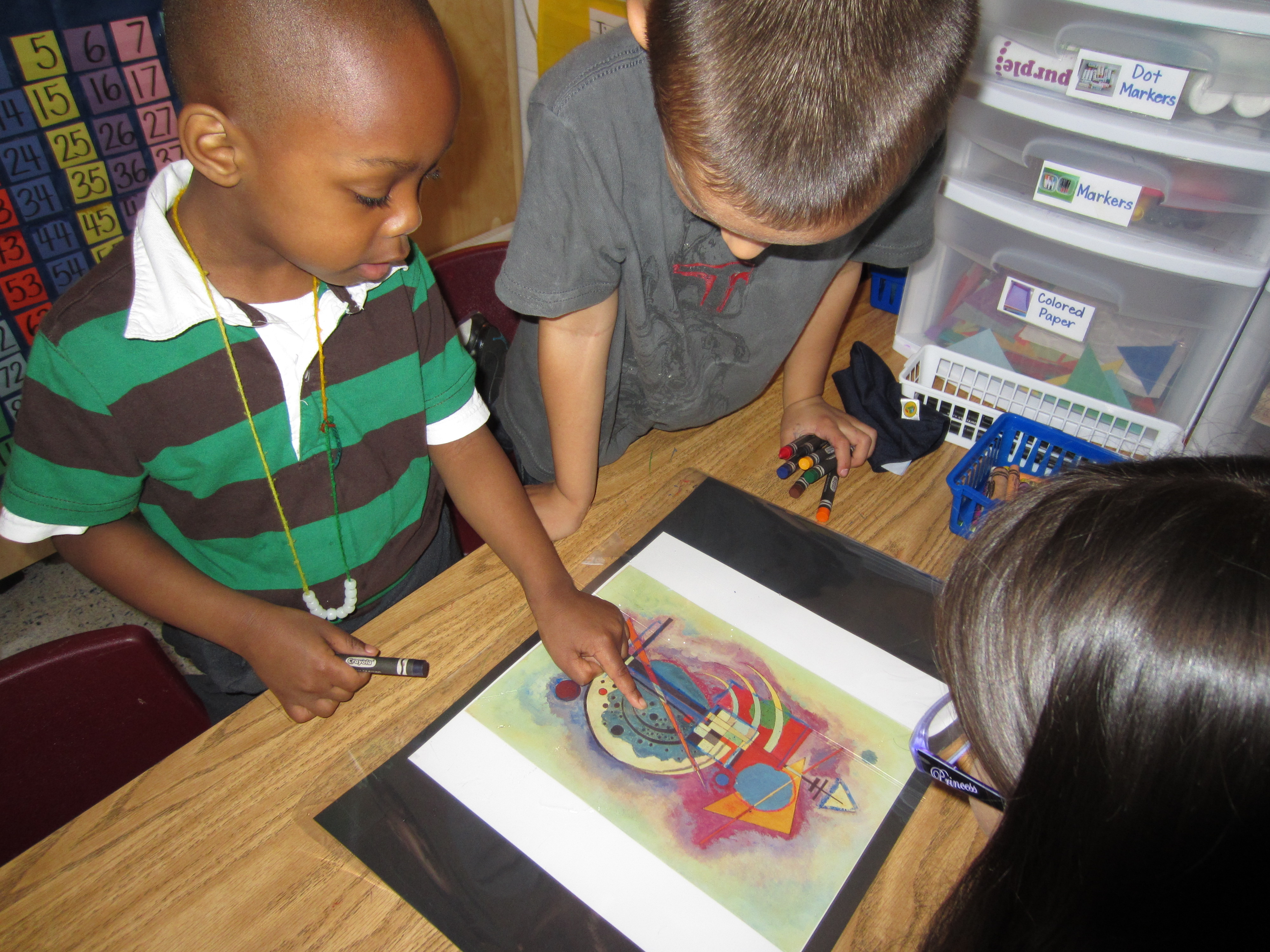
Talking about art while tracing shapes and lines
My kindergarteners have been looking closely at the artwork of Wassily Kandinsky as we learn about geometry in math. We are using his art to explore shapes, lines, color and important vocabulary for positional words that are part of our state standards. I’m using Kandinsky’s art just like I use mentor texts throughout my literacy workshop. It’s been very exciting to see how the children are learning math while “standing on the shoulders” (as Katie Wood Ray says) of this artist. His fascinating abstract art paintings engage my students and allow us to surround our math instruction with rich talk about a variety of geometric terms, as well as art terms. For example, mathematicians use the term “rhombus”, but artists use the term “diamond” to speak about the same shape. We are creating an ongoing shared writing text with what we are noticing. This writing that came from their talk looked like this: I see a red square next to a blue curved line. I see a big yellow curved line overlapping a black circle. I see 5 small circles under a pink rhombus.
Last week we used the program Pixie in the computer lab to create our own Kandinsky inspired works of art. The students used a variety of shapes, colors and lines to create their own work of art. They talked about how they were choosing the placement of their shapes and carefully planned out their work.
This week we are creating our very own “Kindergarten Kandinsky” wall mural as we use his work as our mentor text to create a piece of art showing our knowledge of shapes, colors and lines. Stay tuned for an upcoming post about this!
I value the importance of visual texts, such as our Kandinsky pieces, as another form of literacy. Teaching children to read art, to create art from using artists as mentors, and to talk about art is a key piece of my literacy instruction.
How do you use visual art in your teaching?
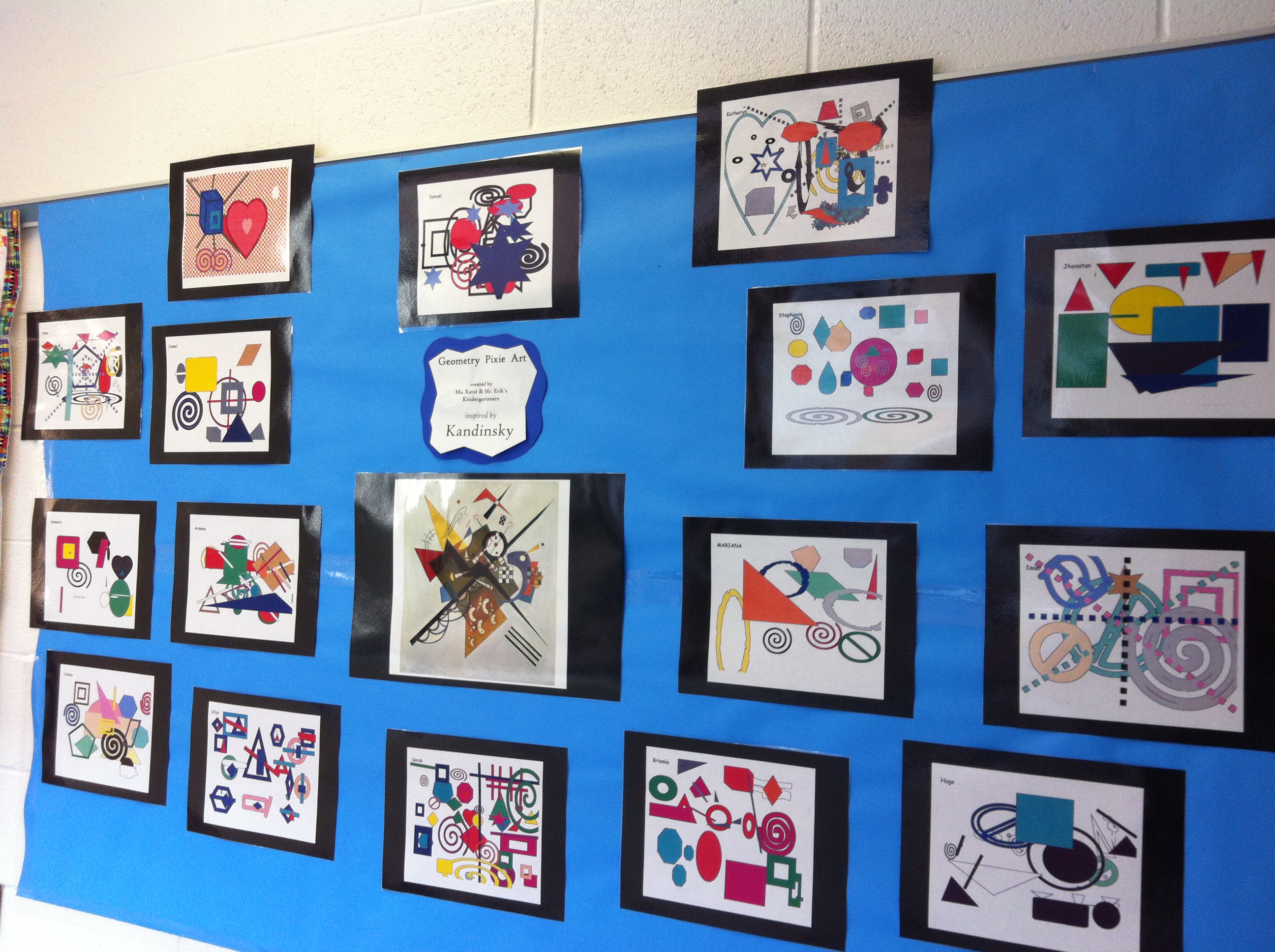
Our Pixie Kandinsky Inspired Art
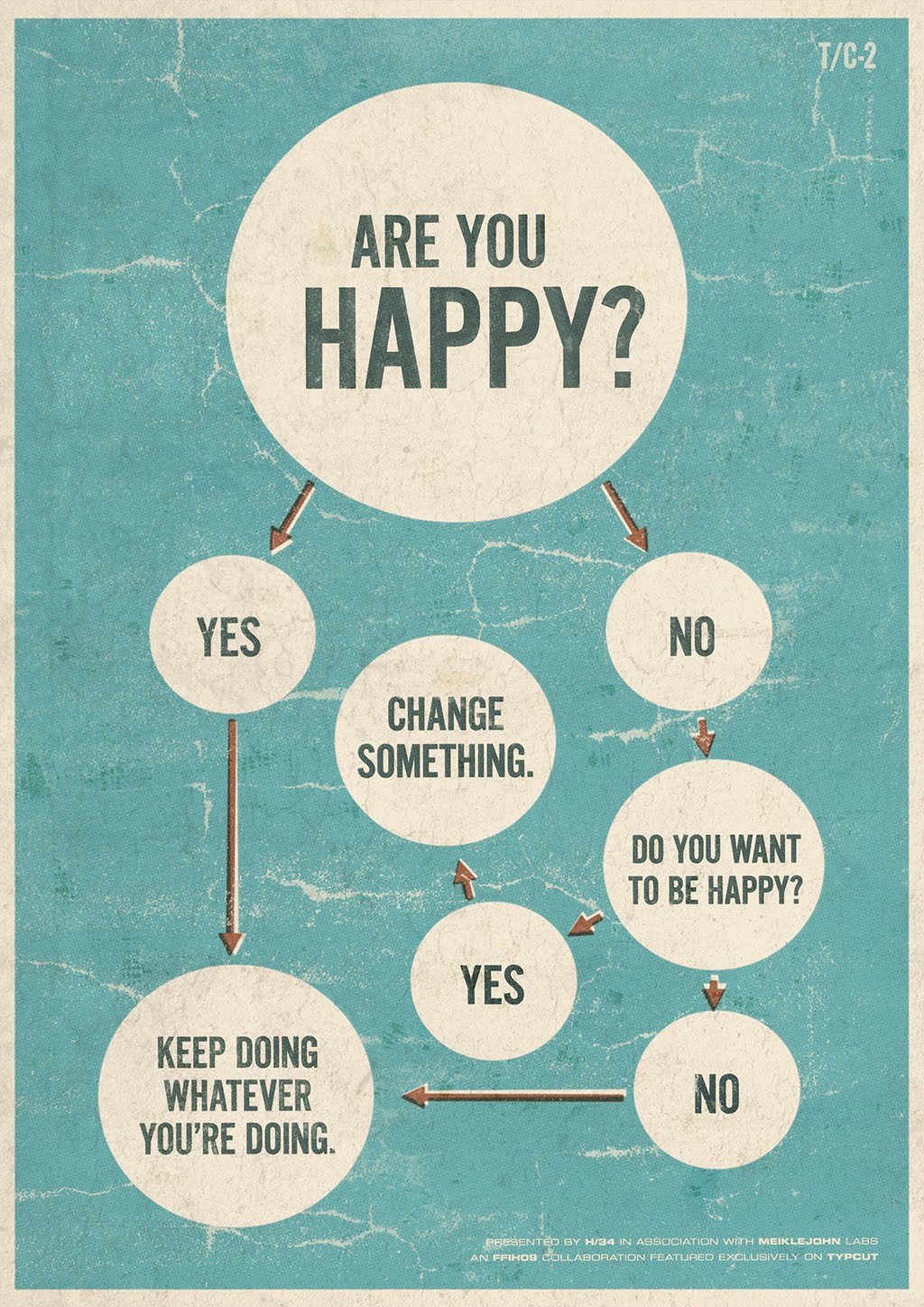
 I enjoyed hearing Pat share about The Happiness Project over dinner last week, and just started reading it last night on my iPad. It got me thinking about what makes me happy in teaching. I’ve had some difficult years where it was very hard to focus on what made me happy. Years where the days that ended in tears far outweighed the days that ended with a smile. Years where I really questioned whether I could stay in this career or not. This year, in my first year teaching kindergarten, I am happier than I’ve ever been in my teaching career. On my run this evening I reflected on why – what is it that has me being so happy as a teacher right now?
1. The kids. I absolutely love my students. They are funny, sweet, caring, energetic, loud, wiggly, creative, bouncy, squirmy, fabulous, thoughtful, inquisitive, wonderful little people. They love being at school and make our classroom such a happy place for us all to be. They force me to be in the present – in the “right now” – because that’s where their world exists. They celebrate the littlest things and help me see the beauty and magic in the 1/2 inch that our plant grows overnight, the magnets in our science center, the first words they put in their books and that first book they read all by themselves. Every day has little celebrations woven throughout. Even when things get tough (and yes they do get tough, as in any classroom) we work through the problems and end up back in our happy place. They seem to get, in their 5 and 6 year old wisdom, that life is short – fix our problems quickly so we can hug and go back to play. I learn so much from my students every day.
2. My team. I work with 2 dedicated, passionate, fun teachers and 3 amazing instructional assistants, as well as a wonderful ESOL team. I feel supported, encouraged and connected unlike any year before in my teaching career. It makes all the difference when you have team members you can share with, reflect with and create with. I never realized the power of collaboration until this year. I learn from these wise educators every day.
3. My school. I feel respected as an educator and trusted to make decisions in my classroom. This is huge. I am VERY aware of how little this happens in other schools around the country. Being trusted as a knowledgeable professional in your classroom and school is empowering and motivating and something ALL teachers should have. And it can make all the difference in how happy you are at work.
4. The play. Our day is full of play. Pure play, playful learning, playful discoveries, outdoor play, dramatic play, literacy/math/science play. Purposeful play that supports children in learning and growing in a developmentally appropriate way. How can you not be happy when your day is full of play? I work hard every day. I go home utterly exhausted. But I like to think of it as playing all day, because it rarely occurs as “work”.
5. The books. Reading books to kindergarteners is pure joy. I love sharing my passion for books with my young learners. They get so excited when I introduce a new book, they love reading books by themselves and with a friend, and they love hearing books read aloud. I get to plan great books to read for our curriculum and share them with my kids. It’s really one of the best parts of my job. Helping to cultivate a love of reading and writing through complete immersion in the wonderful children’s books that are out there is a tough job. But someone has to do it. 😉 I’m so happy it gets to be me.
What makes you happy?
How do you stay happy in the face of the many challenges facing education and educators currently?
 A few weeks ago I wrote about using readers’ statements as a way to focus your teaching, as well as give kids some language to help them as they are learning a strategy or behavior. For the past week and a half, I’ve been using the readers’ statement, “Readers look for words they know.” I start all of our shared reading lessons with this statement, and refer to it throughout my guided reading groups and conferences with kids. We use highlighting tape on our charts and in big books to highlight words we know from our word wall. I want my kids to start noticing all the words they know in the books, charts and online texts we read. I want these words to be “anchors” in the text as they solidify 1:1 matching and begin to self-monitor. We’ve added this statement to other statements we have focused on like, “Readers look at the picture to help them read the words.” and “Readers think about the book.”
I am really amazed at how all my readers, even my most emergent readers, are taking on this readers’ statement. My kids are finding words they know, thinking about the text, and having a reading explosion in our classroom! Today during our literacy stations I saw a group of kids use Wikki Stix to underline known words on a chart and then go back and read the entire chart – helping each other make sure their finger was pointing to the word they were saying. I saw another group of kids reading a book about frogs and talking about the words they knew in the book. I overheard one child say, “I know some of the words, and the pictures can help me read the rest.”
It’s like the floodgates have been opened. Our readers’ statement explicitly told the kids that readers look for words they know. My students all see themselves as readers, so they are doing what readers do – looking for words they know. The excitement is contagious – there are words we know in every book and chart we read! Drawing their attention to the seemingly simple fact that readers look for words they know has raised the level of engagement during our reading time and has all my students reading and hungry for more words to know. It’s an exciting time in kindergarten!
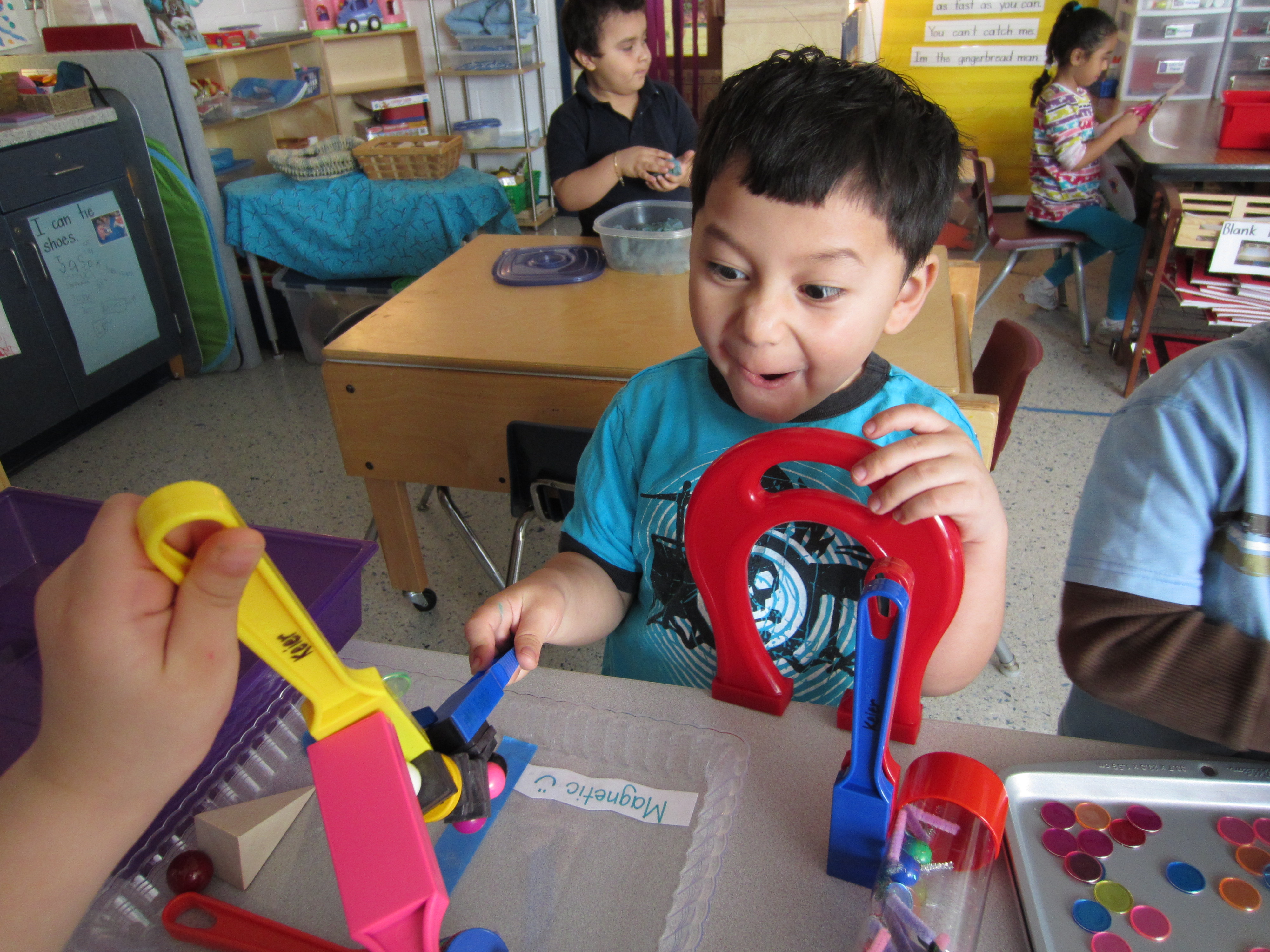
Playing with magnets
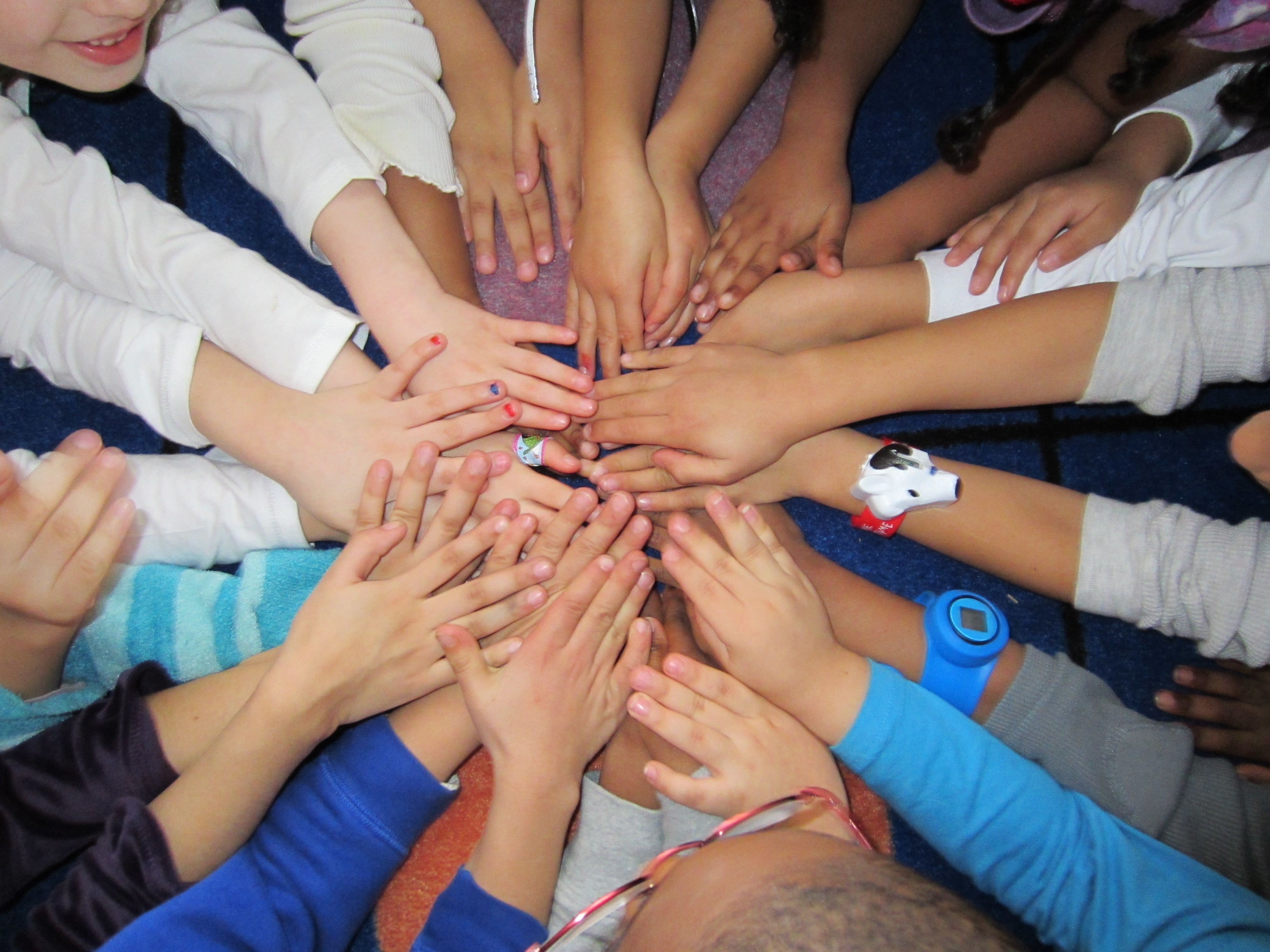
I can think of many words to describe this priceless expression. Whatever you choose to call it, my hope is that all children can experience this feeling in school.
 I was talking with a friend the other day who doesn’t use any type of social media. She doesn’t blog, tweet, Facebook or use Pinterest. I asked her why and her comment was, “all of those things are just a way for people to say “look at me, look how great I am” and it’s all just way too narcissistic.” Wow. I had never thought about it this way. This conversation really got me thinking about why I blog, tweet, post status updates and pictures on Facebook and fill up my boards on Pinterest. It comes down to 3 reasons: Inspiration, Collaboration and Contribution.
I am so inspired from reading about other people’s experiences. Tweeting at @iseetrails, I am connected to my trail running community. Reading their tweets about personal bests, challenges, and seeing the workouts they post motivates me. Waking up at 4:45 and reading tweets about people heading out for their morning run helps me put on the running shoes instead of going back to bed. I don’t consider that they are bragging about running 10 miles before 5am, but rather they are sharing a piece of them with me – helping me see what’s possible in myself. Tweeting at @bluskyz, I am connected to my teaching community. Reading these tweets every morning always gives me something to think about, a new idea to try or a great resource to check out. I don’t see a picture of an amazing class creating ramps and pulleys as their teacher saying, “look how great I am”, but rather as inspiration to find out where to get those pulleys so my kids can have an awesome experience, too. I recently was interviewed for a running blog and loved sharing my thoughts on running. I hope to contribute to the running community and perhaps inspire others – just like many of my running friends inspire me. The education blogs I read weekly inspire me with thoughts about my math teaching, reviews and thoughts on books and stories from the classroom. I blog here to share my thoughts, to reflect on my teaching and perhaps inspire others as well.
Teaching is social, just like learning is. At least for me. I need to talk about what I’m doing, get ideas from others and have a place to go when I am staring at a blank planning sheet wondering what I’m going to do next week. Collaboration is a critical piece in a profession that can be somewhat isolated. In my 20 years of teaching, I’ve had times where I’ve just felt lost. Whether it’s thinking about how to reach that reader who is struggling, or how to create a meaningful learning experience around squirrels, or how to push our talk in small group math instruction or what good book to read next – I’ve needed others to help me make sure my teaching is the best it can be. In addition to the wonderful colleagues I work with and talk with, Blogs, Twitter, Facebook and Pinterest do that for me. I feel like I have a global network of educators who push my thinking, challenge me, share wonderful ideas and help me when I am stuck. And I want to help others as well. I don’t want to always be the one taking ideas and suggestions – I want to give that back. I know how grateful I’ve been when I’ve read that “just-right” blog post that helps me have an “a-ha” moment over a struggling mathematician, or how excited I get when I see an idea on Pinterest that I can use or adapt and change to make it perfect for my students.
I don’t blog, tweet or pin for people to say “wow, look at her”. That’s the LAST thing I want people to say. It’s really all about contribution. I want to contribute to teachers, parents, students – and to the world. I want to make a difference and help someone get “unstuck”, just like so many others have helped me. I want to push people’s thinking, just like so many others push my thinking. I want to give back to the community of educators, just like so many have given to me. It’s through all of these contributions that I am the teacher I am today. My class has a kindergarten cheer we do (taken from a mix of ideas I’ve seen other teachers do – our movement comes from an adaptation of a handshake our dance teacher used to do – and our saying from a comment I read on a classroom wall years ago). We say “together, we can do ANYTHING!” It inspires us, encourages collaboration and helps us see that we all have something to contribute. Teachers need each other more now than perhaps any other time. How lucky we are to have so many places to pull from when we need something – and to contribute, when we have something to share. And together – we CAN do anything.
How do you use social media to inspire, collaborate or contribute to your teaching life?
What social media do you find helps you most in your teaching and learning?
Our daily hall journal informs families, visitors and students about our week. The kids love seeing their pictures up in the hall and remembering our experiences each day. A picture and a summary of our day hangs outside our door in sheet protectors – an easy way to keep track of what we are up to.
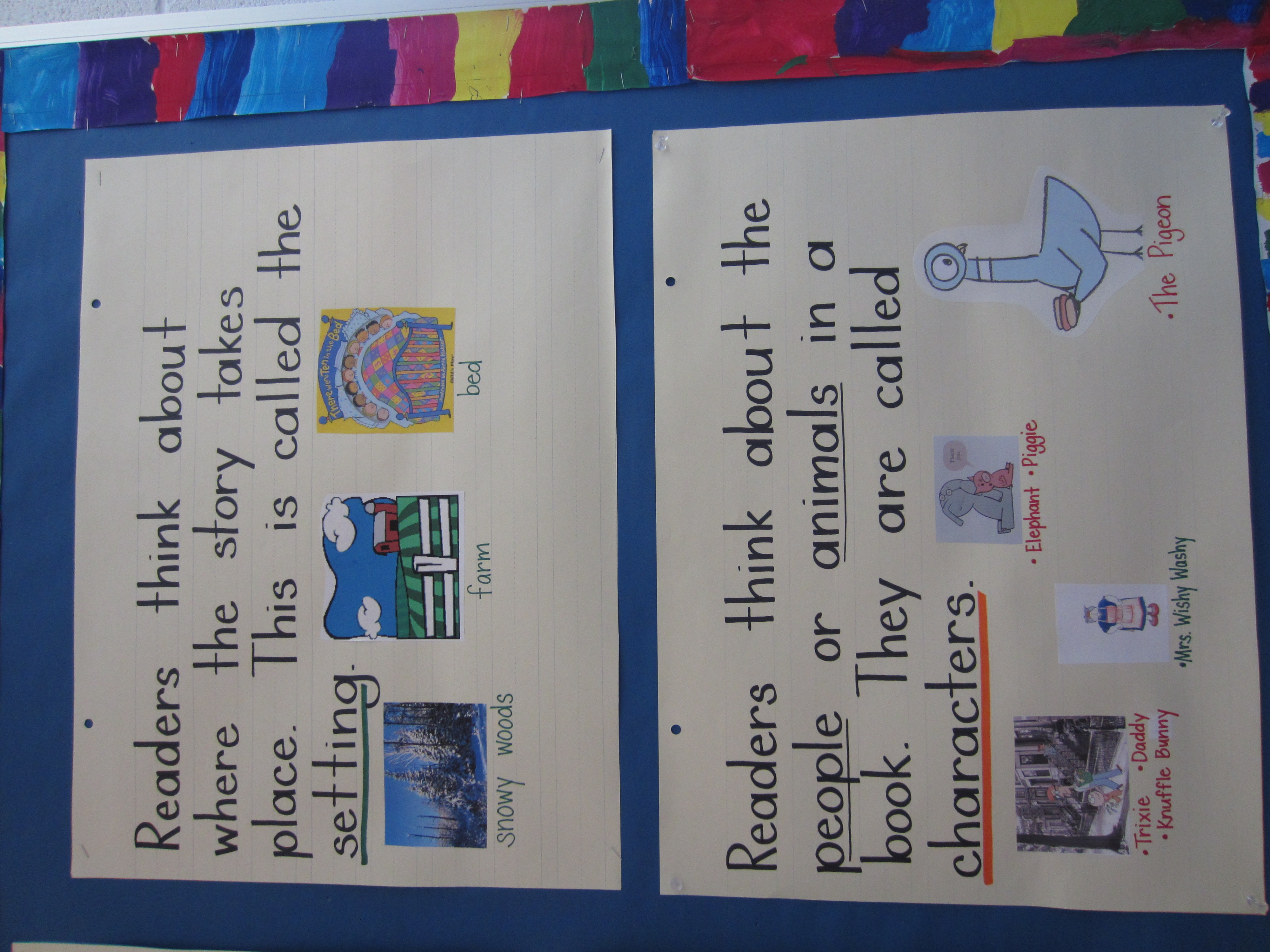
During my first year of Literacy Collaborative I was introduced to “Readers’ Statements”. They made a huge impact in my teaching, and carried over to writing, math, and science in my classroom as Writers’ Statements, Mathematicians’ Statements and Scientists’ Statements.
A readers’ statement is basically a sentence or two that states what readers do. Notice I’m not saying “good” readers. As Peter Johnston writes about in Choice Words, (an absolute MUST READ, if you haven’t already) when we identify someone as a “good” reader, it implies that there must be “bad” readers. “It leaves open the question of who the bad readers are and how you can tell.” I think this greatly impacts the identity our kids have as readers. I want all of my students to see themselves as “readers” – not as “good” or “bad”. So I choose to leave any qualifier off and simply use the term “readers”.
I use the readers’ statements as I plan my instruction, as I teach my focus lessons, as I meet with small groups and one-on-one with children, and throughout our day as I model what reading looks like and what readers do to make meaning from texts. Having a clear readers’ statement helps me stay focused on what I am teaching and allows the students to know what our focus is. When phrased in this way, “readers….” it helps students see themselves in the task. It creates an identity as a reader. They are readers (writers, mathematicians, scientists…) and this is what they do.
I typically choose one or two statements each week or so to focus on. I write them on a chart or on a sentence strip and have them out in a place where we can see them and I can refer to them constantly. I plan this focus by looking carefully at my students and what they need next as readers. I may have one statement as our whole class focus that we look at through interactive read-aloud, shared reading and community writing. I then choose statements for each of my guided reading groups as well as the focus for my one-on-one conferences. Often, the statements I use in small group or 1:1 are ones we have used in the whole class that some students need additional time and practice with as they begin to internalize the strategy or skill we are focusing on.
In kindergarten and first grade, I’ve found it’s very helpful to use the readers’ statements with photos to connect to prior learning and to help the children read and remember what our anchor charts say. Below are just a few examples of readers’ statements I’ve used this year. Take a look at your standards, the strategies you are teaching and what your students need next as readers to come up with your own statements.
Readers think about what they read.
Readers make sure what they read makes sense.
Readers get a picture in their head to help them understand what they read.
Readers notice that a book reminds them of something.
Readers look for words they know in their books.
Readers think about what the characters are feeling.
Have you used readers’ statements? How do you see them supporting the readers in your classroom?
 Catching Readers, Sparking Joy