We are Versatile Bloggers!

A huge thank you to Cathy at Reflect & Refine for nominating us for the Versatile Blogger Award! This blog has been a fun adventure to keep us writing after Catching Readers was published. After accepting this honor we are asked to:

1. Thank the person (people) who nominated you and provide a link back to their blog.                                                2. Share 7 things about you (us).                                               3. Pass this award along to 15 other blogs that you have discovered.

So here we go! Enjoy!

7 things about Pat:

1.)   I’m an avid reader of adult fiction, professional books on teaching reading and writing, and children’s literature.  (My favorite authors are Barbara Kingsolver, Geraldine Brooks, and Ann Patchett.)

2.)   I walk 4-8 miles every day for exercise.  It’s when I do most of my good thinking.

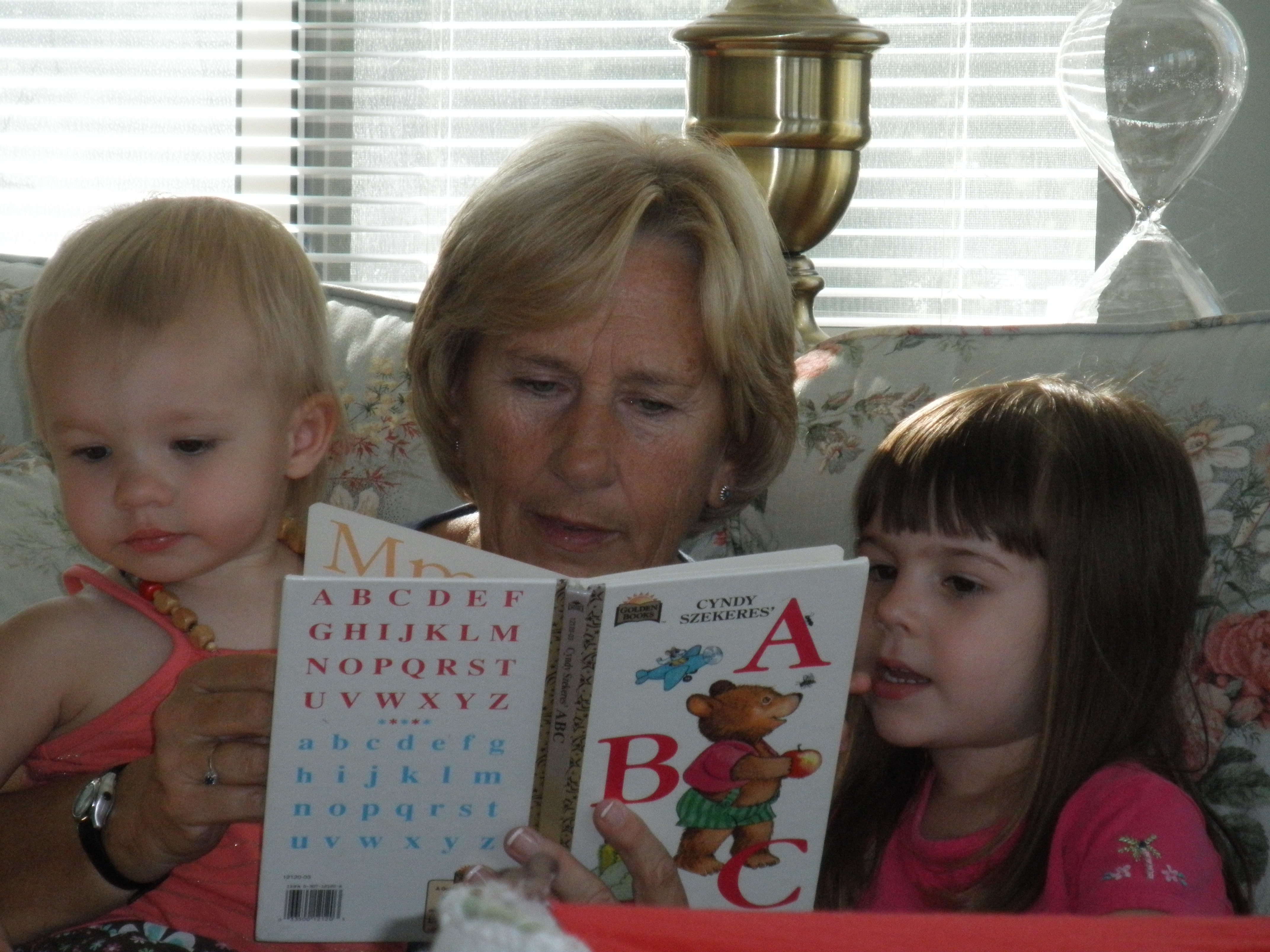
3.)   I have four grandkids, two in Virginia and two in Phoenix, and love spending tons of time with them – going to parks, reading books, or just tickling and cuddling.

4.)   I love talking with teachers, veteran and brand new, about how they can support their struggling readers, or any aspect of teaching reading and writing.

5.)   I have over 30 years experience in education, mostly as a reading teacher in elementary schools, and I’m Reading Recovery trained.

6.)   I’m a storyteller and often tell tales in my grand nieces’ and nephews’ classrooms near their birthdays.

7.)   I enjoy dancing and even have a dance named after me called “The Aunt Pat.”

7 things about Katie:

1. I have a serious book addiction. I am in constant need of 1 more bookshelf. So there are always piles of books somewhere in my house (and Amazon boxes on my front porch).

2. I love to run. I recently started running ultra marathons (distances over the 26.2 marathon) mostly on mountain trails. I love spending time playing on the trails. Most of my writing & teaching ideas happen on the trail.

3. This is my 20th year of teaching. And my first year teaching Kindergarten. I’ve taught grades 1-8 (except for 6th), and have been a literacy specialist and a librarian.

4. I LOVE LOVE LOVE teaching Kindergarten. I laugh more every day than I ever have before. I love playing with the kids, and learning so much alongside of them.

5. I’ve taught in 8 schools (ranging from 100 students to 1000 students) in 3 states (CO, FL, VA)- and I’ve always taught in a Title 1 school.

6. I taught Kelly McGillis’ daughter when I taught in Key West. She was a very cool kid.

7. Helping kids discover new things is the best part of teaching for me. Whether it’s monarch caterpillars, a fun sensory box, making books, a Pete the Cat puppet or reading a book for the first time – it’s what I love about my job.

Here are 15 blogs to recognize. Enjoy!

1. Jenny at let the children play

2. Mari-Ann at Counting Coconuts

3. Zella said purple

4. Tom at Teacher Tom

5. Sherry and Donna at Irresistable Ideas for Play Based Learning

6. MaryLea at Pink and Green Mama

7. Look at My Happy Rainbow

8. Mrs. Mimi at It’s Not All Flowers and Sausages

9. Vanessa at Pre-K Pages

10. Patrick at All-en-A-Day’s Work

11. Yo-Yo Reggio!

12. Scott at Brick by Brick

13. My Mommy Reads

14. Langwitches Blog

15. Tammy at Apples With Many Seeds

Check out these new books on writing

As you begin to set up your writing workshop with your students you might want to take a look at these two new exciting books that I just read.

I hope you read Katie’s blog post about the storytelling time she has set up in her classroom. The telling of stories can be so much fun and that foundational start with her kinders will lead to some great story writers, I’m sure. Her idea fits closely with Carolyn Coman’s new book from Stenhouse called Writing Stories:  Ideas, Exercises, and Encouragement for Teachers and Writers of All Ages. This small book (seriously, it can almost fit in your pocket) is chock full of useful information that will help you as a writer and as a teacher of writing.  Coman explains the difference between character-driven stories and plot-driven stories, teaches about developing voice in your writing, gives tips on using dialogue and speaker tags, shows us how she gets to know her characters deeply and why that’s important, and so much more.  The exercises at the end of each chapter are easily adaptable to many grade levels. They are meant to be quick ideas for students to try out (not prompts) and lead students into a discussion about some aspect of writer’s craft.  I highly recommend this text particularly for teachers of grades 2-6.

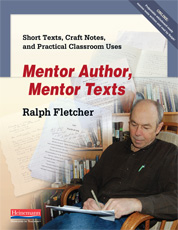
AND… the wait is over.  Ralph Fletcher’s new book is out and ready for instant use in your class’s writing workshop.  Mentor Author, Mentor Texts is right up there with all the other great texts that Fletcher has written for teachers and students (like many other folks, I’m a big fan!) Ralph has written 24 interesting texts, all short enough to be read in one sitting.  Instructions are given as to how to access these whiteboard-ready texts, even with audio clips of RF reading his pieces. But don’t rush so fast to start projecting these pieces and leading discussions with students.  Take the time to read and reflect on Ralph’s ideas on how mentor texts are being used and misused in some of today’s classrooms.  He gives us a new direction on how best to make effective use of his and other authors’ excerpts, essays, non-fiction pieces, or poems.  Rather than force-feeding our ideas or those of the author’s, Fletcher suggests we “put students in charge of what they notice.”  Let them decide what the writer is doing, whether this craft or technique would work for them in their writing, and how they might use the idea in a future piece of their own.  He cautions us to remember that young writers grow slowly.  Wouldn’t it be magical to see “students apprentice themselves to an author they can springboard off to reach new heights on their own”? One of my favorite short texts in this book is “Interview with a Coho Salmon” — very funny (and Ralph said it was a blast to write too.)  If you are using Fletcher’s new text in your classroom, please feel free to comment on how it’s going.

Also, stay tuned in a few weeks when Katie will be writing a review of another great book on writing meant for parents of preschoolers but also appropriate for teachers of PreK-2nd.

What else have you read on writing that has inspired your work with children?

And the Gap Gets Bigger


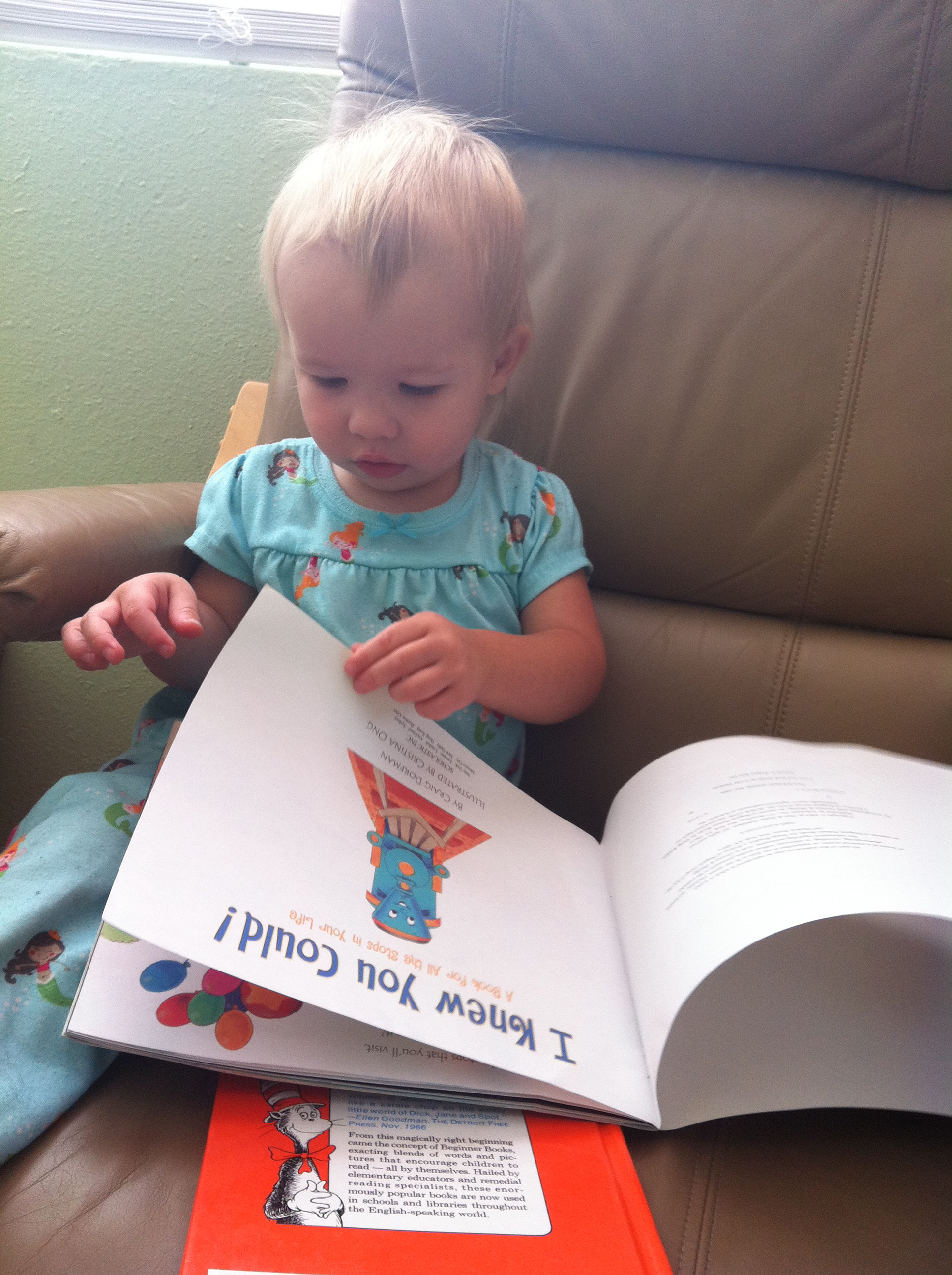
Recently my daughter (living 2400 miles away) sent me a video clip of my 22 month old granddaughter Brenna “reading” Brown Bear, Brown Bear.  Of course I was thrilled to see how those months of reading aloud to her were paying off.  She turned the pages, made up the story, and although her speech wasn’t always clear, you could hear the pattern every now and then “T-sher, T-sher, what do you see?”  But though I’m excited about my own grandchild’s progress, I can’t help but wonder about all those other preschoolers who don’t have the advantages that Brenna has.

I worry a lot about all those homes with very little or no books, with no literate parents or adults in the home, no computers or internet access, and so on. Some parents I know work three jobs just to put food on the table – there is no extra money for books or supplies and no extra time to read, write, or tell stories with their children.  No matter how you look at it, poverty plays a big role in affecting how much of a literate background some kids will begin school with.  And the job of closing the gap falls on the teachers in those early grades.  Blaming the parents or the home environment does nothing to solve the problem.  We know that.

And let’s not forget the technology gap that will also affect these same students.  I was listening to a discussion on NPR radio one day about how kids of the future will be so different because of all their computer knowledge. One father called in and told how he got smart phones for his children so that when they toured Washington D. C. they could log onto a special site that enhanced what they were observing at the museums. As the world gets more and more linked in, what is happening to the others who have very little opportunity and experience with technology?  The poor won’t have those same advantages as the caller on the NPR program.  And that gap will only get bigger.  We have got to get to the root of the problem and do something about those families living below the poverty line!  We have to admit that socio-economic status does correlate at times with children’s success in literacy.

I certainly don’t have all the answers, however, it would make sense to me if we turned our attention to (and poured more tax dollars into) more Headstart programs, more excellent quality pre-schools FREE for children living in poverty, more early intervention programs like Reading Recovery once children start school, and so on.

Here is a quote I keep on my desk at home: “Literacy is inseparable from opportunity, and opportunity is inseparable from freedom.  The freedom promised by literacy is both freedom from — from ignorance, oppression, poverty — and freedom to — to do new things, to make choices, to learn.” Koichiro Matsuura (former UNESCO director.)

Brenna has four more school years at home (in daycare and preschools) before kindergarten.  The literate background and extended vocabulary she will begin kindergarten with will be astounding!  How will we (primary K-2 teachers) close the gap for all those other children? How can teachers support the literacy acquisition of every single one of their students?

We All Have Stories to Tell

I recently read an excellent blog post from Cathy Mere in which she said,  “In a teaching world filled with data, I think the best thing about the first days of school is getting to know kids not by numbers, but by living beside them.” How true and wise these words are. They have echoed in my mind since I read the post. Living beside our students, establishing trust and relationships and getting to know who they really are as people is the foundation of a good year.

The first three days in my new kindergarten class have been full of getting to know my students and beginning to establish a strong community for us to live and learn in all year. For many of my kids, this is their first experience of school. It’s so important for me to make our learning community one where we know each other well, and care about each other. One of the routines I established on day one was an oral storytelling time. It quickly became my favorite time of the day. It’s all about getting to know each other and sharing ourselves in this new community together.

I started our first storytelling time by reading No, David! and sharing the author’s notes by David Shannon on why he wrote that book. Then I said, “you know – everyone has stories to tell, just like David Shannon did. I have stories and I’ll bet you have stories too!” Then I shared a story about my dog Cayo and how she barks at the mailman every day. The kids were spellbound, listening to me weave a story out of an everyday occurrence. I then asked if any of them had a story to tell. All hands went up. These kindergarteners, many of them English language learners, on the first day of school, sat still and were engaged for over 20 minutes while story after story was told by their classmates. It was magical. I realized then that this was a necessary part of every day. We were getting to know each other by sharing what was important to us and by sharing the stories of our lives. What a great way to connect with each other, realize similarities and begin to build a strong community.

As my year continues, I plan to keep our storytelling time as an important part of our day. While I will eventually get to know my kids by numbers, I want to keep living beside them every day, listening to the stories they tell and getting to know them as people.

Math & Literacy

Pat and I have the pleasure of kicking off a blog tour on October 3rd for a new math book from Stenhouse Publishers – Math Exchanges by Kassia Omohundro Wedekind. You may be wondering why we are reviewing a book on math here at Catching Readers. Well, Math Exchanges stands on the shoulders of great literacy thinkers such as Regie Routman, Lucy Calkins and Debbie Miller as the author shows us how conversation through the workshop approach in math is as powerful for teaching and learning with young mathematicians as it is for young readers and writers.  If you are anxious to start implementing powerful small group instruction through a Math Workshop, Math Exchanges is now available and can be previewed on the Stenhouse website. Kassia also has a blog where you can read more of her great math thinking.  Check back on October 3rd as we launch the blog tour!