Fidelity…to what?

Fidelity.

A word that is used quite frequently in education and often connected to a particular program or curriculum. It’s one of those “nails on a chalkboard” words for me, as it’s tossed around so often without a lot of discussion or conversation regarding its meaning or what it looks like in classrooms with actual children. Let’s take a look at what fidelity means. According to Webster, fidelity is the quality or state of being faithful and accuracy in details. Because I am curious about words and what they mean, I read further. 

Fidelity came to English by way of French in the 15th century, and can ultimately be traced back to the Latin fidēlis, meaning “faithful, loyal, trustworthy.” While fidelity was originally exclusively about loyalty, it has for centuries also been used to refer to accuracy, as in “questions about the fidelity of the translation.”  (Webster’s Dictionary website)

I’m left with questions regarding teaching with fidelity. Who are we being faithful to? A curriculum or children? What details are we challenged to be accurate about? A curriculum or children?

While teachers do not take an oath to become a teacher, I’ve personally always believed in, “first, do no harm”. For me, this means questioning and reaching for understanding about the “why” behind my pedagogy and always putting the children in my care and their needs first. Combining years of research, learning, observation and knowledge and continually seeking new research and learning is what I’ve found supports and sustains me as a teacher and allows the children in our classroom to truly thrive. Paying close attention to the details within the children in our classroom and what their needs are is at the heart of my work. No two days are ever the same. Teachers must continually think and reflect on the curriculum and how children are learning. There is not a script for teaching young children. 

Perhaps we need to rethink what we are teaching with fidelity. What are we faithful to? What if we were faithful to children? What if we put them first in our planning and interactions in the classroom?  What if we used many tools and resources, all supported by research and best practices, to teach? 

What if we taught with fidelity to children?
After I hit publish on this post, WordPress connected this post with one I wrote in 2017. As I reread those words, I wanted to reshare a portion here because it connects to this current post so well.

A teacher leader in my county once helped me reflect on the idea of fidelity vs. thoughtfulness. I keep coming back to that. Perhaps we need to be implementing new structures, programs, etc. with “thoughtfulness”, rather than “fidelity”. We need to look at the programs, curriculums and expectations our district and administration give us with a critical eye. We need to deconstruct these things together with our team, be thoughtful in our implementation, question and reflect on what works and what doesn’t.  As one of my former principals always says, “the answer is in the room”.  Talk, reflect and think together – don’t just blindly follow something from outside. We need to use the abundance of resources we have as departure points to launch our own best teaching. We need to keep talking, questioning and thinking with our team and on our own.  As I’ve said before, we teach children, not curriculum, programs or standards.
Fidelity vs. Thoughtfulness

img_9986 We live in a time right now when professional resources are abundant. We have endless access to lesson plans, problem based learning projects, activities, ideas, blog posts, professional books, teachers sharing with teachers, curriculum guides, programs, etc… I can Google any topic and find a wealth of resources. Teachers are not at a loss for what to teach and ideas for how to teach it. But there’s something that I keep coming back to:

Are we being thoughtful with what and how we teach?

There are now scripts written out for literacy workshops, charts to copy or simply post, literacy “cookbooks” of sorts with specific lessons for exactly what your students might need and other resources to make our lives easier and to save time. These are good things, for the most part. Don’t get me wrong. They are based in research, carefully thought out by expert educators who know how kids learn best, tested in real classrooms with real kids. I own most of these resources and use them as I plan – (as a resource, not as a script). And these are WAY better than any basal textbook series I’ve ever seen. These resources have definitely lifted the quality of literacy instruction in many schools. They’ve provided a scaffold for implementing literacy workshops.

But are we thinking deeply about the kids we are teaching? 

img_0082Years ago while teaching in Florida I was at a required basal textbook training for a series my county had just adopted. The representative said, “Look! Everything is written out for you. Even the teachable moments. You don’t even have to think!” And that’s when I walked out of the meeting. I didn’t go into teaching to not think. And I value my profession way more than to accept the idea that it would be a good thing if I didn’t have to think. It’s offensive and degrading to be told you don’t have to think.

It’s easy to flip open a book and have your lesson plan written out for you and ready to go. And chances are, with many of these resources, you would be teaching a good lesson. We get ideas from each other – that’s what teachers do. We don’t have to constantly recreate the wheel.  But I hope that we are still thinking. And reflecting. And connecting with OUR kids – the ones sitting with us in our classrooms at this very moment. I hope we are not taking exactly what’s handed to us and teaching it blindly because we were told to “teach with fidelity”. We need to think and question. We need to teach our kids to think and question. We need to continue learning as teachers and understand the WHY behind what we are doing. We need to be responsive and reflective as teachers.

img_0081A teacher leader in my county once helped me reflect on the idea of fidelity vs. thoughtfulness. I keep coming back to that. Perhaps we need to be implementing new structures, programs, etc. with “thoughtfulness”, rather than “fidelity”. We need to look at the programs, curriculums and expectations our district and administration give us with a critical eye. We need to be very careful with resources we find online. We need to tweak the “recipes” in these literacy “cookbooks” to meet the needs of our students. We need to use the pre-printed anchor charts as a temporary scaffold for us as teachers – and replace them with kid pictures and drawings and our own students’ words as soon as we feel solid in that teaching.  We need to deconstruct these things together with our team, be thoughtful in our implementation, question and reflect on what works and what doesn’t.  As one of my former principals always says, “the answer is in the room”.  Talk, reflect and think together – don’t just blindly follow something from outside. We need to use the abundance of resources we have as departure points to launch our own best teaching. We need to keep talking, questioning and thinking with our team and on our own.  As I’ve said before, we teach children, not curriculum, programs or standards.
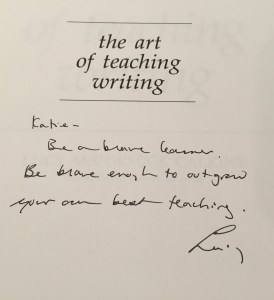
Be thoughtful. Question. Be willing to change your thinking.  And as Lucy Calkins once wrote in my copy of The Art of Teaching Writing, 

“Be a brave learner. Be brave enough to outgrow your own best teaching.”

img_0877