Big Pedagogy

Learning is not the transmission of a defined body of knowledge, what Loris Malaguzzi refers to as a ‘small’ pedagogy. It is constructive, the subject constructing her or his own knowledge but always in democratic relationships with others and being open to different ways of seeing, since individual knowledge is always partial and provisional. From this perspective, learning is a process of constructing, testing and reconstructing theories, constantly creating new knowledge. Teachers as well as children are constantly learning. Learning itself is a subject for constant research, and as such must be made visible.

Carla Rinaldi and Peter Moss
It is our job as educators to learn as much as we can. To read, think, talk, question, wonder, challenge…and then do it all again. To be brave enough to challenge our own best thinking – to observe, listen, reflect, talk, learn and unlearn. We have to be researchers, kidwatchers and thinkers – alongside the children we teach, and in partnership with colleagues and knowledgeable others who can help us learn and push our thinking. We have to ask the hard questions, ponder the unanswerable questions, and keep growing as educators. We have to be willing to rethink our pedagogy, to observe and collect data, and to continue learning. We must continually ask “why?” Our children deserve this. We deserve this.

Our pedagogy is not small.

However, there are many movements to make our pedagogy small. Scripted programs, lockstep curriculum, plug and play slide decks, TikTok teaching, non-educators influencing and making decisions, etc… – these all can negate the knowledge of the teacher. They can negate the brilliance of the children. They can dumb down the learning. They can ignore the funds of knowledge our children and their families bring. They can take the trust and ownership away from the teachers and children. They can steal the joy and reduce teaching to following a script, a program or a curriculum made by people who have never known your children, your community, or you.

So how can we keep our pedagogy big and in service of the children, families, community and us?

Ever since I started teaching, I have devoured professional books, articles and journals. I’ve found people, as Katie Wood Ray said, “to stand on their shoulders” and learn from their brilliance. I’ve followed researchers, educators and wise thinkers who have done this work for a long time and who continue to contribute to our field. Whose shoulders do you stand on? Who are you reading, joining in conversations, following research, and learning from? How are you pushing back on teaching that is not best practice and can actually do harm to children? How are you collecting the research and continuing to learn in the context of the children you teach? How are you constructing knowledge and being open to different ways of seeing?

It’s time for teachers, as professionals, to stand committed to big pedagogy. I hope you’ll take some time this summer to find some shoulders to stand on, to think about what this might mean for you as a teacher, and most importantly, what it might mean for the children you teach.

I’ll start by sharing a short list of a few of my current favorites. Please join me in sharing yours – the shoulders we can stand on in this journey together. Happy learning!

What Matters Most? Toward a Robust and Social Just Science of Reading

Literacy Talk blog

Fact-Checking the Science of Reading: Opening Up the Conversation

Diane Kashin’s blog – Technology Rich Inquiry Based Research

The Studio for Playful Inquiry

In Conversation with Regie Routman

Science of Reading Unpacked – podcast with Elena Aydarova

Choice Words: How our Language Affects Children’s Learning by Peter Johnston

Shifting the Balance: Six Ways to Bring the Science of Reading into the Balanced Literacy Classroom by Jan Burkins and Kari Yates

Reading Above the Fray by Julia Lindsey

Hands Down, Speak Out: Listening and Talking Across Literacy and Math by Kassia Wedekind and Christy Thompson

Classroom Design for Student Agency: Create Spaces to Empower Young Readers and Writers by Lynsey Burkins and Franki Sibberson

Troublemakers: Lessons in Freedom from Young Children at School by Carla Shalaby
We are readers!

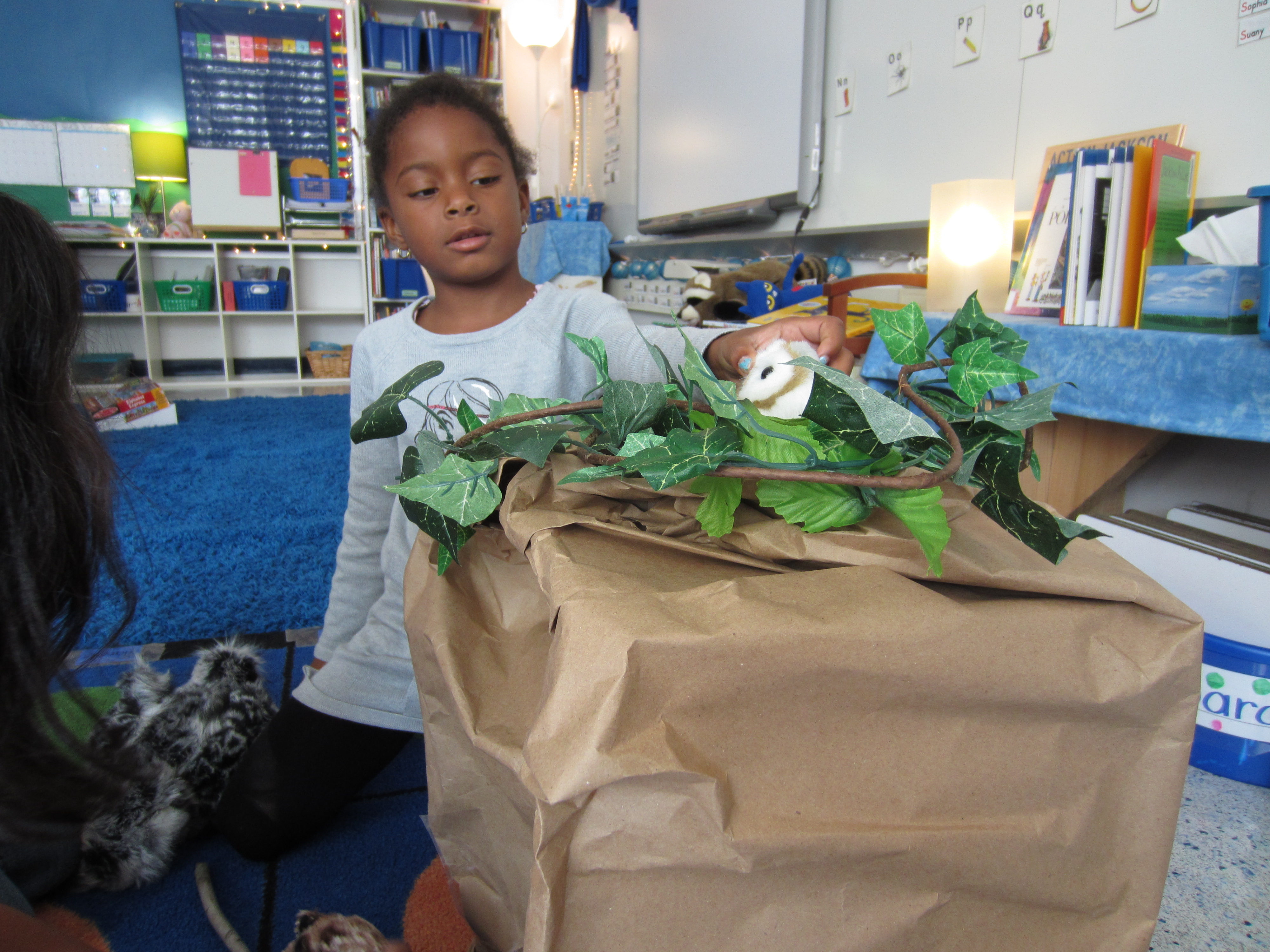
Retelling the story Owl Babies with props

My kindergarteners are readers. Every single one of them. Every day we read poems and songs together on charts, we read art, we read the morning message on our SMARTboard, we read labels in our classroom, we read books that we write, we read on the iPads, we read Tweets and blogs, we read books by ourselves and with buddies and we listen to lots of books read aloud. The kids are learning to read the pictures, read the words and talk about the books. We retell and act out our favorite stories with toys that go along with the books. We spend a lot of time talking about authors and what authors do. Some of our favorite authors are: Mo Willems, David Shannon, Eric Carle and Eric Litwin. I refer to my students as “readers” throughout the day. I am helping build  and create that identity and have them see themselves as readers. It’s the foundation we build in kindergarten that will carry our readers through to a lifetime of reading.

Who are some of your favorite authors? How are your readers building their identity?

We make books!

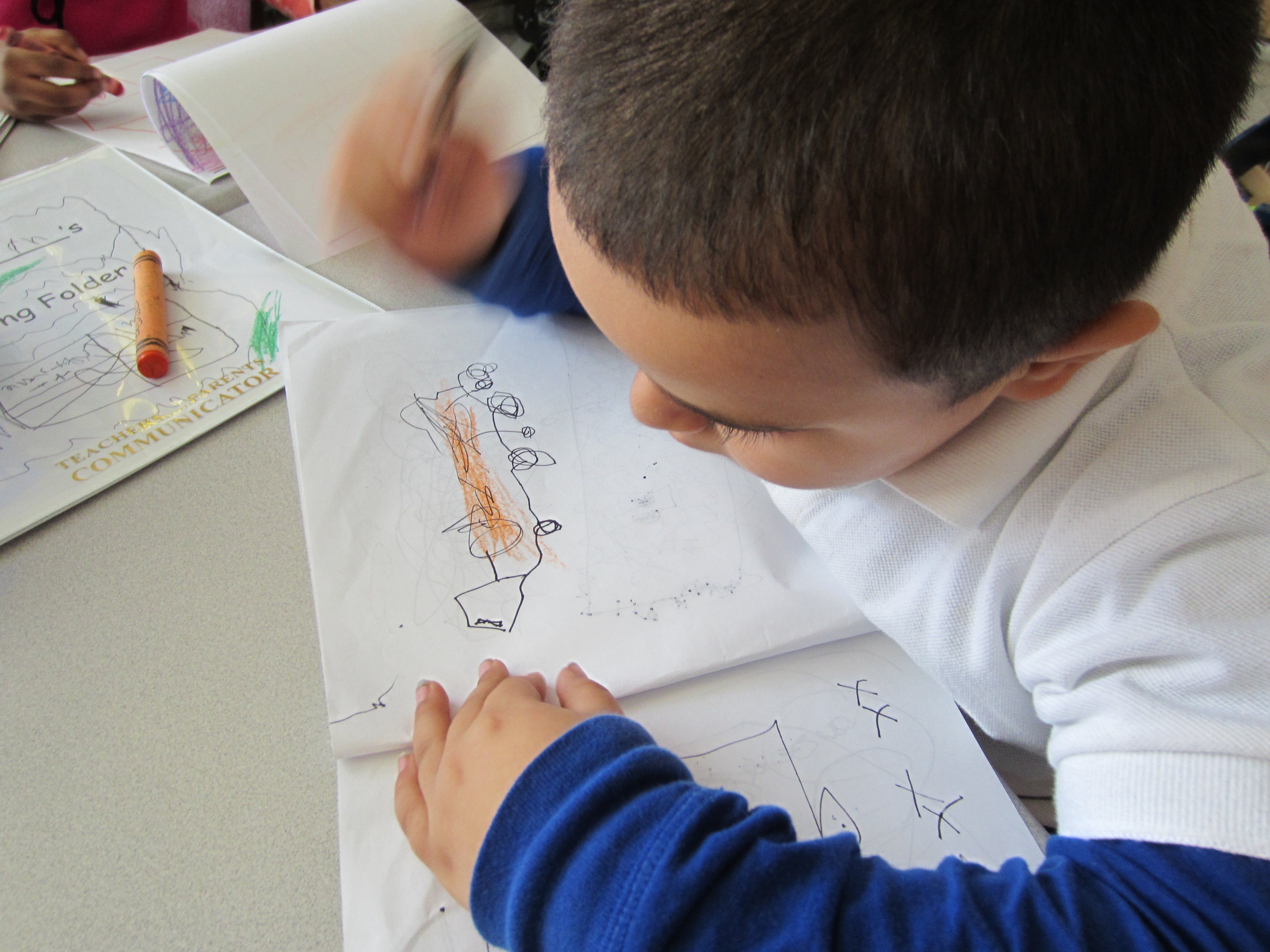
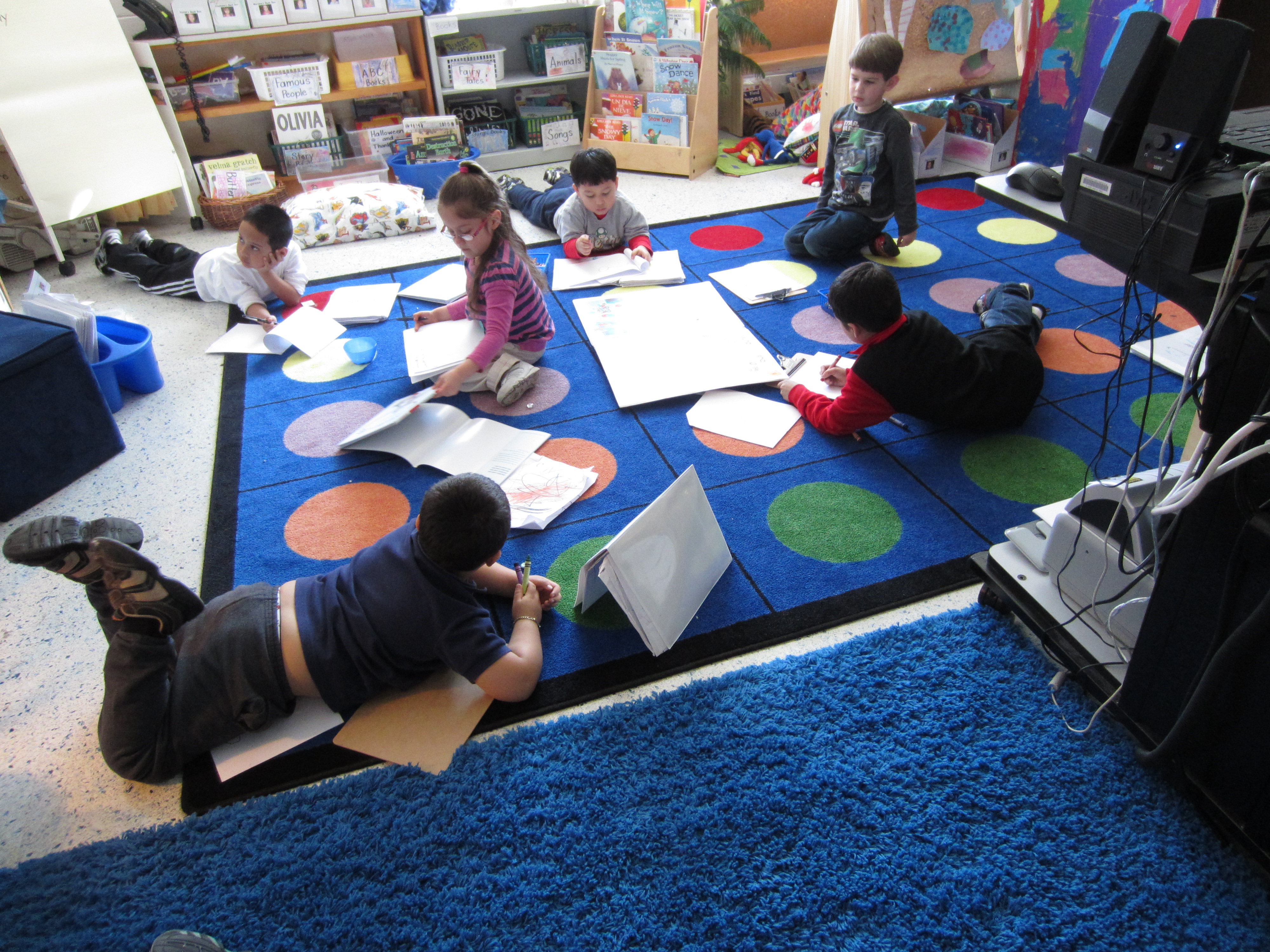
Friday was the 9th day of school – and the 9th day of Writer’s Workshop in our kindergarten classroom. We make books every day after lunch, a routine that was established on the very first day of school. Our Writer’s Workshop begins by reading or revisiting a book and talking about the author. I introduced David Shannon as the first author we studied. We read No, David! and I shared the author’s note on the inside cover where David talks about how he got the idea for this book. I sent my 4 and 5 year olds off with 5 pages of stapled, blank pieces of paper to “make books, just like David Shannon!” Every single one of my kindergarteners then proceeded to make a book – and many complained when I called them back to the rug after 30 minutes of writing time. I had to reassure them that we would have time tomorrow and every day to write. We shared our books then – princess books, dinosaur books, truck books, kitten books, cowboy books – all of the children had chosen a different topic and made a book about the topic that was important to them. If I didn’t know better, I would say it was magic.

But it’s not magic – it’s carefully planned teaching and honoring children’s imagination, development and ability. I call my students “authors” from Day 1. I set up that first day of Writer’s Workshop as a time that is so special, so wonderful, so extraordinary that we will do it every single day! I want them to see themselves as authors and live into that identity. I want them to understand what a writer is and what a writer does. I carefully choose books and authors to study that can help build this identity. We talk about how authors write about what they know. Joy Cowley wrote Chameleon, Chameleon because she knows a lot about chameleons. So if one of my kindergarteners knows a lot about dinosaurs, then it only makes sense that she makes a book about that. I don’t need to dole out topics – children come to us full of things they know about and things that are important to them. I help them see how anything can be made into a book and how they can start living like writers. A story that is shared during morning meeting, read alouds throughout the day, something that happens in the classroom or dramatic play scenarios all get my response of, “wow, you could make a book about that!” I help the young writers in my classroom see themselves as writers through a great deal of talk, a lot of book and author sharing and modeling my own writing. As Katie Wood Ray says, “Children need to understand that everyday, ordinary people make books by doing everyday, ordinary things – writing words and drawing pictures – and that they can make them too.” (Already Ready, Ray & Glover, 2008)

How is your Writer’s Workshop going?

What ways do you help your students create an identity as a writer?


Standing on the Shoulders of Authors

We write every day in our kindergarten classroom. I love it and the kids love it. Most days we start our writer’s workshop with a read aloud and lots of talk about author’s craft, the illustrations, what kind of book it is, etc. I always tell the kids, “maybe you could try (whatever we noticed and talked about), just like this author did”. I want them to see themselves as authors and to envision themselves doing the wonderful things we notice that Mo Willems, Eric Carle, Jan Thomas or whatever author we are currently reading, is doing.

This past week we read and LOVED John Himmelman’s Chickens to the Rescue. If you haven’t read it yet, it’s a week in the life of the Farmer Greenstalk and his family. They have problems like the farmer’s watch falling down the well and a duck taking the farmer’s truck, plus several more. Every time, it’s the chickens that come to the rescue. The repetitive pattern and the hilarious illustrations had my kids wanting to hear it again and again. What was really great was how several kids chose to “stand on the shoulders” (as Katie Wood Ray says) of John Himmelman, and write their own ________to the Rescue! books. We had Jayden to the Rescue, a story of bad guys doing things like stealing purses (not sure where that one came from!) and Jayden, a superhero, coming to the rescue. And Pigeon to the Rescue, the story of our favorite pigeon (from Mo Willems’ books) saving the day in our classroom when crayons spill, the sandbox dumps over and the SMARTboard breaks. I loved how my young writers got the gist of Himmelman’s book and carried it over into their own writing. They weren’t copying his book, they were creating their own work – standing on his shoulders. It was amazing!

What mentor texts are you using in your writer’s workshop?

How do your writers stand on the shoulders of their favorite authors?