Opening Minds: Summer Cyber PD

I’m excited to be reading Peter Johnston’s Opening Minds and joining the #cyberPD conversation hosted by Cathy Mere, Jill Fisch and Laura Komos. If this wonderful book is on your summer reading list, please join us! Check out Cathy’s blog for more information or follow the #cyberPD hashtag on Twitter. And if this book isn’t on your summer reading list…I strongly suggest adding it! Here are my reflections on Chapters 1-3.

When I read Choice Words (Peter Johnston’s first book) eight years ago, it changed who I am as a teacher. I remember reading it. Then reading it again. And again. It was a little book that was jam packed with “a-ha moments”. I felt as if I got something new from it every time I read it. (I still do, which I why I reread it every summer.) I started a teachers as readers group at my school to talk about the book and kept referring back to it. I wanted to internalize all of his wonderful words and wisdom. I was extremely lucky to be invited to a small group lunch with Peter Johnston at NCTE in 2005. I remember what he shared with the table – he told us to feel free to make “cheat sheets” – to write down the phrases, language and responses from the book that we wanted to internalize. He told us to use the cheat sheets until the language became a natural part of our teaching. I recently found those cheat sheets in a file and was amazed at how much of that language is just a part of who I am in the classroom. I really did internalize and now own a new way of thinking, talking and teaching. I am so excited about Peter’s new book and I am starting my new “cheat sheets” for next year after reading the first three chapters of Opening Minds.

At the top of my “cheat sheet” is the word, “yet“. What a powerful word it is!  Imagine what happens when a child says, “I’m not good at this.” vs. “I’m not good at this, yet.” I just love the sense of possibility that the word “yet” generates. It opens up so many opportunities, rather than shutting down the learning. Working with kindergarteners gives me a huge opportunity to help them create themselves as learners. Johnston talks about how “for us to have agency we have to believe that things are changeable, because if they can’t be changed, taking action is futile.” (p.27) I want my students to see themselves as “can-do kids” – kids who can make a difference in their learning, their lives and the world. Choice Words talked a lot about agency and Opening Minds layers bold new thinking on this idea.

Next on my list is, “thanks for teaching us that“. (p.32) I often ask my students “how did you do that?” or “how did you figure that out?” and then I ask them to explain and share with the class. But I love how ending that conversation with “thank you for teaching us that”, rather than with praise, empowers children and positions them as another teacher in the classroom.

My third word on my cheat sheet is one I want to eliminate, the word “smart“. After reading Choice Words, I immediately stopped using the term “good” – as in “good readers/writers/mathematicians” because by saying someone or some action/behavior was good, I felt that it was implying that someone or some actions must be bad. Johnston illustrates, and shares research on why  using the word smart, and telling children “you must be so smart”, really do the same thing. (p.9-10) It implies that you are either smart or dumb, which is a fixed characteristic that doesn’t leave a lot of room for learning, growth or facing challenges. I grew up thinking and saying (often) that I was dumb in math. Recently, I’ve changed that fixed theory and embraced learning and teaching math. Thanks to many great mentors, professional texts and workshops, I have come to see math as a fun challenge to teach and to continue learning more about. I even started my summer with a 2 day math workshop! I realized that my fixed idea about being dumb in math wasn’t serving me or my students. I don’t want my students to stay in a fixed mindset about anything in school, or beyond. Johnston says, “when children holding fixed theories encounter difficulties, mistakes become crippling.” (p.11) I want our classroom community to be one where people take risks, attempt challenges, make mistakes and learn from all of these things. I want them to see that “when you run into difficulty it just means things are becoming more interesting. Challenging activities present no threat, only the promise of learning something new.” (p.12). Imagine how exciting, interesting and fulfilling learning and teaching would be if that was our thinking!

I am looking forward to reading the rest of this book, probably multiple times, and reflecting on my language as a learner and a teacher. Please join in our discussion in the comments section here, on any of the host blogs mentioned at the beginning of the post, or on Twitter. Check back in the next two weeks for posts on the rest of the book.

If you are interested in reading Opening Minds or Choice Words, both books are available at Stenhouse for 20% off during their Blogstitute Event, along with free shipping. Just use the code BLOG when you order online. Peter Johnston is a featured author for the Blogstitute, so look for his posts on the Stenhouse blog site.

Enjoy!

SHARING

I’m sure you’ve seen the poster about “Everything I learned in life, I learned in Kindergarten.”  ‘Sharing’ was undoubtedly one of those things.  In fact, learning to share starts even before that.  Two of my grandchildren are two years old and we constantly remind them about sharing nicely.  When Reilly starts to complain at the pool because a little boy is using her watering can, I say, “Remember we brought those toys to share.”  And when Brenna lays on top of 100 legos trying to guard them with her life, her mom says, “Lincoln came over to play with you, Brenna, so you have to share your toys.”

Sharing.  It’s one of the reasons I love teaching so much.  Teachers are famous for sharing.  They share ideas, materials, books, lessons, quotes, and so on.  In other careers or businesses, it might be all about competition — who made the most sales this month or who has the best, new, innovative idea?  But teaching is much more about collaboration and sharing than competition (or, at least, it should be!)

Lucy Calkins once shared an idea with me by signing my copy of her book, The Art of Teaching Writing, many years ago.  She wrote, “…and when you get there, there is no there there.”  Now, granted, she may have written that to 100 others, but I got her message. It helped me stay a learner all these years. And it suggested to me that I should never think I have all the answers, but should remain open and tentative about what I believe the teaching of reading should be.  I use that example to show that sometimes just sharing a saying or quote can mean a lot to a teacher.

Just the other day, on this blog, Katie wrote about sharing what you are reading. She shared a few professional books on her pile this summer.  I’m sure more than a few teachers took note of her recommendations.   Also, have you noticed all the fantastic literacy blogs lately? They are usually nothing more than a teacher sharing his/her thoughts, ideas, and reflections. There’s never enough time to read them all, but I encourage you to sign up for a few.  And they’re FREE.

I just finished What Readers Really Do by Barnhouse and Vinton from Heinemann. It’s excellent. My favorite parts of the book are the charts that they put at the end of some chapters: What we used to do/ What we do now.  I’m always interested in the shifts in teachers’ thinking as they learn and grow.

While reading the text, I was reminded of the idea that Katie and I tried to sort out in Catching Readers Before They Fall.  Having concerns about some of the strategy teaching we’d seen, we talk about the difference between spotlighting a strategy as opposed to teaching strategies for strategy sake. We emphasize the integration factor and urge teachers to keep meaning-making front and center.  Well, the authors of this new text go much further with this idea than we did.  Their book is fabulous.  Even though their examples are from third, fifth, and seventh grade classrooms, there is definitely something for everyone in this text.  In fact, I liked it so much I emailed ten really smart teachers I know — some Literacy Collaborative folks, some K teachers, some 5th grade teachers, a university professor, a retired reading teacher — a nice mix of ages and experiences. They quickly bought it and began reading. Presently, we are picking dates to get together to share our ideas and reflections.

Teaching is all about sharing.  I hope you will share an idea, reflection, book, or even just a quote with another teacher this summer. Anything you’d like to share right now? Feel free to comment.

Summer Reading

One of my very favorite things about summer is the time I have to read. I have vivid memories of riding my bike to the public library during summer vacations when I was in elementary school. I would check out 12 books (the most they would allow), balance them precariously in the basket of my bike, ride home and devour them on the screened in back porch and then ride back to the library to get 12 more. Summer days spent reading were the best. I still feel that way now.

I started my summer by reading several “just for fun” books. Elin Hilderbrand is one of my favorite “beach book” authors, as well as Chris Bohjalian. Now that I’ve decompressed a bit and am in full-on summer mode, I’m diving into my professional reading stack. Of course, I’ll make sure to mix up the professional reading with plenty of pleasure reading too.

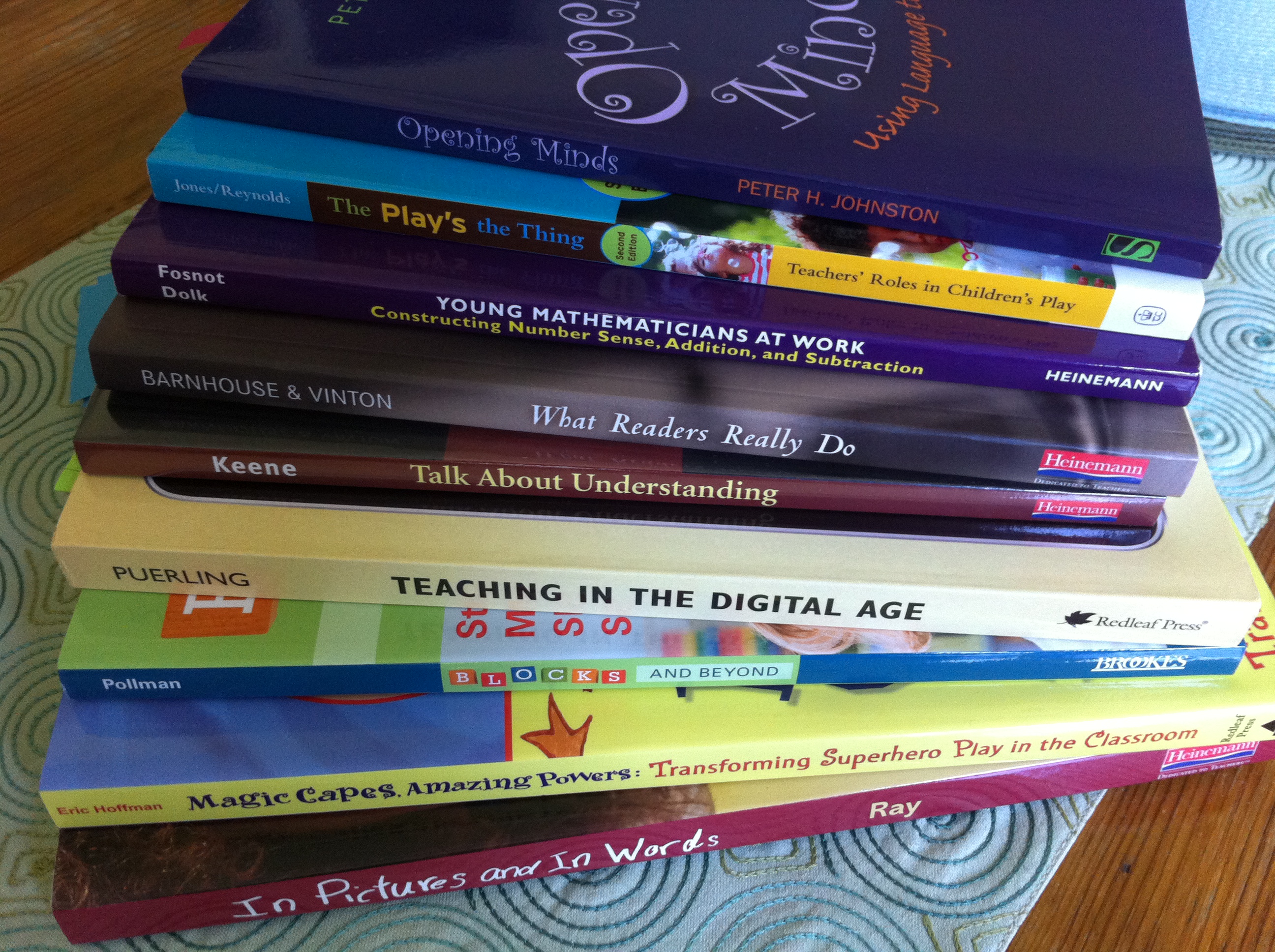
Here’s what’s on my professional reading list:

Teaching in the Digital Age: Smart Tools for Age 3 to Grade 3 by Brian Puerling

Talk About Understanding: Rethinking Classroom Talk to Enhance Comprehension by Ellin Oliver Keene

What Readers Really Do: Teaching the Process of Meaning Making by Dorothy Barnhouse and Vicki Vinton

Choice Words (I always reread this one in the summer) and Opening Minds by Peter Johnston

Blocks and Beyond: Strengthening Early Math and Science Skills Through Spatial Learning by Mary Jo Pollman

The Play’s the Thing: Teachers’ Roles in Children’s Play by Elizabeth Jones and Gretchen Reynolds

Magic Capes, Amazing Powers: Transforming Superhero Play in the Classroom by Eric Hoffman

Already Ready: Nurturing Writers in Preschool and Kindergarten (rereading & discussing with my Kindergarten team) by Katie Wood Ray and Matt Glover

Young Mathematicians at Work: Constructing Number Sense, Addition and Subtraction by Cathy Twomey Fosnot and Maarten Dolk

In Pictures and In Words: Teaching the Qualities of Good Writing Through Illustration Study (another reread but I want to do more with this next year) by Katie Wood Ray

Happy summer reading, friends! Enjoy.

What’s on your summer reading list?

Do you have favorite books you read and reread as a summer ritual?

Lessons from Kindergarten

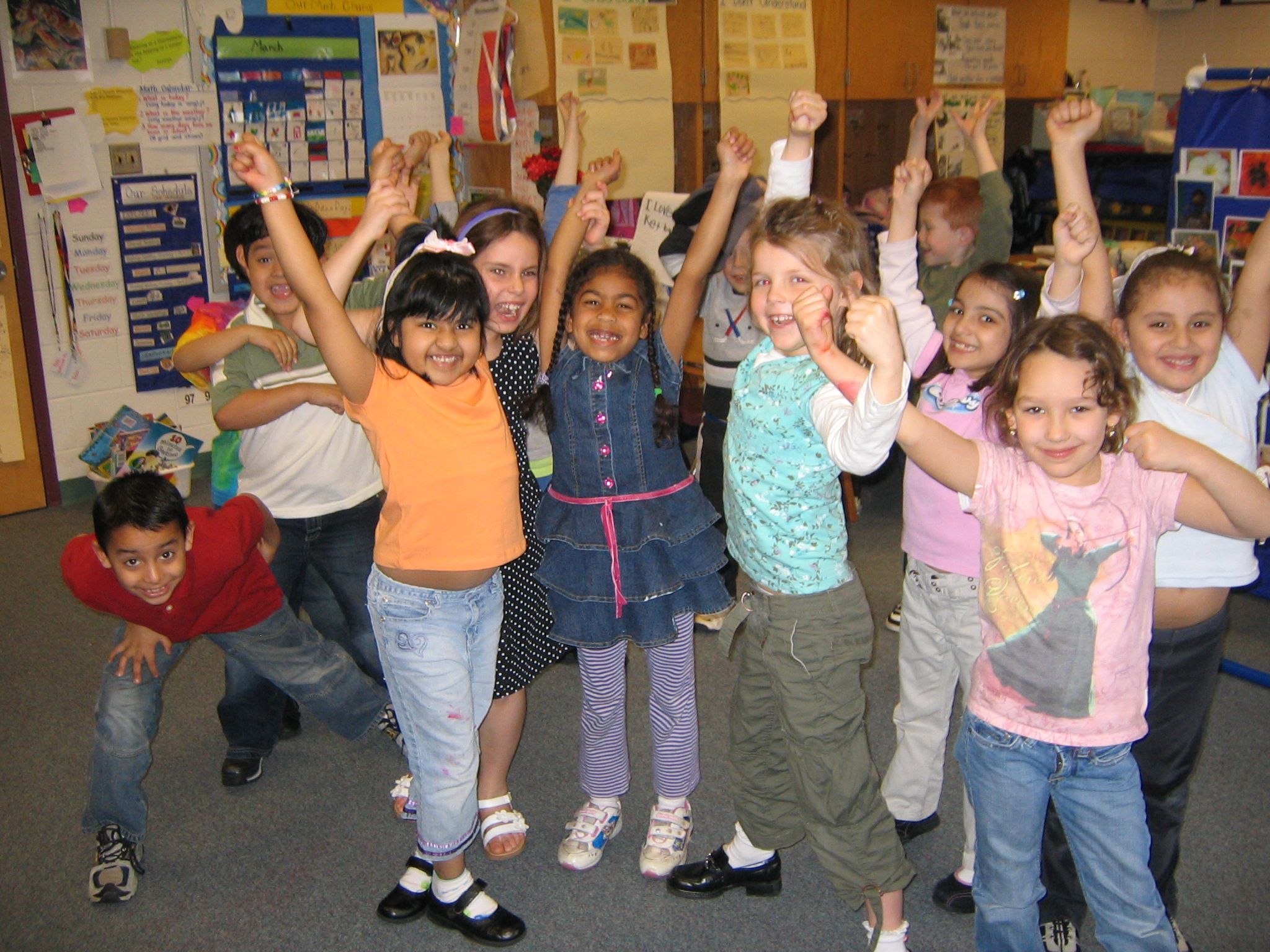
Last week I finished my 20th year of teaching, and my first year of teaching kindergarten. Every year I learn many, many things to layer onto my learning and growing as a teacher. Who I am as a teacher is a rich tapestry of 20 years of students, colleagues, parents and experiences. Here is a list of the lessons learned this year.

1. Read. You can never read too many books. I filled our days with read alouds and exposed my kids to many authors and genres. The last week of school we reflected on our favorite books. The conversation was long and spirited as we discussed favorite authors and books. We finally came to the conclusion that it’s impossible to have just one favorite. I love that my kindergarteners are going into first grade with long lists of favorite authors and titles. They cherish books as much as I do. I hope this stays with them for many years.

2. Laugh. You can never laugh too much. Teaching can be stressful and teaching 20+ 4 and 5 year olds can be like herding cats. But we always have a choice  – to allow ourselves to get stressed and upset or to step back and find some humor in the situation. I learned a lot from my little friends this year about how to see the joy and laughter in a situation instead of allowing the stress to get the best of me.

3. Play. Never underestimate the power of play. I learned so much about each of my kids by observing and joining them in play. There is nothing that could be more beneficial than the Explore time we have at the beginning and end of each day.

4. Slow down. Kindergarten has taught me that everything will take at least twice as long as I’ve planned for it to take. And I finally embraced that. Next year I will really focus on planning less and not feeling rushed or pressured to move through things quickly. Slowing down lets me be more present for my students and to enjoy the moments more as well.

5. Talk more. In a classroom with the majority of children learning English for the first time, developing oral language is key. Encouraging talk during play, writing, reading, math, morning meeting, science, social studies, and throughout our day allowed all children to greatly increase their language. Talking was how we solved problems, negotiated our curriculum, built our relationships and got to know each other in our community of learners. A kindergarten classroom is never quiet. And that’s OK.

6. Talk less. This one is big for me. I tend to talk too much. I still do. But I’m working on listening more and talking less. I am trying to focus my instructions, explanations, etc. and get to the point right away. Kids tune out after a few short seconds and I’m aware of that and working at being more concise. When I talk less, it gives them more time to talk, play and learn!

7. Play. (yes, I realize I have this twice – it’s that important) Some people reply to my telling them I teach kindergarten with a “how cute – you get to play all day!” While I despise the “cute” word, it is true, I do get to play all day. And by play I am talking about all kinds of play – imaginative play, dramatic play, purposeful playful learning, authentic play, inquiry based play and discovery play. Play that goes way beyond the traditional definition of play.  I do want my kids to view making books, reading, and math workshop as play. Play is fun and learning should be fun too! I embrace the word “play” in our classroom and realize that a lot of adults need to understand what “play” looks like in our classrooms and how critical play is to learning. And while we may “play” all day – it’s through play that we learn, grow, build a solid foundation of academic and social learning and inspire a love of learning.

8. Build a community. While I’ve known for quite some time how important a strong community is, this year reminded me once again that it’s the glue that holds us all together. Our classroom community sets the stage for all the learning that occurs throughout the year. But it’s also the community that is built within our teams and our schools. I had the privilege of working with a phenomenal team this year. Sharing your days with like-minded, passionate and caring educators makes coming to school every day a joyful experience. I realize and appreciate how lucky I am to have this.

Kindergarten is my happy place. It’s where I need to be as a teacher. Having been a teacher in grades 1-8, a literacy specialist and a librarian – I’ve finally found my home in kindergarten. I thank each of my students and my colleagues for helping me see that and for giving me so much to learn from this year.

What did your students teach you this year? 

Community

For many of my early years in teaching I spent a significant amount of time before school started designing the *perfect* behavior management system. I had the colored cards, boxes on desks with tokens, and one year an elaborate system that involved a fancy bulletin board and names on balloons that kids moved from level to level as I told them to “drop their balloon”.  And every year it was the same kids’ balloons/cards, etc. that were tattered and beat up from moving and turning them and the same kids who got to visit the treasure box or turn in tokens for rewards. Clearly, this extrinsic way of controlling behaviors was not working. Perhaps it created an illusion of an orderly classroom, (and oftentimes not) but there were always children who did not feel empowered and who were making decisions in order to “get something” or to avoid a punishment rather than to work towards a common peacefulness, community and mutual respect in our classroom.

Then, about 8 years into my teaching career,  I realized what really mattered in behavior management – and it wasn’t management at all. It was community. I really think that the heart of a successful classroom is a strong community. I don’t have a behavior plan, a behavior system, rewards, tokens, stickers, treasure boxes or anything else that, in my opinion, equates with controlling children. I don’t even have a class list of rules. Instead, I work very hard with my students from Day 1 right up to Day 180 to create a community of learners who respect, listen, care, are kind to each other and who can live together peacefully in a small space for 180 days.

So how do we do this?

We talk. A LOT. In class meetings, in role play situations, in short puppet skits that address behavior issues we need to think about as a class, and in one-on-one conferences with children who may need more guidance in becoming a part of a larger community – we work to build the relationships in our classroom. While I don’t make a list of class rules, we do create some charts together as needs arise. Charts that we construct together like, “What kind of classroom do we want to live in?” and “Words that Hurt / Words that Help” – help us keep track of our thinking as we have classroom discussions about issues that inevitably arise when many people share a small space together. I trust my kindergarteners to handle problems independently and often will say, “do you think you can handle this or do you need my help?” when a problem is brought to my attention. Most of the time, children want to be empowered to solve problems and will talk about it with their friend and come to a good solution that works for them. I want them to feel in control in our classroom and feel a shared sense of responsibility for how our classroom runs. When they do need my help we get out the puppets, do a role play, read a book that relates or have a class meeting. I turn it over to the kids with a “we have a problem in our community. How can WE solve it?”

Yes, this social curriculum takes time away from reading, writing, math, etc. But it is a critical piece of education – whether there is a standard for it or not. Children have to learn how to solve problems and how to work together in our world. They need to learn empathy, compassion, how to work through frustrations, how to build mutual respect with people they work with, and how to celebrate their successes. I want children to leave our classroom feeling empowered, with a strong sense of self-efficacy, equipped with tools to negotiate problems and issues they are going to encounter in the world. I want them to be thinkers, reasoners, questioners, problem solvers – who care a whole lot for themselves, the world and each other. Without this, it doesn’t matter what test scores, reading levels or report cards grades look like. We teach all the academic subjects, why not teach children how to create and sustain relationships, community, trust and respect. It will take them further than we can imagine.

Here are some excellent resources that I’ve read as I moved towards a child-centered, progressive classroom:

Choice Words by Peter Johnston

Learning to Trust by Marilyn Watson and Laura Ecken

On Their Side by Bob Strachota

Beyond Discipline by Alfie Kohn

Responsive Classroom materials

Children All Over the World

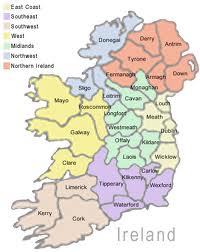
I just returned from my first trip to Ireland.  Had a fabulous time touring the southwest area with its many castles, heritage centers, forts, seaside towns, cathedrals, and beautiful scenery. What a “lovely” country (a word they use a lot in all the B & B’s.)  There were so many of the obvious differences — like the steering wheels on the opposite side and driving on the left side of the road. But the one difference that effected me the most is that THERE IS NO ICED TEA IN ALL OF IRELAND! And I’m an iced tea addict. They never even heard of making iced tea.  I would get the strangest looks when I finally tried to make my own in a McDonalds with a cup of hot tea and another cup of ice.

But there is one thing that is the same the world over…. and that is children and their love of story. One day we were visiting a fort and there was a group of 3rd graders with their two teachers. Unfortunately, it was a day of torrential rains.  The kids were soaked and cold as they trudged from building to building listening quietly to the tour guide who rattled on about battles and chiefs and life in the old fort.  The children’s eyes seemed to glaze over as they stood there shivering. My sister, who is quite a character, started telling the teacher that I was a storyteller and maybe the children would like a good story at the end of their tour.  The teacher was delighted and before I knew it I was up in front of 30 kids telling “Tailypo.” The class enjoyed it, of course, but I couldn’t get over how “the same” they were as kids in the U. S.  They laughed at the same places (especially the dogs’ names of Uno, Ino, and Cumtico Calico); they said “ewwww” in the same place (when the old man eats the chopped-off tail of the creature); and they sat on the edge of their seats in the same way when the creature returns for the third time to get his tail back (“Tailypo, tailypo, alls I wants, my tailypo” I said in my spooky voice.) Stories are universal and we need more of them in schools. What a treat it was for me to be up there in front of a group of wide-eyed kids!

After  chatting with them about the story, I said, “I hope you enjoyed your story gift from America.” One little girl raised her hand and said, “My aunt lives in America.” I asked, “Oh, really, what state?” And she said, “Ummm….. the United States!” I guess all of our third graders need a little more geography.  I’m sure if I asked a U. S. student “What county in Ireland is your aunt from?” she would have given me the same blank stare.  The teacher then asked a little boy to share his favorite fact from a report he had just finished on “The White House.”  He stood up and proudly told me, “The White House has 35 toilets!” And I live 15 miles from the White House and never knew that! My experience with those Irish children certainly left a warm place in my heart for children and stories all over the world.

A Quick and Easy Class Book

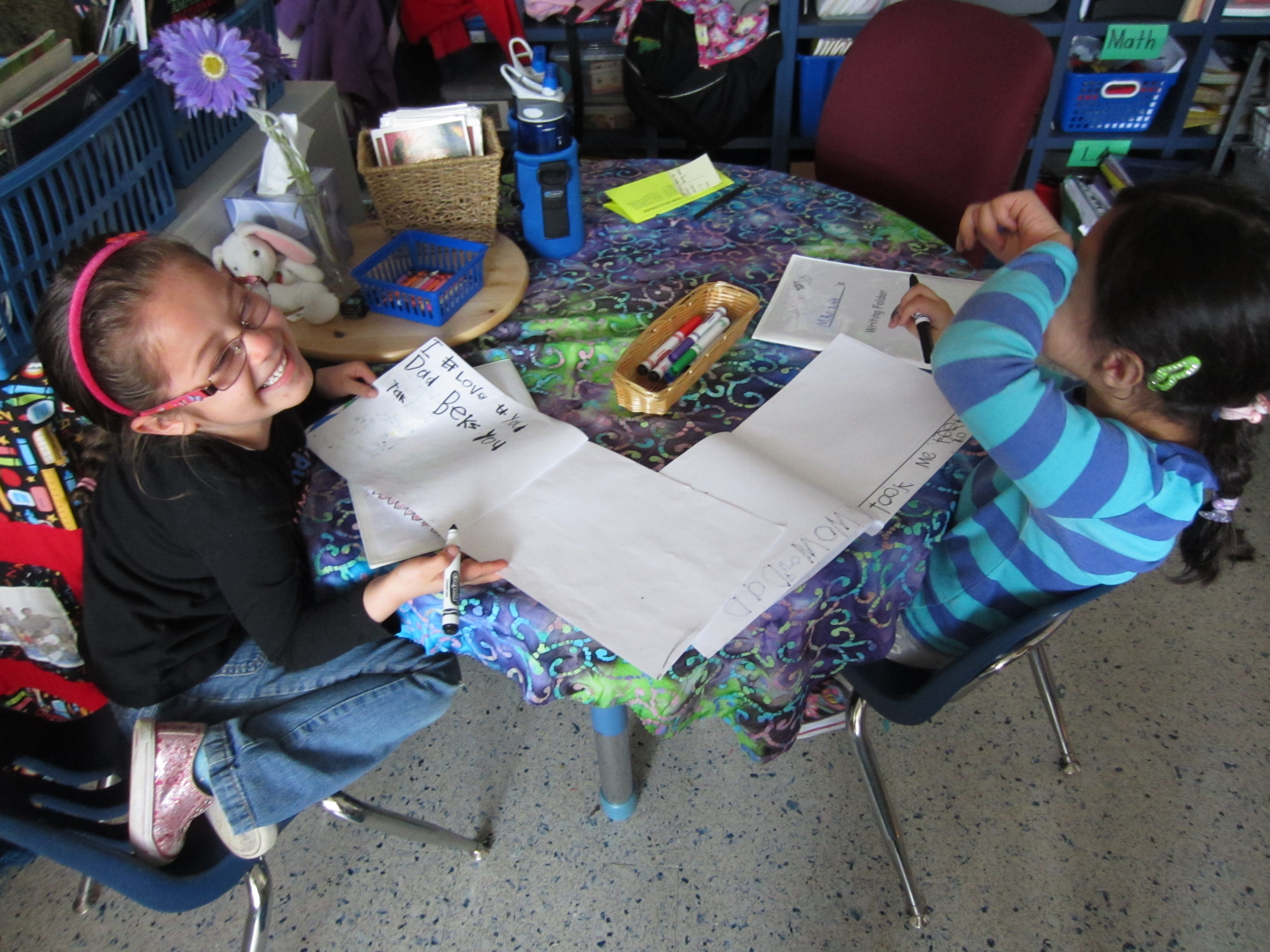
Kids of all ages find it easy to write from personal experiences. I’m a firm believer in getting kids to tell their own stories. And everyone has stories about older or younger siblings (or what it’s like being an only child.) With only a few weeks left before summer break, I was looking for something fun to do with the kids.  Between all the testing days, they needed something light.

So in two fifth-grade classes recently, I read aloud the book The Younger Brother’s Survival Guide by Lisa Kopelke.  We laughed together at the tips about switching glasses when your sister is not looking after she has made you a mystery concoction or rearranging her room while she is away at camp.  Being the youngest of six children I had plenty of my own tips to give so that kids wouldn’t get tricked like I had been so many times while growing up.  After the reading, I told three of my own stories and wrote my tips in front of them as models.  The students were brimming with ideas.

Next the students each wrote three tips of their own.  They could choose whether the tips were about surviving older sibs, younger ones, or being an only child (there was only one student in this last situation.) I took their papers home and chose one tip to type up for each student.  Then I cut them into strips.

Here are a few they came up with for living with younger siblings:

When your younger brother is mad or in a bad mood, watch out for your things. Guard them!

Don’t let your little sister play with water.  She’ll just flood the place.

When your younger sister is napping —- TIPTOE!  Don’t wake her up.

Don’t leave your books on the table for even five minutes.  You might come back and find some pages missing.

And a few tips for living with older siblings:

Don’t listen to your older brother when he says this roller coaster ride is like a kiddie ride.

Always agree with them.  Make life easy on yourself.

Take notes on your older sister.  See if she shows any patterns.  Then outsmart her by predicting and preparing for her next move.

Don’t believe your older brother if he says you will die from eating raw shrimp.  He just wants it all for himself.

On my return visit, we looked at the picture book again, but this time focused on the illustrations.  We noticed that the tip summarized the idea but that there was much more information in the pictures to each actual story.  I had the students illustrate their stories that led to their survival tips.  They glued their tip to the bottom of their drawing.  After that there was just a matter of a cover, a title page, and binding the books together. Each class has two books, one about older and one about younger (the only child tips were included in one of the books as a bonus section.)

It was quick and easy and I can’t tell you how much the kids enjoyed sharing their stories and survival tips!  The books are part of the classroom and the students choose to read them often.


Jumping Up and Down for Books and Stories

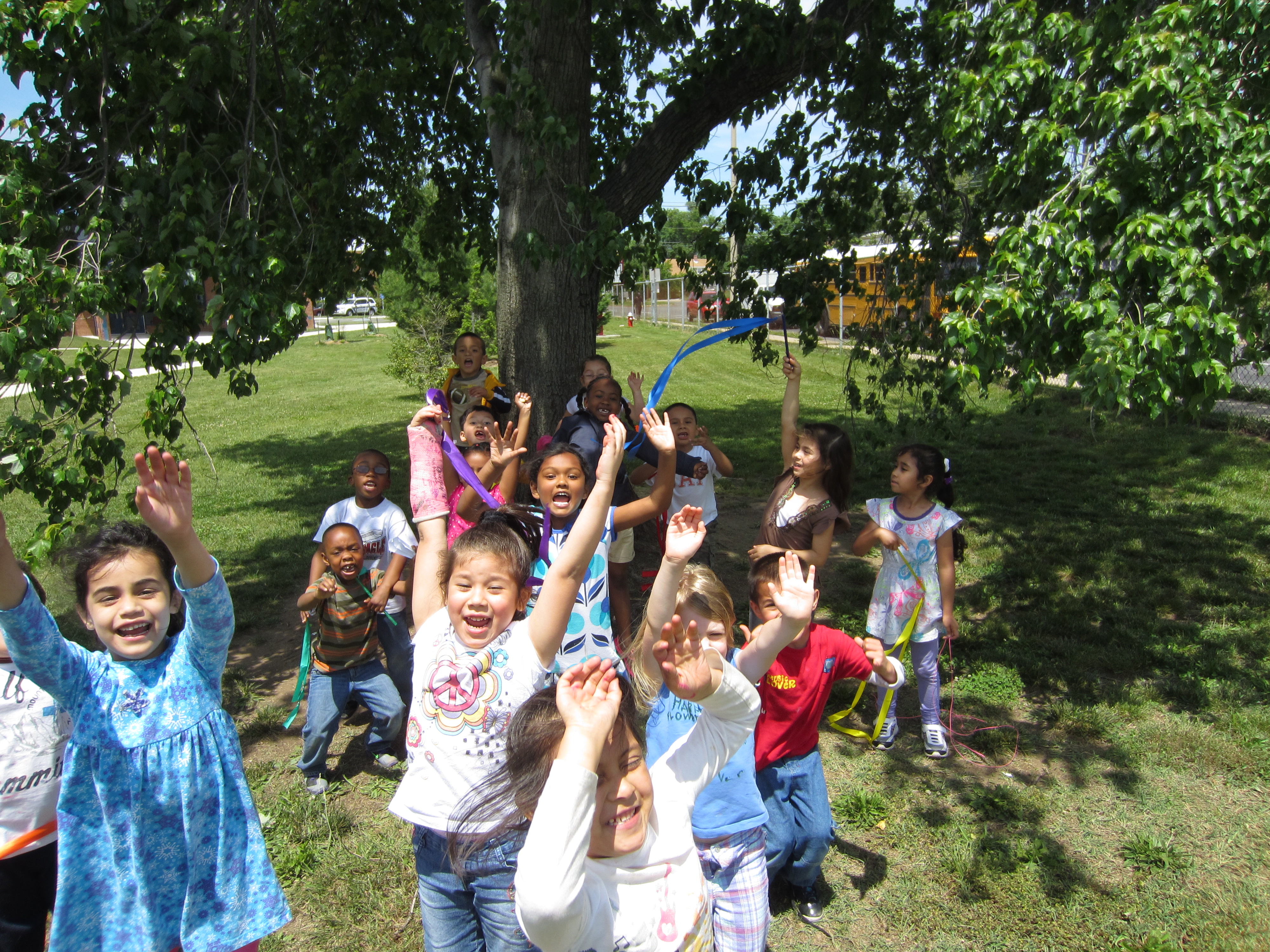
I’m a walker.  I try to walk 4-6 miles every day. A few days ago I was almost finished with my walk when I passed two little girls with their nanny. The older one (about 4 ½) let out a great big “HI!” with a big smile on her face.  So I stopped and our conversation went like this:

Pat:  Well, hello there, you guys look like you are going somewhere fun.  Are you on your way to the library or the park? (both nearby)

4 yr old: (practically screaming with excitement) We’re going to the library!

Pat: WOW, that sounds great.  Do you like books?  I love books.

4 yr. old:  Yes! (Now she’s literally jumping up and down) “And… And …. And…They have storytime!!!”

Pat:  Well, get going.  You don’t want to miss that.

Don’t you wish all our students, leaving us now at the end of the school year, would leave with that enthusiasm for books and stories?

I’ve noticed lately (as we only have 20 more school days) that talk in the teacher’s lounges centers around teachers’ worries about passing tests.  Did my students pass the fiction and non-fiction on the DRA tests?  Did they pass the standardized state tests in math, science, and social studies? Did they use punctuation correctly, spell lots of word quickly, and write a story with a beginning, middle and end to pass the writing prompt?

Though we have to answer the above questions, and we hope that all the answers are yes, wouldn’t it be great if our hopes or questions for our students could look more like these:

  • I hope my students are leaving with some fond memories of the books we shared together this year.
  • I hope they have lists or piles of books they want to read over the summer. Will they take time to read? Do they have favorite authors?
  • I hope they are leaving with a sense of inquiry.  Have I done enough this year to instill in them a desire to wonder about their world, live with questions, and search for answers?
  • I know they have grown as writers.  Do they know that writing can be powerful; persuade someone to change their opinion? Do they know they are full of ideas of what to write about and that their ideas and opinions matter?
  • Have I done a good job with building community this school year?  Will it help to stop the bullying?
  • And if perchance they do hurt someone’s feelings or injure them in any way, will they say they are sorry with heartfelt sincerity?
  • Do they treat others’ opinions with respect in discussions? Are they better listeners than when they first came to me?
  • And, finally, do they have the spirit of jumping up and down when they think about stories, poems, and informational texts?

What is the one question that you hope to answer with a resounding “YES” at the end of the school year?