“Once upon a time there was a magical forest. And a lion lived there. But he didn’t have a friend. So one day he found a girl who wanted to live in the magical forest with him. She had a crystal that lighted up when she was with kind people. The lion loved the girl and they were friends. They lighted up the crystals to find other friends and be kind. They loved the animals, the magic forest and everyone. The end.”
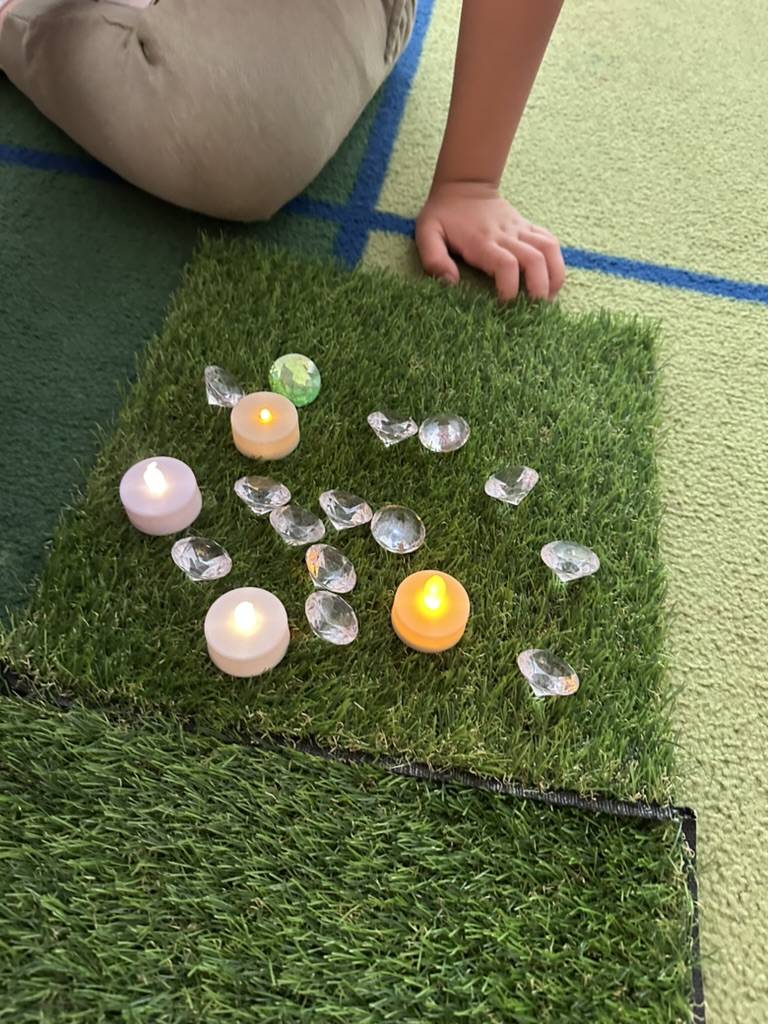
Storytelling in kindergarten. It’s my “magical forest”. From our first day together, children are encouraged and invited to find the stories in our classroom. Susan Harris MacKay inspired me to believe and to share with children that “stories live everywhere”! And their job (our job!) is to find them and share them. Each day that first week of school, I bring a material to our gathering rug. It might be blocks, paper, loose parts, clay, sand, magnetic tiles, etc. – any material that is in our room out for them to play and engage with. I make up a simple oral story using the materials and then invite the children to find their own stories in our room.
“Stories live everywhere! What story will you find today? Off you go!”
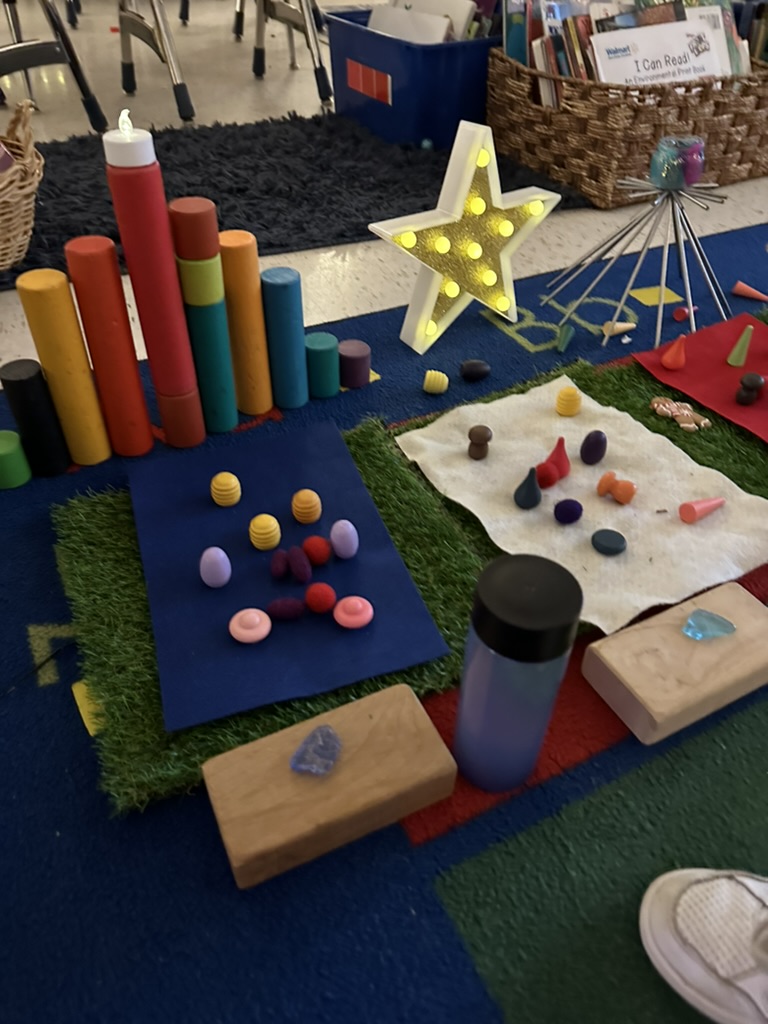
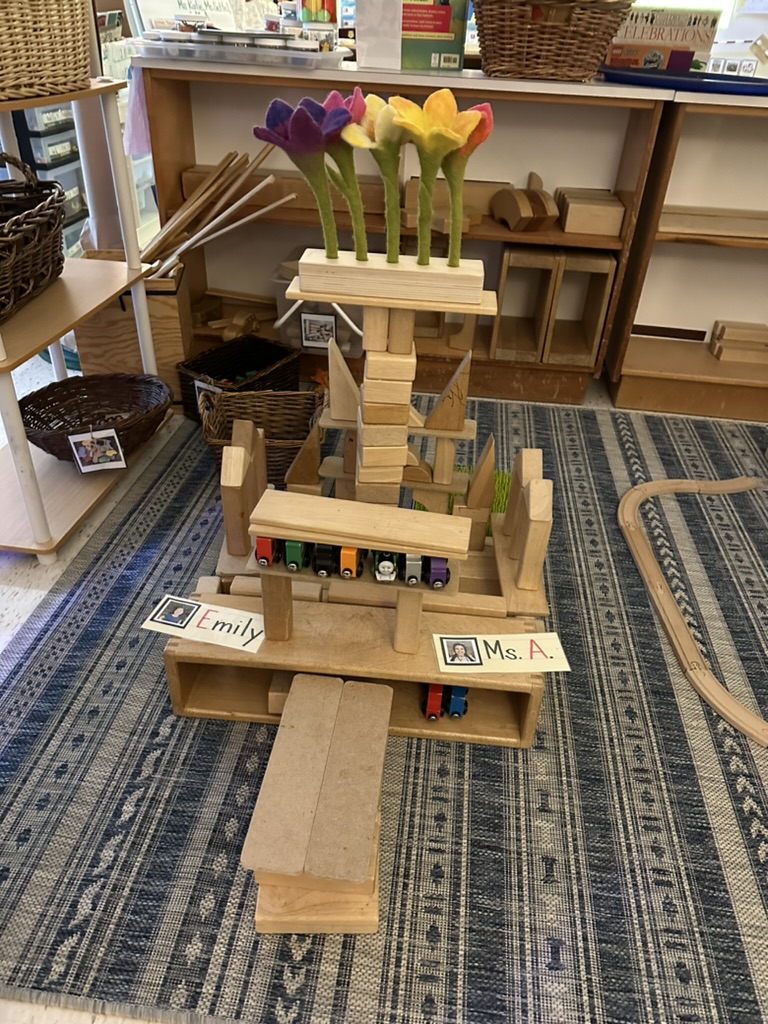
They don’t need to be asked twice. Children eagerly run off to find their stories. They find stories as they play at the light table, the dramatic play area (equipped with minimal props – real kitchen items, scarves, baby dolls), the block area, the music area, the art table or the Story Shelf (our shelf with loose parts that I add to on a regular basis – starting very small and simple and expanding as the year goes on). They soon discover that stories do, indeed, live everywhere. I roam around the room, eagerly listening to their wonderful stories. And then I invite them to put their story in a book, so it can live forever. There are blank 3 page books in our art area and many of the children choose to make a book with their story right away. But some wait a while to take this next step. And that’s okay. After listening to their classmates tell their stories, while looking at a photo I took and projected, or sitting beside the storyteller, or listening to an author share the book they made – all children will eventually want to make books so their stories can live forever.
But for now, the joy is in the process of finding stories and sharing them with one another. Oral language is a key component of a kindergarten classroom. We learn about characters and setting and children delight in knowing those words and purposefully plan these elements in their stories. They realize that stories live in the cafeteria, in our specials classes and on the playground. I continue with loads of storytelling as we create our story together as a community. They lean into an identity as a storyteller. They become confident in their oral language and their ability to capture the attention of peers and adults with their words. They learn story language and what makes sense. They learn how to answer questions from friends and add details to make their stories clearer. These first days set the stage for the rest of our year together. Our Writers Playshop follows a predictable structure of a whole group focus lesson, story making time and ending with a sharing time. But our story telling focus quickly expands.
We move into story acting – where children dictate a story to me and then they become the director as they choose actors and actresses to act out their story in front of an audience of their friends. We take our storytelling into math, where loose parts and tiny toys help children create math stories to explore mathematical thinking. We grow into our identity as authors and illustrators as book making takes off and our classroom library becomes full of the books we make. And we grow into our identity as readers, as we listen to many, many rich read aloud books and ask ourselves, “what did we hear or read today that might help us as story makers, authors and illustrators?”.
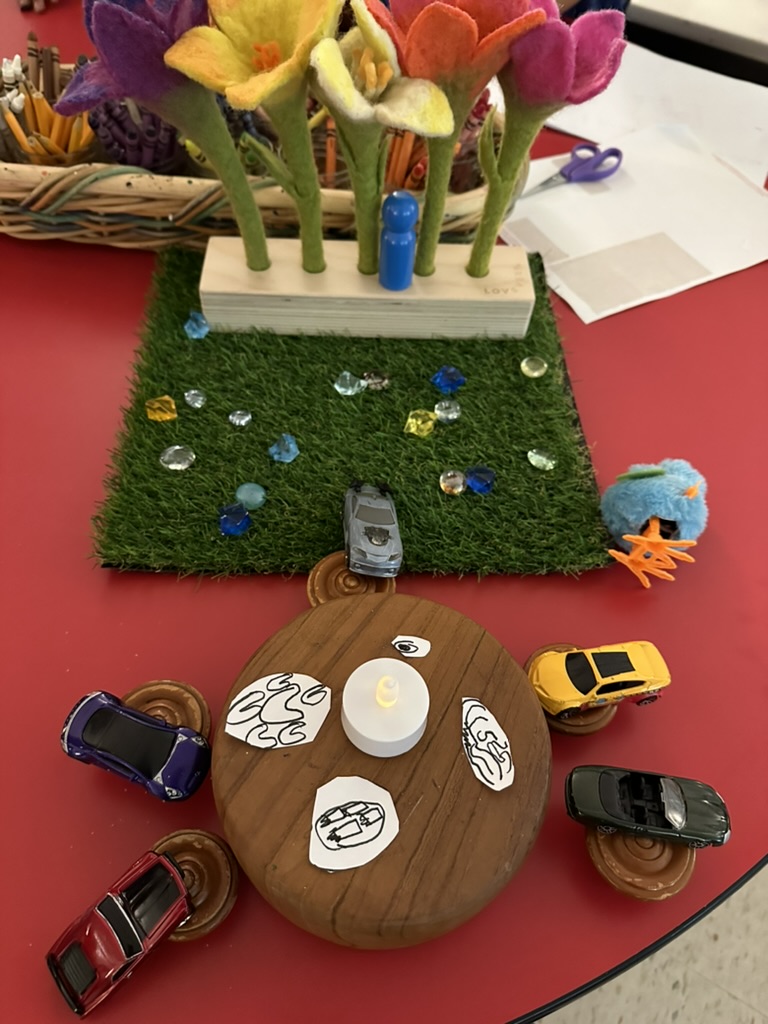
This work is not new, nor is it exclusively mine. I stand on the shoulders of so many wonderful educators such as Katie Wood Ray, Lisa Cleaveland, Donald Graves, Lucy Calkins, Matt Glover, Trisha Lee, Vivian Gussin Paley, Michelle Kay Compton, Robin Chappele Thompson, Georgina Ardalan, Angelique Thompson, Kenisha Bynoe, Susan Harris MacKay, Matt Karlsen, Angela Stockman and the many, many educators I’ve connected with through the years of studying writing, literacy and the Reggio Emilia approach to learning and teaching. Our Writers Playshop (named “Playshop” several years ago by a child who asked me why it was called “workshop” when it was really play) is a product of my 33 years of teaching, learning, unlearning, observing, reading, writing, researching and reflecting. It changes often, and I continue to learn and listen to what the children are telling me. There is not a script or a program to follow. It’s about following the children. I’ve found that the standards and expectations of a public school kindergarten classroom can be far surpassed with this way of teaching. Children go way beyond what is typically expected in a kindergarten curriculum. Writers Playshop is a powerful way of teaching that honors, challenges, supports and celebrates children and their learning – for life, not just for school.
If you’d like to get started, here are a few resources you might check out. Stay curious, keep reading and talking with colleagues and most of all, trust the children. Play is how children learn. Jump in tomorrow – join your children in finding stories, telling them and writing them down. Trust the children. Story creates our communities and brings joy to our lives. It’s truly magical.
Story Workshop: New Possibilities for Young Writers by Susan Harris MacKay
Princesses, Dragons and Helicopter Stories by Trisha Lee
The Gift of Playful Learning by Angelique Thompson and Kenisha Bynoe
About the Authors: Writing Workshop with Our Youngest Writers by Katie Wood Ray and Lisa Cleaveland
“Children have a right to high-quality, vigorous instruction intended to support their academic skills within the discipline of literacy. But those skills must be inextricably linked to stories – to the paths every child determines need clarity in their own life. Increasing literacy skill should be seen as a means by which the stories flowing through each of us are supported as the effort they are to make better sense of the world in which we experience the complexity of our everyday lives. Literacy skills are no end in and of themselves, and treating them as such takes us further from the capacity every child has to use them to find and share our stories.”
Susan Harris MacKay in Story Workshop: New Possibilities for Young Writers
 Catching Readers, Sparking Joy
So glad you shared your Writers Playshop with us. Children have so much to “say” our role is best served as listeners and learners.