The Wonder of It All

“If I had influence with the good fairy who is supposed to preside over the christening of all children I should ask that her gift to each child in the world be a sense of wonder so indestructible that it would last throughout life, as an unfailing antidote against the boredom and disenchantments of later years, the sterile preoccupation with things artificial, the alienation from the sources of our strength.”

Rachel Carson, The Sense of Wonder


Discovering magnets for the first time!

Discovering magnets for the first time!

Kindergarteners come to school with a huge sense of wonder. They are constantly questioning, pondering, discovering, wondering, exploring – it’s just a natural part of who they are. I absolutely love this part of working with four and five year olds! I think it’s my job to keep that sense of wonder alive and to encourage it as a part of the learning experience. While most of us have a curriculum and/or state standards to follow, I find that the standards are simply a departure point. If I only teach the standards as they are written, in order to “cover” an objective, I miss many opportunities to get kids excited about learning. I once had an instructor tell me, “if you’re only going to cover something, you may as well bury it in the backyard.” This has stuck with me and I try very hard to create learning experiences that are ongoing, meaningful, deep and full of discoveries.
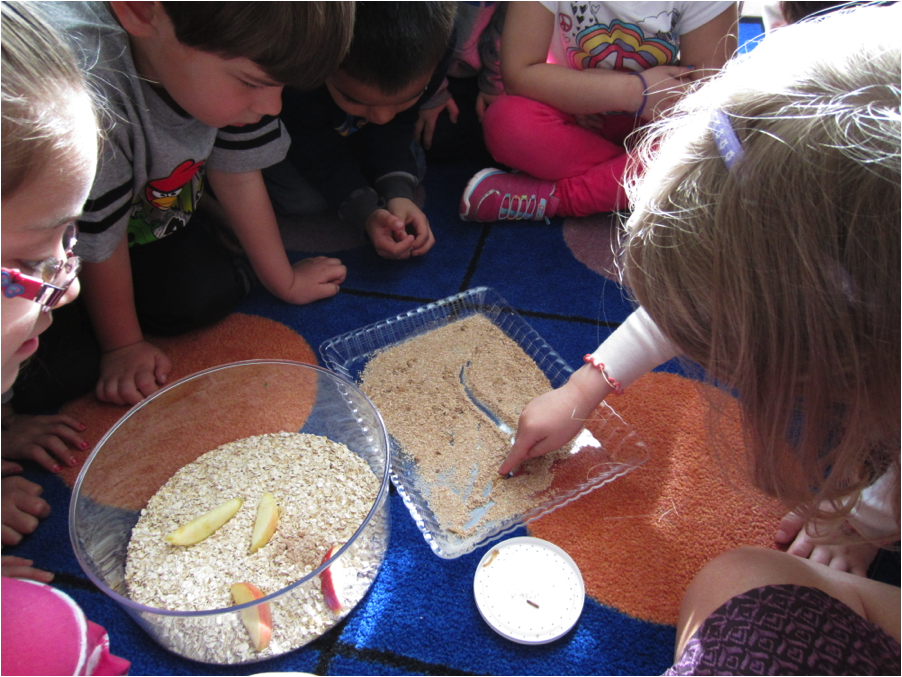
Setting up the baby beetle habitats – counting how many we have

Setting up the baby beetle habitats – counting how many we have

Life cycles are a part of our curriculum. Our county provides us with an ant farm, which is a fun way to study life cycles, but I like to go beyond that by extending this study throughout the year. We start the year with monarch caterpillars in our classroom. We witness the amazing transformation to butterflies and then track their migration to Mexico. In the winter we bring “baby beetles”, commonly called mealworms, into our classroom. The children observe the tiny wormlike critters go through their transformation into large, black beetles. We count, record and observe the changes. We get them out of their habitat and look at them closely, feel them crawling on our hands and experience their life cycle firsthand. We get an incubator in the spring and learn about chickens – watching the baby chicks hatch in our classroom. Through these many experiences, students truly learn our required standard about the life cycles of living creatures. They also learn much, much more.

Playing with the dinosaur sensory box while making a book about dinosaurs

Playing with the dinosaur sensory box while making a book about dinosaurs

This year my class is extremely interested in dinosaurs. I started a dinosaur box the first week of school in order to appeal to this interest. I filled it with dinosaur books, toy dinosaurs, pictures of dinosaurs and fabrics, rocks & stones to create dinosaur habitats. We also have a dinosaur sensory box, an app on our ipads that teaches kids how to draw dinosaurs as well as an app that teaches kids information about dinosaurs. Out of this play area, many children have written books to teach others about dinosaurs. They have learned how to read nonfiction texts with graphs, labels, captions, and various nonfiction text features. They are continuously drawn to the dinosaur play because it is something that interests them. They want to learn more and they want to share their learning with others. Are dinosaurs in my curriculum? No, but through the dinosaur play many of my literacy standards are being met.

Our class “Wonder Wall”

Our class “Wonder Wall”

Another way I try to keep wonder alive in our classroom is with our “Wonder Wall”. I first read about this idea in the fabulous book, A Place for Wonder by Georgia Heard and Jen McDonough. We have a special board in our room where we can put post-it notes about things we wonder about. This is a way to keep track of our thinking and to remind us about things we want to talk about, investigate, explore and learn more about. I keep a close eye on the Wonder Wall and use it as a launching place for classroom units of study, books we read, websites to visit and experts we might know that can come and share their knowledge with us. It’s a great way to keep track of the many wonders that kindergarteners have!

Playing with fake snow in a classroom sensory box

Playing with fake snow in a classroom sensory box

Deep learning and exploring happens when children are encouraged to follow passions, explore interests, inquire and wonder. Giving children time to explore and honoring their investigations, thoughts and discoveries allows for real learning that will stay with children forever. I try to not get caught up in the push to follow pacing guides and “cover” the curriculum. I want my teaching to be deep so that the learning sticks and is meaningful and exciting for the children. I follow the children’s lead while making sure I am accountable to the curriculum, standards and expectations of my county. It’s a juggling act of sorts, and it’s not easy, but it’s something that I can’t do any other way. I strive to be that “good fairy” and give my children the gift of a lifelong sense of wonder and to keep my sense of wonder alive each day in our classroom. I can only do that when my focus is on the children in our classroom, their interests and their needs, at this moment in time.

How are you keeping wonder alive in your classroom? 

This post is cross posted on the #kinderchat blog  as part of the NaBloPoMo project. Early childhood educators from all over the world have contributed to the #kinderchat blog this month for daily posts about teaching children in the early grades.  Join us for our weekly chat on Twitter – 9pm EST Mondays under the #kinderchat hashtag – and for a new Webinar series starting January 30. Katie will be leading a conversation about writing in the early years at 9pm EST January 30. Join us in Blackboard Collaborate for the first #kinderchat Campfire Webinar

Vygotsky Talk

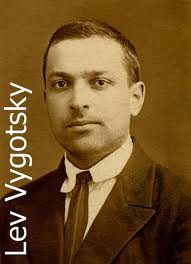
imagesI always love Vygotsky talk!  Whenever any teacher wants to talk about Vygotsky, I’m all ears.  Katie and I tried to make some of Vygotsky’s work understandable and relevant for teachers in Chapter 3 of our book.  If you enjoyed that chapter, “Vygotsky Takes a Seat in our Classrooms”, then you’ll probably want to look for this great article in January, 2013, Language Arts magazine.  It’s called “What Does Vygotsky Provide for the 21st Century Language Arts Teacher?” The author, Peter Smagorinsky, goes into several aspects of Vygotsky’s work. His words got me thinking.

1.  He explains how speech should be used as a tool. In other words, students shouldn’t be expected to speak in final draft form, but should be given opportunities for talking that allow them to figure out and work through what they are trying to say. Kids need to use speech to explore their ideas and opinions.  The author says, “Teachers overlook the potential of classrooms to encourage the development of thinking through the relatively unfettered opportunity to use speech as a tool for generating new ideas through the process of speaking.” This section has me thinking about and returning to Maria Nicols’ books – Comprehension Through Conversation and Talking about Texts.

2.  The author then addresses the issue of emotion and cognition.  In Vygotsky’s view,  emotions and learning are very interconnected.  “How we think and how we feel cannot be separated.” Smagorinsky asks us to think about a student who is constantly corrected for his use of English.  This student may then associate speaking in class with feelings of embarrassment or shame, which in turn would shut down his future participation in class discussions.  The author suggests “that teachers structure classrooms to promote empathy.”  Of course, this whole section had me thinking of all the great teachers I know who spend time building classroom communities.

3. There are several more sections to the article all of which are guaranteed to get you reflecting on your classroom practice. He talks about making curriculum meaningful for students; about how learning and thinking are social in origin and what that means for our classrooms; and about attending to matters of inclusion so that people of difference feel welcome in our schools.  If you work in schools with diverse populations, you will find the article particularly rewarding.  One last quote, “The culture of school serves some students better than others because some have far fewer adaptations to make in order to fit.  One solution is for teachers to create more hybrid classroom learning spaces that allow for broader legitimate participation in classroom activities.”

Let us know your ‘Vygotskian thoughts.’ Do you feel that his work has influenced you as a teacher?

Wordless Books

As teachers, we know to encourage kids to use the pictures to help them with the words. We’ve all, at some time or other, helped a parent (who thinks it’s best to cover up the pictures) to understand this. So what is the place of wordless books in primary grades?  Some may wonder, “Since the children are starting to learn to read, maybe all the books I use should have words in them.” But wordless books have tremendous benefits.

Why do we want students to create stories for wordless books?

  • It helps with retelling – a skill that they will be asked to do as time goes on
  • It makes great use of their imaginations
  • It helps with adding details in writing
  • In fact, it’s a great way to rehearse a story that could be told in writing
  • They learn to tell a story in order
  • It’s great for oral language practice and expansion of vocabulary
  • And it gets kids inventing what the characters could be thinking, feeling, or saying — which is inferring beyond the literal level.

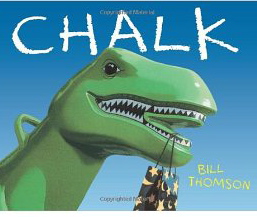
41mCUifyOJL._BO2,204,203,200_PIsitb-sticker-arrow-click,TopRight,35,-76_AA300_SH20_OU01_I recently shared Chalk, by Bill Thomson, with a group of primary teachers.  They all fell in love with it and couldn’t wait to go order a copy. Have you ever actually taught the kids to read a wordless book?  Are you assuming they already know how? Many children who haven’t been read to a lot at home may not know how to do this at all. Modeling with a wordless picture book is easy.  You know how stories work and how they sound.  Just use your storytelling voice and begin.  You will be amazed at how fast the kids will pick up on the process. Any of the books listed below would work well in grades K-2.  And think of the benefits to students with language delays or those who are learning English as a second language. Here are some old favorites, as well as some more recent titles, that would work well in any Kinder-2nd grade classrooms, special education classes, and with ELL students:

  • Rain or Circus, both by Peter Spier
  • The Snowman, Raymond Briggs
  • Deep in the Forest, Brinton Turkle
  • The Angel and The Soldier Boy, Peter Collington
  • Good Dog, Carl (and all the Carl books), by Alexandra Day
  • Good Night, Gorilla, Peggy Rathmann
  • A Boy, A dog, and A Frog, Mercer Mayer (there are many in this series)
  • The Lion and the Mouse, by Jerry Pinkney
  • The Red Sled, Lita Judge
  • The Red Book, Barbara Lehman
  • Chalk, Bill Thomson
  • The Adventures of Polo, by Regis Faller
  • Also Polo and Lily, Polo and the Dragon, Polo & the Magician, Polo & the Magic Flute51YcCdeJLoL._BO2,204,203,200_PIsitb-sticker-arrow-click,TopRight,35,-76_AA300_SH20_OU01_415chFKl5gL._BO2,204,203,200_PIsitb-sticker-arrow-click,TopRight,35,-76_AA300_SH20_OU01_41vGnbPb-QL._SL160_PIsitb-sticker-arrow-dp,TopRight,12,-18_SH30_OU01_AA160_